The quiet periods that test judgment more than the busiest days
“Volume looks low today. Should be an easy shift.”
Anyone who has worked in Trust & Safety operations has heard some version of that sentence before.
The dashboards look calm. Queues are stable. No escalation floods. No breaking incidents. No major abuse spikes. Compared to high-pressure moderation days, it almost feels like a chance to relax.
And honestly, at first glance, it does seem easier.
But after years of working in Trust & Safety environments, I’ve learned something that sounds completely counterintuitive:
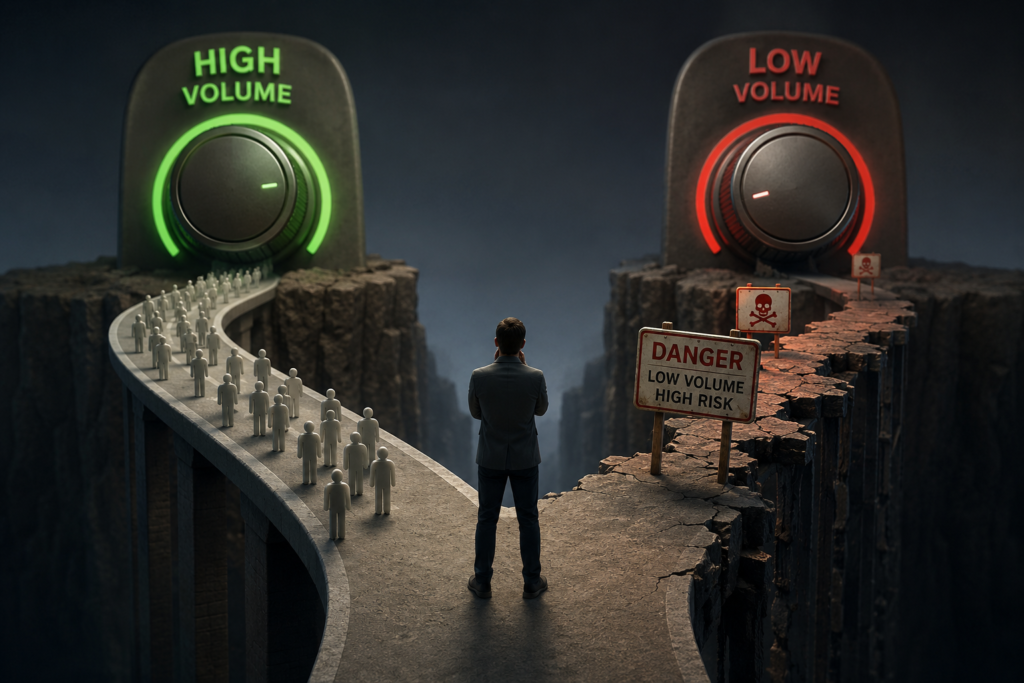
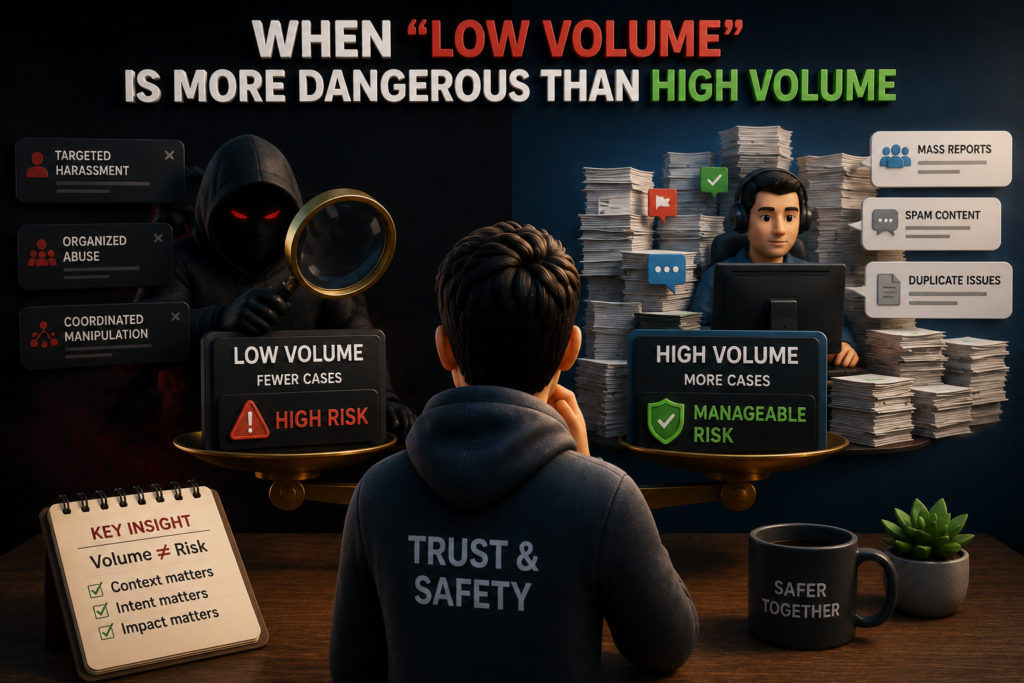
Low volume days can quietly create more operational risk than high volume ones.
Not because the work becomes harder.
But because people change when the pressure disappears.
“ ”
The Psychology of High Volume vs Low Volume
High volume shifts create intensity.
When queues spike, reviewers become highly focused. Decisions happen faster, communication increases, and everyone locks into operational rhythm. There’s a strong sense of awareness because the environment itself demands attention.
You stay mentally engaged.
You notice patterns faster.
You rely on instincts sharpened through repetition.
There’s almost no room for distraction because the workflow keeps pulling your attention forward.
Low volume shifts feel completely different.
The pace slows down.
Cases arrive with larger gaps between them.
Conversations become casual.
People breathe a little easier.
And that’s exactly where the hidden risk begins.
Because when urgency disappears, so does the natural sharpness that urgency creates.
A Quiet Shift That Started Showing Small Cracks
I remember one moderation shift where incoming volume suddenly dropped far below normal levels.
No abuse campaign.
No trending incidents.
No major escalations.
At first, the team welcomed it. Everyone finally had time to slow down after several intense weeks.
But after a few hours, subtle inconsistencies started appearing across decisions.
Nothing dramatic.
Just small things:
- Similar cases receiving slightly different enforcement outcomes
- Borderline content interpreted inconsistently
- Reviewers spending unusually long on routine decisions
- Minor quality variations appearing during audits
Individually, none of these issues looked serious.
But together, they revealed something important.
Low volume had changed the team’s decision-making behavior.
Not intentionally.
Not consciously.
But operational rhythm had disappeared, and consistency started drifting with it.
Why Low Volume Affects Judgment
One thing I’ve noticed in Trust & Safety is that moderation accuracy is deeply connected to cognitive rhythm.
In high volume environments, reviewers see repeated patterns constantly.
The brain becomes optimized for recognition.
You process signals faster because similar examples appear repeatedly within short periods of time. That repetition strengthens consistency.
Low volume interrupts that process.
Cases feel isolated instead of connected.
Reviewers lose immediate comparison references.
And without realizing it, people begin interpreting cases differently.
I’ve seen experienced moderators do things on low-volume days that rarely happen during busy shifts:
- Overanalyze straightforward cases
- Second-guess clear decisions
- Spend too much time validating obvious conclusions
- Drift slightly away from policy standards
- Become less confident in borderline calls
Not because they lacked skill.
But because the operational environment changed their mental state.
The Dangerous Myth That “More Time Means Better Quality”
This is one of the biggest misconceptions in moderation work.
People naturally assume more time improves decision quality.
But in Trust & Safety, more time can sometimes reduce consistency.
I’ve personally experienced this many times.
During slower shifts, I’ve caught myself revisiting decisions that were already clear within the first review. Instead of trusting established policy patterns, I would continue analyzing edge possibilities that realistically didn’t change the outcome.
Ironically, that extra thinking occasionally moved me further away from the most policy-aligned decision.
Because moderation isn’t just about analysis.
It’s also about disciplined consistency.
Too little time creates rushed decisions.
Too much time can create unnecessary complexity.
The balance matters.
The Hidden Threat: Pattern Blindness
One of the biggest operational risks during low volume periods is missing coordinated behavior.
High volume environments make patterns obvious.
If dozens of similar cases arrive together, reviewers notice repetition quickly. Teams start discussing similarities naturally. Escalations happen faster because signals cluster visibly.
Low volume spreads those same signals apart.
That makes dangerous activity much harder to detect.
I remember one situation where related accounts appeared across several hours instead of entering the queue together.
Individually, each case looked harmless.
No obvious violation.
No strong escalation signal.
Nothing urgent.
But once someone later connected the activity timeline, it became clear the accounts were coordinated.
If those same cases had arrived during a high-volume spike, the pattern would probably have been recognized immediately.
Instead, the spacing between cases almost allowed the operation to go unnoticed entirely.
That experience completely changed how I viewed “quiet” moderation days.
Energy Levels Quietly Affect Moderation Quality
Another thing people rarely discuss openly is energy.
High volume creates pressure, but it also creates engagement.
Teams communicate more.
Reviewers stay alert.
People cross-check cases actively.
There’s movement, urgency, and awareness across the operation.
Low volume affects team energy differently.
Not dramatically.
Subtly.
You start seeing:
- Slower reactions
- Fewer policy discussions
- Less escalation collaboration
- Reduced urgency around borderline cases
- Longer silence periods across moderation floors
I’ve seen entire teams become noticeably quieter during low-volume shifts.
And while calm environments sound positive, reduced interaction can weaken decision alignment over time.
Because many moderation insights happen through active discussion.
A Case That Almost Looked Too Normal
One shift stands out clearly in my memory.
Volume was low. The queue looked routine. Most cases were straightforward.
Then one piece of content appeared that felt slightly unusual.
Not clearly violating.
Not clearly safe.
At first glance, it looked easy to dismiss.
But something about the surrounding behavior didn’t feel consistent with normal activity patterns.
Because the queue was quiet, it would have been easy to process quickly and move on.
Instead, I slowed down intentionally.
I checked related signals.
Reviewed surrounding account activity.
Compared it with older cases I’d seen months earlier.
Eventually, that deeper review revealed behavior linked to a broader abuse pattern that was still emerging.
What struck me later was this:
The danger wasn’t hidden by high volume.
It was hidden by calmness.
Why High Volume Sometimes Feels Operationally Safer
This sounds strange to people outside moderation, but many experienced Trust & Safety professionals understand it immediately:
High volume often feels operationally safer than low volume.
Because during high volume:
- Everyone stays fully engaged
- Policy alignment becomes sharper
- Patterns emerge faster
- Communication increases naturally
- Reviewers trust established workflows more consistently
The environment itself forces focus.
Low volume removes that structure.
And once that structure disappears, small inconsistencies can quietly grow unnoticed.
Managing Low Volume Effectively
Over time, I realized low-volume moderation requires a completely different mindset.
You cannot treat it as “easy mode.”
Instead, you need deliberate discipline.
Some practices that helped me and my teams:
Maintain standard decision rhythm
Avoid changing your interpretation approach just because the queue is slower.
Cross-check borderline decisions actively
Quiet shifts are the best time to calibrate thinking before inconsistencies spread.
Keep discussions alive
Low activity should increase collaboration, not reduce it.
Watch for over-analysis
If a routine case suddenly takes excessive time, step back and reassess objectively.
Look for spaced-out signals
Patterns during low volume rarely appear clustered together.
Leadership During Quiet Operations
Managing teams during low volume is surprisingly difficult.
You don’t need to push productivity aggressively.
You need to maintain focus without artificial pressure.
Some of the most valuable team conversations I’ve had happened during quieter operational periods:
- Reviewing edge cases together
- Discussing audit inconsistencies
- Comparing policy interpretations
- Revisiting historical enforcement trends
- Talking through difficult contextual decisions
Because quiet periods are actually ideal opportunities to strengthen reviewer judgment.
If used correctly, low volume becomes training space.
If ignored, it becomes blind-spot territory.
Final Thought
High volume tests operational endurance.
Low volume tests operational discipline.
One challenges your speed.
The other challenges your consistency.
And in many ways, consistency is harder.
Because when dashboards are calm, humans naturally relax their attention. That’s normal behavior.
But Trust & Safety work has a strange reality:
Some of the biggest moderation risks appear when nothing feels urgent.
That’s why experienced reviewers learn something important over time:
A quiet queue does not always mean a safe platform.
Sometimes, the most important signals appear in silence.
And sometimes, the most dangerous shifts are the ones that look the easiest from the outside.