An honest perspective from inside Trust & Safety
Whenever someone reaches out to me about breaking into Trust & Safety, the conversation usually follows the same pattern.
The first question is almost always:
“How do I enter the field?”
The second comes immediately after:
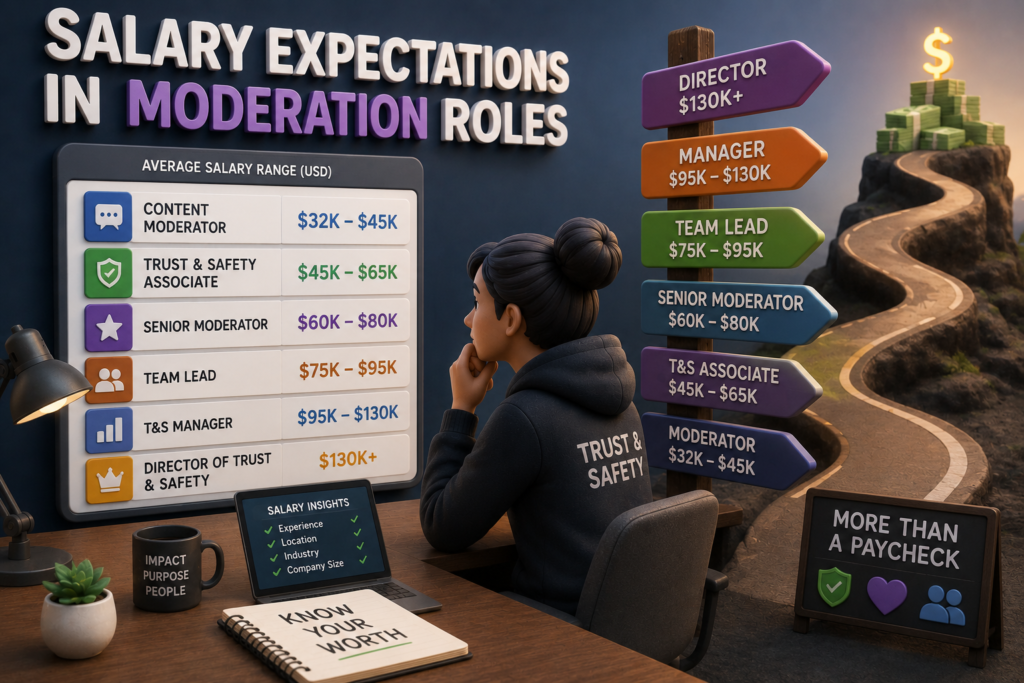
“What kind of salary can I expect?”
It’s a fair question.
Trust & Safety is emotionally demanding work. It requires fast decision-making, policy interpretation, pattern recognition, emotional resilience, and constant exposure to difficult online behavior. The industry now sits at the center of how platforms manage abuse, misinformation, exploitation, fraud, and user safety.
From the outside, that sounds like a highly valued profession.
But once people enter the field, many are surprised by the reality of compensation, especially at the beginning.
And honestly, the answer is more complicated than most career videos or job descriptions make it sound.
The Reality of Entry-Level Moderation
Most professionals enter Trust & Safety through operational moderation roles.
Titles vary depending on the company:
- Content Moderator
- Safety Reviewer
- Content Analyst
- Trust & Safety Associate
- Operations Specialist
But the core work is usually similar.
You review reported content, apply policy, escalate harmful material, and maintain platform standards.
For many people, this becomes their first exposure to how the internet actually looks behind the scenes.
And it can be overwhelming.
I still remember conversations with new reviewers during onboarding periods. Many expected moderation to feel repetitive but manageable, almost like administrative work.
Then the real queue appeared.
Graphic violence.
Exploitation attempts.
Harassment.
Manipulated content.
Self-harm threats.
Coordinated abuse patterns.
Suddenly the role felt far heavier than the salary suggested.
That disconnect surprises a lot of newcomers.
Because from a platform perspective, moderation is mission-critical.
But from a budgeting perspective, entry-level moderation is still often treated like operational support.
And those two realities do not always align financially.
The Vendor vs In-House Salary Gap
One of the biggest salary differences in Trust & Safety comes down to where you work.
Not what you do.
Many moderation teams globally operate through outsourcing vendors rather than directly under tech platforms.
That creates a major compensation divide.
Two people may review equally difficult content under similar policies while working in completely different salary structures.
I’ve seen this firsthand multiple times.
Vendor Roles Often Focus on:
- Queue handling
- SLA targets
- Productivity metrics
- Accuracy scores
- Escalation compliance
The environment is usually highly operational.
Career growth exists, but it can feel narrower because the focus stays heavily tied to moderation throughput and performance management.
In-House Roles Often Include:
- Better salary bands
- Stronger benefits
- More strategic exposure
- Product and policy collaboration
- Internal mobility opportunities
In-house teams are also more likely to involve moderators in discussions around workflow design, policy adaptation, escalation strategy, or emerging platform risks.
That difference matters long term.
Because exposure to strategic work often becomes the bridge to higher-paying Trust & Safety careers.
The Emotional Premium Nobody Talks About Enough
There’s an uncomfortable truth in this industry that deserves more honest discussion.
The people reviewing the most disturbing material are often the people earning the least.
Entry-level moderators regularly handle some of the hardest exposure online:
- Graphic violence
- Child safety escalations
- Suicide-related content
- Hate speech
- Terrorism-related media
- Severe harassment cases
And yet compensation at the entry level often does not reflect the psychological intensity of the work.
I’ve had conversations with talented moderators who could manage incredibly difficult queues under pressure while earning salaries that barely matched the emotional demands placed on them.
That imbalance is real.
And across the industry, companies are still figuring out how to address it properly.
Some organizations now invest more heavily in:
- Wellness support
- Counseling access
- Exposure reduction systems
- Rotational moderation models
- Better compensation structures
Others are improving more slowly.
The industry is evolving, but not evenly.
The Career Shift That Changes Everything
One thing I always tell newcomers is this:
Moderation is usually the entry point, not the final destination.
The biggest salary growth in Trust & Safety happens when professionals move beyond pure queue handling into analytical or strategic roles.
This is where the field starts becoming much more interesting financially.
I noticed this shift clearly during my own experience in operations environments.
The moment someone develops strong policy understanding combined with operational thinking, their value changes significantly.
Because now they are not just enforcing systems.
They are helping improve them.
Mid-Level Roles Where Compensation Improves
After gaining moderation experience, many professionals move into roles like:
- Quality Analyst
- Policy Specialist
- Escalation Investigator
- Risk Analyst
- Workforce Management
- Operations Lead
- Training Specialist
- Abuse Operations Analyst
These positions usually pay noticeably better than frontline moderation roles.
Why?
Because the skill set changes.
You’re no longer only reviewing content.
You’re now:
- Auditing enforcement quality
- Identifying moderation gaps
- Investigating emerging abuse trends
- Improving workflows
- Supporting policy interpretation
- Training new reviewers
- Managing operational risks
That combination of operational experience and strategic thinking becomes extremely valuable.
Especially because good Trust & Safety professionals are difficult to replace.
A Real Difference I’ve Seen in Teams
I’ve worked with moderators who initially entered the field with very little long-term career planning.
At first, many viewed moderation as temporary work.
But over time, some developed deep expertise in:
- Platform abuse behavior
- Escalation management
- Fraud patterns
- Online risk ecosystems
- Enforcement consistency
- Policy interpretation
Those people often advanced quickly because they understood something important:
Trust & Safety is no longer just content review.
It’s becoming digital risk management.
And companies increasingly need people who understand both operational realities and platform safety strategy.
Leadership Roles and High-Earning Paths
At senior levels, Trust & Safety compensation can become highly competitive, especially within major technology companies.
Roles like:
- Trust & Safety Manager
- Global Escalation Lead
- Safety Operations Manager
- Policy Lead
- Integrity Program Manager
- Risk Governance Lead
- Head of Trust & Safety
often involve responsibilities far beyond moderation itself.
At that stage, professionals are dealing with:
- Regulatory compliance
- Government escalations
- Crisis response
- Product safety design
- Public policy concerns
- Global risk mitigation
- Cross-functional leadership
- Reputation management
The work becomes much more strategic.
And salaries reflect that broader organizational impact.
This is the stage where Trust & Safety starts intersecting heavily with business continuity, legal exposure, platform growth, and public trust.
The Skill That Increases Your Value Fastest
If there’s one thing I’ve noticed repeatedly, it’s this:
Moderation alone has salary limits.
But moderation plus strategic skills creates long-term career growth.
The professionals who grow fastest usually develop abilities beyond queue handling:
- Communication
- Policy writing
- Trend analysis
- Stakeholder management
- Risk assessment
- Data interpretation
- Crisis handling
- Operational leadership
That combination changes how companies view you.
You stop being seen only as someone who reviews cases.
You become someone who helps platforms make safer decisions at scale.
What I Tell People Honestly
Whenever someone asks me whether Trust & Safety is a “high-paying career,” I try to answer honestly instead of giving motivational clichés.
At the beginning, compensation may feel lower than expected relative to the emotional weight of the work.
That’s the truth.
If someone enters the field expecting immediate high salaries, they may become disappointed early on.
But if they treat moderation as the foundation for building expertise in:
- Digital safety
- Online risk
- Abuse ecosystems
- Platform governance
- Policy systems
- Internet operations
then the long-term opportunities become much stronger.
Because this field is changing rapidly.
Governments are increasing platform regulations.
Companies are investing more heavily in integrity systems.
AI-generated abuse is creating new moderation challenges.
And platforms increasingly understand that weak Trust & Safety systems create enormous business risk.
That means skilled professionals in this space are becoming more valuable every year.
Final Thought
Trust & Safety is still a relatively young industry compared to fields like engineering, finance, or law.
Its salary structures are still evolving.
Its career paths are still maturing.
And many companies are still learning how to properly value moderation expertise.
But one thing is becoming increasingly clear:
Online safety is no longer optional infrastructure for platforms.
It is core infrastructure.
That shift is slowly changing how the industry values Trust & Safety professionals.
So when people ask me how much Trust & Safety pays, my answer is usually this:
The starting point may not impress you.
But the ceiling is much higher than most people realize.
Because moderation is not the end of the career path.
It’s the doorway into understanding how the internet actually works behind the scenes.
And that knowledge becomes incredibly valuable over time.