From someone working in Trust & Safety
One of the most uncomfortable questions people ask about Trust & Safety is also one of the most understandable:
“Are moderators reading my private messages?”
The fear behind that question is real.
Private conversations feel deeply personal. People share emotions, arguments, relationships, vulnerabilities, secrets, and moments they would never post publicly. The idea that a stranger inside a platform could suddenly see those conversations feels invasive to most users.
And honestly, from the outside, it’s easy to imagine moderation systems working like constant surveillance.
But after working in Trust & Safety environments, I can say the reality is very different from what most people imagine.
The short answer is:
No, moderators are not casually reading random private conversations.
But the full answer is more nuanced than a simple yes or no.
Because moderation in private messaging environments sits at the difficult intersection of two responsibilities:
Protecting user privacy.
And preventing serious harm.
Balancing those two goals is one of the hardest challenges platforms deal with today.
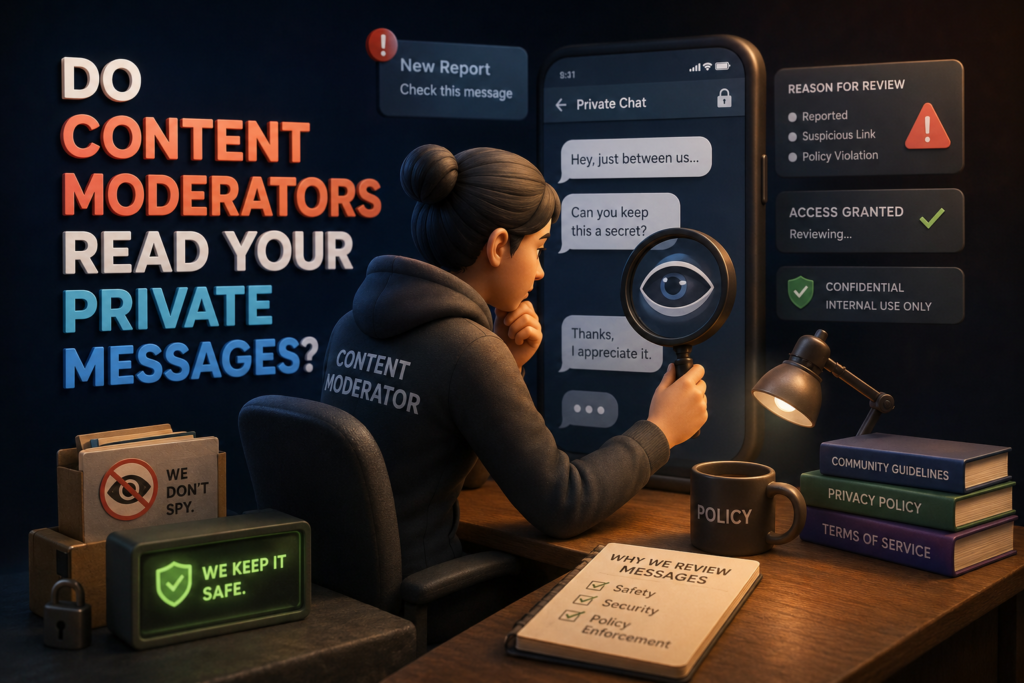
The Biggest Misconception About Message Moderation
A lot of people picture moderation teams sitting in front of screens scrolling through random chats all day.
That’s not how modern Trust & Safety operations work.
First, the scale alone would make that impossible.
Major platforms process billions of private messages daily. No human moderation team could manually review conversations at that volume.
Second, privacy expectations matter enormously to platforms.
User trust depends on the idea that private spaces actually remain private most of the time. Platforms understand that if users believe employees are casually browsing conversations, trust collapses very quickly.
That’s why most private message moderation systems are designed to be reactive, not proactive.
In simple terms:
Human review usually happens only when something triggers it.
What Actually Triggers Message Review?
In my experience, private messages typically enter moderation systems under a few specific conditions.
1. User Reports
This is the most common trigger.
If someone receives:
- Harassment
- Threats
- Exploitation attempts
- Non-consensual content
- Scam messages
- Child safety concerns
- Violent threats
they can report the conversation.
Once reported, the relevant content enters a moderation queue where a reviewer may assess the reported material.
Importantly, reviewers usually do not receive unrestricted access to someone’s entire messaging history.
Access is typically scoped around:
- The reported messages
- Immediate surrounding context
- Relevant metadata necessary for investigation
That distinction matters.
The goal is not curiosity.
The goal is evaluating a specific safety concern.
A Scenario That Changed How I Viewed Message Moderation
I remember reviewing a harassment escalation involving repeated threatening messages between accounts.
The user reporting the messages was clearly distressed. Some of the threats referenced real-world locations and personal information.
Without seeing the messages, the platform would have had no ability to investigate or respond appropriately.
That case stayed with me because it highlighted something people outside moderation sometimes overlook:
Private messaging protections also protect victims.
If platforms completely avoided reviewing reported conversations under any circumstances, abusive users would effectively gain protected spaces to operate without accountability.
That creates a different kind of harm entirely.
Automation Handles More Than Humans Do
One thing many users don’t realize is that automation plays a much larger role in private safety systems than human reviewers.
Most messaging moderation environments rely heavily on automated detection systems.
These systems look for:
- Known harmful material hashes
- High-risk behavioral patterns
- Spam networks
- Coordinated scam behavior
- Child exploitation indicators
- Malware links
- Credible violence signals
But even here, the systems are usually analyzing patterns rather than “reading” conversations the way humans do.
That difference matters.
The system is generally trying to calculate:
“Does this resemble known harmful behavior?”
Not:
“What are these two people talking about emotionally?”
If no report happens and no serious risk threshold gets triggered, human review often never occurs at all.
And in reality, the overwhelming majority of private conversations are never seen by a moderator.
Why High-Risk Messaging Cases Are Treated Differently
Certain categories receive far more serious attention inside Trust & Safety systems.
Especially:
- Child safety threats
- Terrorism-related coordination
- Credible violence threats
- Sextortion
- Human trafficking indicators
- Organized scam operations
In these situations, platforms face legal, ethical, and sometimes life-or-death responsibilities.
I’ve seen escalations where delayed action inside private messaging environments could have created real-world consequences.
That’s why some systems intentionally prioritize high-risk signal detection even in otherwise private spaces.
Not because platforms want to “spy.”
But because some forms of harm specifically rely on private communication channels to operate safely.
The Safeguards Most Users Never See
One thing I wish more people understood is that access to private content inside Trust & Safety environments is usually heavily controlled.
From my experience, moderation systems generally involve:
- Permission restrictions
- Logged access trails
- Audit systems
- Confidentiality requirements
- Policy-based access limitations
- Escalation approvals for sensitive cases
Moderators are trained extensively around privacy expectations.
And honestly, private message reviews are usually treated more seriously internally than public content reviews because of the sensitivity involved.
The idea that moderators casually browse conversations for entertainment is far removed from operational reality.
Most reviewers are focused on processing specific reported risks under strict workflow structures.
The Emotional Weight of Reviewing Private Harm
There’s another side to this work people rarely think about.
When moderators do review private conversations, it’s often because something has already gone seriously wrong.
Some of the hardest cases I’ve encountered involved:
- Blackmail attempts
- Grooming behavior
- Threat escalation
- Domestic abuse evidence
- Coercive manipulation
- Severe harassment campaigns
These are not casual conversations.
They are usually situations where someone actively needed help or protection.
That changes the nature of moderation completely.
Because the reviewer is not entering the conversation as an observer.
They are entering because harm has potentially occurred.
Why People Still Feel Uncomfortable About It
Even with safeguards, people naturally feel uneasy about the idea of message review.
And honestly, that discomfort is reasonable.
Privacy matters deeply to people because private spaces are tied to identity, relationships, trust, and emotional safety.
Most users never think about moderation until something goes wrong.
So when they learn platforms can sometimes access reported conversations, the reaction often feels personal.
I understand that.
But what I’ve learned working in Trust & Safety is this:
Moderation systems are usually built less around curiosity and more around risk management.
The overwhelming majority of conversations remain untouched.
The small fraction that enters review systems usually does so because someone reported harm or because severe safety indicators appeared.
The Balancing Act Platforms Face
Private message moderation is essentially a constant balancing act between two competing values:
Privacy
Users deserve spaces where they can communicate freely without fear of surveillance.
Safety
Platforms also have responsibilities to respond to abuse, exploitation, threats, and illegal harm occurring through their systems.
Neither side can be ignored completely.
And there is no perfect formula that satisfies everyone.
Too little moderation creates dangerous blind spots for abuse.
Too much monitoring destroys trust and privacy expectations.
Most modern platforms operate somewhere in the middle, trying to intervene only when meaningful risk signals appear.
What I’ve Learned Working in Trust & Safety
One thing this field teaches very quickly is that most moderation systems are far more structured and limited than public imagination assumes.
From the outside, people often picture unlimited platform visibility into private lives.
The operational reality is usually far narrower:
- Triggered access
- Scoped review
- Logged systems
- Risk-focused workflows
- Restricted visibility
Could moderation systems improve further? Absolutely.
Should privacy protections continue evolving? Definitely.
But the idea that moderators casually sit reading random personal conversations all day does not reflect how most Trust & Safety operations actually function.
Final Thought
So, are moderators reading your private messages?
In the overwhelming majority of cases, no.
Most private conversations stay exactly where users expect them to stay: private.
Human review usually happens only when:
- A report is submitted
- Serious safety risks are detected
- Legal processes require investigation
- High-risk abuse patterns trigger escalation systems
And even then, access is generally limited to what is operationally necessary.
Trust & Safety teams are not trying to eliminate privacy.
They are trying to balance privacy with protection in environments where real harm can also happen behind closed digital doors.
That balance is imperfect.
But it is intentional.
And from inside the system, the reality is far more controlled, audited, and risk-focused than most people imagine from the outside.