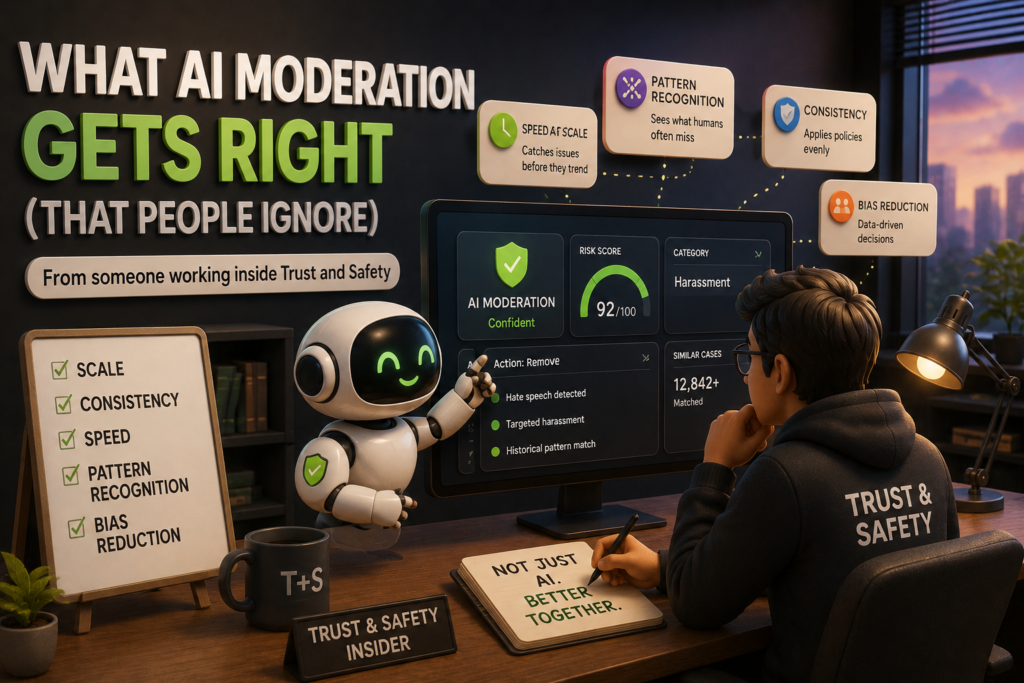
From someone working inside Trust and Safety
In my previous piece, I talked about where AI moderation goes wrong.
The false positives.
The missed abuse.
The lack of context.
The frustrating moments where harmless content gets removed while obvious violations somehow stay online.
Those failures are real, and anyone working in Trust & Safety has seen them firsthand.
But there’s another side to this conversation that often gets ignored online:
AI moderation also gets a lot right.
And honestly, if we only focus on its failures, we miss the reason automation became essential to modern moderation in the first place.
Because after working inside Trust & Safety operations, one thing becomes very clear very quickly:
Without AI, large digital platforms would not function safely at scale.
Not imperfectly.
Not poorly.
Not slowly.
They simply would not function.
That doesn’t mean AI is perfect.
Far from it.
But it does mean the conversation around moderation becomes incomplete when people treat automation only as a problem instead of understanding why platforms rely on it so heavily.
So let’s talk about what AI moderation actually does well.
The Scale Problem Most People Never See
One of the biggest misconceptions about moderation is that humans could realistically handle everything manually if companies simply hired enough people.
Operationally, that idea collapses very fast.
Major platforms process millions, sometimes billions, of pieces of content daily:
- Posts
- Videos
- Images
- Comments
- Livestreams
- Messages
- Reports
- Account creations
The volume is almost impossible to visualize unless you’ve worked inside moderation systems.
I remember watching moderation queues during major global events where content volume exploded within minutes.
No human review team on earth could process that in real time manually.
Without automation:
- Harmful content would spread faster than review systems could react
- Queues would become unmanageable
- Escalations would bury operations teams
- Dangerous material would remain visible for far longer
AI became central to moderation because scale stopped being humanly manageable years ago.
That’s the reality many people outside Trust & Safety never fully see.
AI Is Extremely Good at Obvious Violations
Where automation shines brightest is in high-confidence detection.
There are categories of abuse that become highly recognizable statistically:
- Spam campaigns
- Bot-driven behavior
- Known terrorist propaganda
- Previously identified exploitative content
- Repeated scam patterns
- Explicit adult material
- Malware links
- Mass fake account creation
For these categories, AI systems can act with incredible speed.
And speed matters enormously online.
A harmful post spreading for 30 minutes can reach millions of people before human review even begins.
I’ve seen situations where automated systems removed dangerous content so quickly that users never even realized it existed.
That’s one of the strange realities of successful moderation:
When automation works well, nobody notices.
The harmful material disappears quietly before it becomes visible at scale.
Those invisible successes rarely make headlines.
But operationally, they matter constantly.
A Real Example of Automation Preventing Queue Collapse
I remember periods where spam attacks suddenly surged across platforms.
Thousands of nearly identical posts would appear within minutes using automated account networks.
Without AI filtering, human reviewers would have drowned immediately.
Instead, automated systems detected repeated posting structures, suspicious velocity patterns, and account coordination signals before most of the content even reached manual queues.
Human reviewers still handled escalations and edge cases.
But automation absorbed the overwhelming majority of repetitive abuse.
That distinction matters.
AI did not replace moderators.
It protected moderation systems from collapsing under volume.
AI Sees Patterns Humans Cannot
One of automation’s biggest strengths is large-scale behavioral analysis.
Human reviewers usually experience moderation one case at a time.
AI systems can evaluate:
- Millions of accounts simultaneously
- Posting frequency trends
- Device patterns
- Behavioral relationships
- Engagement anomalies
- Cross-platform coordination indicators
That creates a very different kind of visibility.
I’ve seen cases where individual posts looked harmless alone, but automation detected suspicious network behavior connecting hundreds of related accounts.
Humans may recognize abuse contextually.
AI often recognizes it statistically.
And in Trust & Safety, statistical visibility across massive datasets can become incredibly powerful.
Especially for detecting:
- Coordinated manipulation campaigns
- Fake engagement operations
- Spam farms
- Fraud ecosystems
- Bot amplification networks
These patterns are often too large or too distributed for humans to recognize quickly without system assistance.
One of the Most Underrated Benefits: Reviewer Protection
This is something people rarely discuss enough outside moderation circles.
AI filtering also protects moderators themselves.
One of the hardest realities of Trust & Safety work is repeated exposure to disturbing content.
Graphic violence.
Exploitation.
Abuse.
Trauma.
Over time, constant exposure affects people psychologically.
Automation helps reduce that exposure volume.
Not eliminate it completely.
But reduce it significantly.
I’ve worked in environments where automated systems filtered obvious high-confidence violations before they reached broader reviewer pools. That meant only smaller specialized escalation teams handled the worst material directly.
That matters more than many people realize.
Because good moderation systems should protect not only users, but also the humans doing the reviewing.
AI Helps Prioritize What Actually Matters Most
Another huge operational advantage is prioritization.
Not all violations carry equal risk.
A spam comment and a credible violence threat should not sit in the same review priority level.
AI systems help moderation teams allocate attention strategically.
For example, automation can prioritize:
- Child safety risks
- Credible self-harm indicators
- Violent threat patterns
- Rapidly spreading harmful misinformation
- Coordinated harassment campaigns
Without prioritization systems, dangerous cases could remain buried under enormous volumes of lower-risk content.
I’ve seen how valuable this becomes during crisis situations.
During fast-moving incidents, moderation is not just about accuracy.
It’s about directing limited human attention toward the highest-risk problems first.
AI triage makes that operationally possible.
Consistency Is Another Major Strength
Humans are inconsistent by nature.
Fatigue affects decisions.
Stress affects interpretation.
Context changes perception.
Two reviewers may interpret borderline cases differently even under the same policy.
Automation brings something humans struggle with at scale:
Consistency.
If a rule is clearly defined, AI systems can apply it uniformly across enormous volumes of content.
That consistency becomes especially useful for:
- Spam enforcement
- Repeated known violations
- Standardized abuse patterns
- Clear policy boundaries
Of course, nuance remains difficult for AI.
But consistency itself is extremely valuable in moderation systems where millions of users expect predictable enforcement.
The Most Effective Systems Are Hybrid
One thing I’ve learned after years in Trust & Safety is this:
The best moderation systems are not AI-only.
And they are not human-only either.
They are layered systems where different strengths complement each other.
The strongest operational structures I’ve seen usually work something like this:
AI Handles:
- High-confidence violations
- Scale filtering
- Pattern detection
- Prioritization
- Behavioral risk scoring
Human Reviewers Handle:
- Contextual nuance
- Appeals
- Ambiguous cases
- Cultural interpretation
- Edge-case analysis
Escalation Teams Handle:
- Sensitive investigations
- Emerging abuse trends
- Policy uncertainty
- High-risk incidents
That layered approach creates balance.
Because automation alone lacks judgment.
But humans alone cannot handle internet scale.
The Mistake People Make About AI Moderation
One thing I notice often online is that people evaluate AI moderation based only on visible failures.
That makes sense emotionally.
If your harmless post gets removed incorrectly, you notice immediately.
But users rarely see the millions of dangerous posts filtered successfully before reaching them.
Successful moderation is mostly invisible.
Nobody wakes up thinking:
“Wow, I’m grateful I didn’t see 50,000 spam scams today.”
But those invisible interventions happen constantly behind the scenes.
And modern platforms rely on them heavily.
What I’ve Learned Working Inside Moderation Systems
Working in Trust & Safety changed how I think about automation completely.
Before entering the field, it was easy to imagine moderation as mostly human judgment.
After seeing real operational scale, I realized automation is less about replacing humans and more about making human moderation survivable.
AI absorbs volume.
Humans absorb nuance.
That distinction matters enormously.
Because the future of moderation is probably not about choosing between AI and people.
It’s about building systems where both compensate for each other’s weaknesses.
Final Thought
AI moderation is not a magic solution.
It makes mistakes.
It misses context.
It requires auditing, oversight, appeals, and continuous improvement.
But dismissing it entirely ignores the reality of how modern platforms operate.
Without automation:
- Harm would spread faster
- Queues would collapse
- Review systems would fail operationally
- Human exposure would become unsustainable
The real challenge is not deciding whether AI should exist in moderation.
It already has to.
The real challenge is designing systems where:
- AI handles scale
- Humans handle judgment
- Platforms remain accountable
- Users retain trust
From inside Trust & Safety, that’s what the conversation increasingly looks like.
Not humans versus AI.
But how to build moderation systems where both work together responsibly.
Because when AI moderation works properly, most users never notice it at all.
And honestly, that quiet invisibility is usually a sign the system is doing its job.