Headcount isn’t capacity
In operations, especially in Trust and Safety, one metric shows up everywhere: FTE (Full-Time Equivalent).
How many FTEs are assigned?
How many more do we need?
Can we deliver with the current FTE count?
It sounds logical. More people should mean more output.
I used to plan the same way.
Until I realized something uncomfortable: FTE doesn’t actually tell you how much work is getting done.
It tells you how many people are available on paper.
And those two things are not the same.
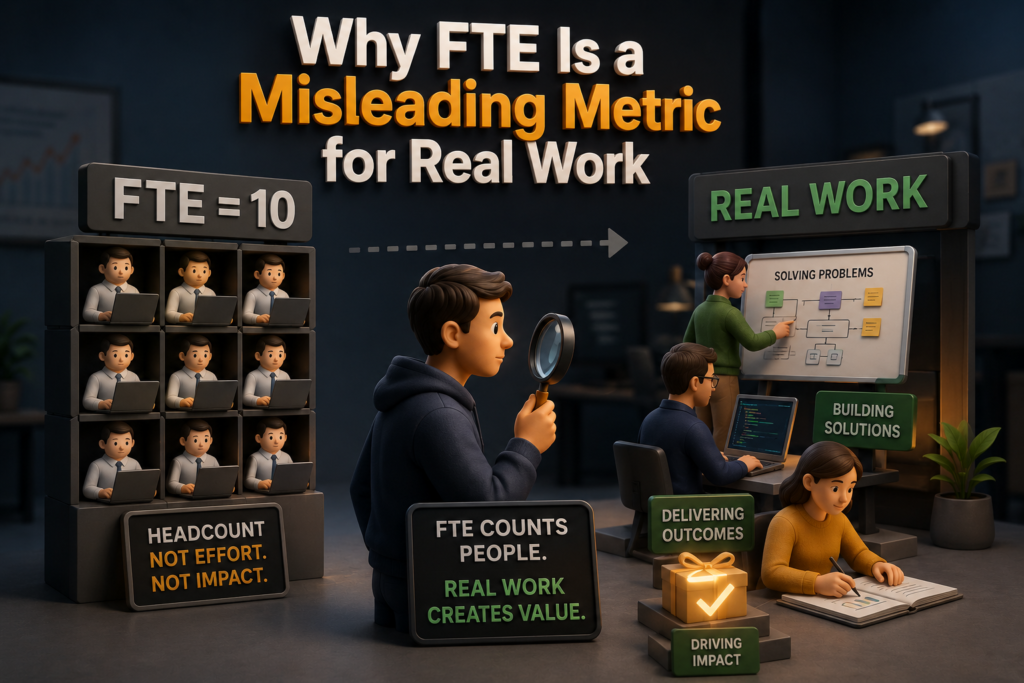
The Assumption We All Make
At some point, every operations team builds a simple model:
- 1 FTE = 8 hours
- 8 hours = X number of cases
- Therefore, 10 FTE = 10X output
It’s clean. It’s easy to explain. It works well in planning decks.
But the reality on the floor is very different.
Because not all hours are equal.
And not all work fits neatly into those hours.
A Real Scenario: “We Have Enough FTE”
In one of my projects, we were confident going into the month.
The numbers looked solid:
- Required: 20 FTE
- Available: 21 FTE
- Buffer: 1 extra resource
Everything suggested we were covered.
But within the first week:
- Backlogs started building
- SLA began slipping
- Pressure increased on the team
The immediate reaction was obvious:
“We need more FTE.”
But when we looked deeper, the issue wasn’t headcount.
It was how the work actually behaved.

What the FTE Model Missed
Here’s what our planning didn’t account for:
1. Complexity Variation
Not all cases took the same time.
Some were:
- Quick spam reviews (seconds)
- Others were nuanced policy decisions (minutes)
FTE assumes uniform effort.
Reality doesn’t.
2. Context Switching
Moderators weren’t working on a single queue.
They were:
- Switching between categories
- Handling escalations
- Responding to queries
Each switch reduced effective output.
But FTE counts every hour as fully productive.
3. Hidden Work
A significant portion of time went into:
- Clarifications
- Team discussions
- Tool issues
- Emotional recovery after heavy content
None of this showed up in FTE calculations.
But it directly impacted capacity.
The Turning Point
Instead of asking, “Do we have enough people?” we changed the question:
“Do we have enough effective capacity?”
That shift changed everything.
We started breaking down work differently:
- Time per case by category
- Effort required for complex decisions
- Non-review activities
And what we found was surprising.
Our “21 FTE” team was effectively operating like 15–16 FTE.
Not because people weren’t working.
But because the system was consuming their time in ways FTE couldn’t capture.
Another Scenario: Same FTE, Different Output
This one was even more revealing.
We had two teams:
- Same number of FTE
- Same working hours
- Same tools
But very different outcomes.
Team A:
- Consistently met SLA
- Stable quality
- Low stress levels
Team B:
- Frequent backlogs
- Fluctuating quality
- Higher fatigue
On paper, they were identical.
So what was different?
When we observed closely, the answer became clear.
Team B was handling:
- More complex queues
- Higher escalation volume
- More interruptions
Same FTE.
Completely different workload reality.
Why FTE Feels Reliable (But Isn’t)
FTE works well for planning because it simplifies things.
It gives:
- A clear number
- Easy comparisons
- Straightforward reporting
But it also creates a false sense of precision.
Because it ignores:
- Work variability
- Human factors
- System inefficiencies
In Trust and Safety, where decisions are rarely repetitive and often nuanced, this gap becomes significant.
The Human Side of the Problem
This isn’t just a planning issue.
It affects people directly.
When leaders rely too heavily on FTE, the expectation becomes:
“If we have enough headcount, why isn’t the work getting done?”
That pressure trickles down.
Moderators start feeling:
- They are too slow
- They need to work faster
- They are the problem
Even when the real issue is workload design.
I’ve had team members say:
“I’m working the whole day, but it still feels like I’m behind.”
That’s not a performance issue.
That’s a capacity mismatch.
What I Changed in My Approach
After seeing this repeatedly, I stopped treating FTE as the primary metric.
Instead, I focused on understanding real work.
Here’s what helped:
1. Effort-Based Planning
Instead of assigning work based on headcount, we estimated effort:
- How long does each category take?
- How much variation exists?
This gave a more realistic view of capacity.
2. Separate “Productive” vs “Support” Time
Not all work is direct output.
We started accounting for:
- Meetings
- Clarifications
- Breaks
- Recovery time
This reduced unrealistic expectations.
3. Track Interruptions
Frequent pings, escalations, and switches reduce effective capacity.
By measuring this, we identified where time was actually going.
4. Adjust Expectations by Queue
Instead of a single productivity target, we aligned targets with:
- Complexity
- Risk level
- Decision time
This made performance evaluation fairer.
5. Listen to the Floor
Sometimes the simplest signal is the most accurate.
When multiple moderators say:
“This queue feels heavier,”
It usually is.
Even if the FTE model says otherwise.
A Simple Analogy
Think of FTE like counting the number of machines in a factory.
If all machines run at the same speed, it works.
But what if:
- Some machines slow down for complex tasks
- Some need frequent resets
- Some require maintenance
- Some handle delicate work
Counting machines won’t tell you actual output.
You need to understand how they’re being used.
That’s exactly the gap with FTE.
What Leaders Should Watch For
If you’re managing operations, here are a few questions worth asking:
- Are we assuming all work takes equal time?
- How much of our team’s time is non-productive but necessary?
- Are some queues silently consuming more effort?
- Do teams with the same FTE deliver different outcomes? Why?
These questions reveal more than any headcount number.
Final Thought
FTE is not useless.
It’s just incomplete.
It tells you how many people you have.
It doesn’t tell you how much work they can realistically handle.
In Trust and Safety, where complexity, emotion, and judgment are part of the job, that difference matters.
If you rely only on FTE, you’ll keep asking:
“Why aren’t we meeting targets?”
When the better question is:
“Are we measuring work the right way?”
Because real productivity isn’t about how many people you have.
It’s about how much meaningful work your system actually allows them to do.