In Trust and Safety, it’s usually not harsh feedback that damages performance.
It’s silence.
The kind of silence that quietly allows mistakes to repeat until they become habits.
The kind of silence that makes moderators believe they’re doing well while error patterns are already forming underneath the surface.
Early in my career, I used to think negative feedback was the biggest risk to team morale.
I believed tough feedback discouraged people, reduced confidence, and created unnecessary pressure.
So like many leads, I sometimes delayed difficult conversations.
Not intentionally.
Mostly because I wanted to:
- Gather more examples
- Avoid sounding too critical
- Wait for complete audit data
- Give people “more time”
But after managing Trust and Safety operations for years, I noticed something important.
The real operational damage rarely came from tough feedback itself.
It came from feedback arriving too late.
And by the time the correction finally happened, the cost was already much higher than the original mistake.
The Dangerous Comfort of “No News Is Good News”
In moderation operations, silence often feels reassuring.
If:
- No lead messages appear
- No QA comments arrive
- No escalations happen
- No one mentions your decisions
…most moderators naturally assume:
“I must be doing fine.”
And honestly, that assumption is understandable.
I’ve seen many moderators build confidence simply because nothing negative had surfaced yet.
But operationally, silence can be misleading.
Because in many workflows, feedback moves slower than production itself.
Moderators make hundreds or thousands of decisions before audits catch patterns.
And during that gap, incorrect interpretations can quietly become normal behavior.
That’s the dangerous part.
Not the mistake itself.
The repetition.
A Real Scenario That Changed My Perspective
I remember one moderator who looked like a perfect performer on paper.
Everything appeared strong:
- SLA was excellent
- Productivity targets were consistently achieved
- Queue handling looked smooth
- No visible escalations existed
For almost two weeks, there were no warning signs.
Then quality audits arrived.
And the entire picture changed.
The moderator had been repeatedly misinterpreting a sensitive minor safety policy category.
Not randomly.
Consistently.
The same mistake pattern appeared across multiple cases.
By the time feedback finally reached him:
- The incorrect interpretation already felt “normal”
- Dozens of moderation decisions required review
- Confidence dropped immediately
- Retraining became necessary
What stayed with me most was his reaction during our conversation.
He didn’t argue.
He simply said:
“If someone told me earlier, I would’ve fixed this on day one.”
That sentence completely changed how I viewed feedback systems.
The issue wasn’t lack of skill.
It was delayed visibility.
Delayed Feedback Creates Habit Formation
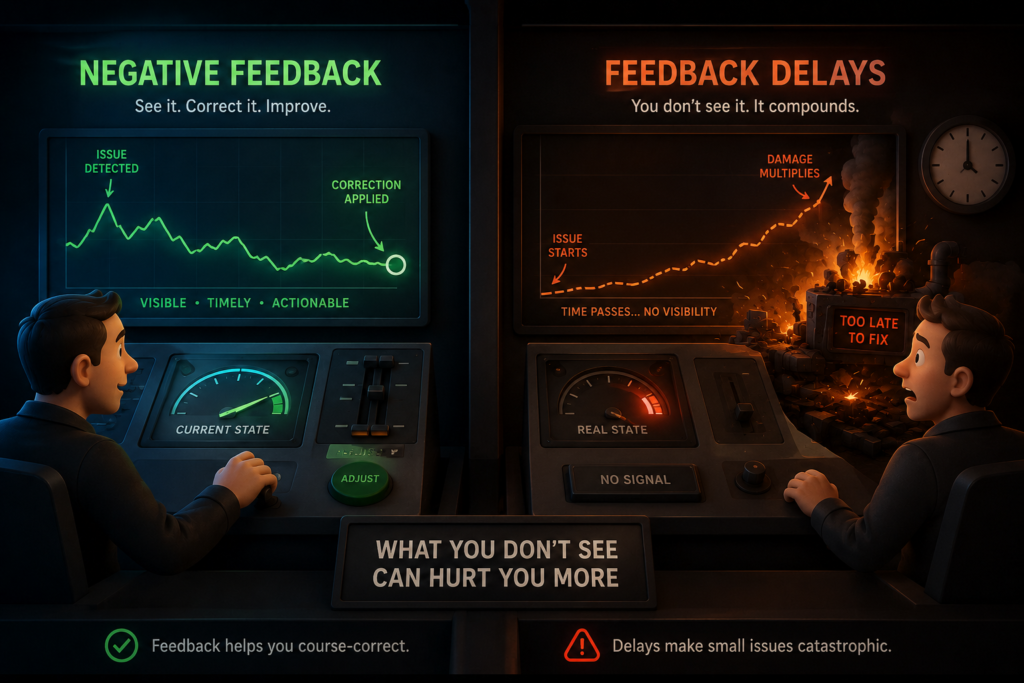
Negative feedback given early is usually corrective.
Delayed feedback becomes disruptive.
That difference matters enormously in Trust and Safety operations.
When feedback arrives quickly, moderators can:
- Adjust interpretation immediately
- Clarify confusion early
- Correct misunderstanding before repetition
- Build confidence around accurate behavior
But when feedback is delayed:
- Wrong assumptions solidify
- Decision patterns repeat automatically
- Confidence builds around incorrect understanding
- Errors spread across larger volumes
And once behavior becomes routine, correction becomes harder.
Because now people are not simply fixing a mistake.
They are unlearning a habit.
That process is psychologically much heavier.
The “Sudden Quality Drop” Illusion
One of the most misleading things in operations is the appearance of sudden performance decline.
I once worked on a project where a group of moderators experienced what leadership initially called a “sharp quality collapse.”
Scores dropped heavily within a short reporting period.
At first glance, it looked like performance had suddenly deteriorated.
But after tracing the timeline carefully, the reality was very different.
The actual mistakes had started weeks earlier.
The delay happened because:
- QA bandwidth was limited
- Audits were backlogged
- Feedback cycles moved slowly
- Corrections reached moderators late
So moderators continued working under the assumption that their interpretations were correct.
By the time audit results surfaced:
- Errors had accumulated massively
- Scores dropped all at once
- Leadership saw a “sudden decline”
But the decline was never sudden.
Only the visibility was delayed.
That distinction is extremely important operationally.
Late Feedback Damages Confidence More Than Early Feedback
This is something I underestimated earlier in my career.
Delayed feedback doesn’t only affect performance metrics.
It affects emotional stability too.
Imagine spending days believing you’re performing well, only to suddenly hear:
“You’ve been handling this incorrectly for weeks.”
Even strong performers react badly to that experience.
Not because they dislike feedback.
But because delayed correction creates shock.
I’ve seen moderators experience:
- Frustration
- Self-doubt
- Defensive reactions
- Anxiety around decision making
- Fear of hidden mistakes
And often, the emotional damage comes less from the mistake itself and more from discovering it too late.
That delay makes people feel blindsided.
What Happened When We Shortened Feedback Loops
One of the most effective operational changes I’ve seen involved reducing feedback delay dramatically.
In one high-risk moderation queue, we experimented with near real-time feedback systems.
Instead of waiting for weekly QA cycles:
- Leads reviewed samples daily
- Small corrections were shared quickly
- Patterns were addressed within hours
- Uncertainty was clarified immediately
The impact became visible surprisingly fast.
We saw:
- Lower repeat error rates
- Faster policy alignment
- Higher moderator confidence
- Better escalation quality
- More open discussions around difficult cases
Most importantly, mistakes stopped accumulating silently.
They were corrected before becoming habits.
That single operational shift improved learning speed more than any retraining program we implemented later.
Why Feedback Delays Happen So Often
The tricky part is that delayed feedback is rarely intentional.
Most teams genuinely want faster correction cycles.
But operational realities interfere.
From what I’ve observed, delays usually happen because of four major reasons.
1. Bandwidth Constraints
QA teams and leads are often overloaded.
When queues grow, feedback naturally slows down.
2. Over-Reliance on Formal Audits
Some operations depend too heavily on scheduled reviews instead of continuous coaching.
That creates long visibility gaps.
3. Fear of Sounding Too Critical
Many leaders hesitate to deliver immediate correction because they worry about discouraging moderators.
Ironically, delayed feedback usually creates more frustration later.
4. Missing Feedback Structures
Some workflows simply lack systems for rapid communication around recurring errors.
Without structured loops, delays become normal.
None of these issues are malicious.
But operationally, their impact is massive.
What I Changed In My Own Leadership Approach
After seeing how damaging delayed feedback could become, I changed several things in my own management style.
1. Prioritize Speed Over Perfect Wording
Feedback does not need to sound perfect.
It needs to arrive early.
Even a short clarification like:
“This decision should fall under X policy because of Y signal”
…is often enough to stop incorrect repetition immediately.
2. Address Patterns Early
Instead of only discussing isolated mistakes, I started highlighting trends quickly.
For example:
“I’m noticing a pattern in borderline harassment interpretation.”
That approach helps moderators recognize risk areas before errors spread widely.
3. Reduce Feedback Distance
Moving from weekly feedback toward daily touchpoints made a huge difference in some workflows.
Smaller corrections prevented larger retraining problems later.
4. Normalize Feedback As Workflow
Feedback should not feel like punishment.
It should feel routine.
When correction becomes part of everyday operations, people stop fearing it.
And discussions become healthier.
5. Encourage Self-Escalation
One of the best improvements came from encouraging moderators to openly flag uncertainty.
That transformed feedback from:
“Top-down correction”
Into:
“Collaborative decision support.”
That cultural shift matters a lot.
A Simple Analogy
I often compare feedback to navigation systems.
If you take a wrong turn while driving and GPS corrects you immediately, the mistake is small.
But imagine the GPS waits 15 minutes before telling you.
Now:
- You’re far off route
- More fuel is wasted
- Correction becomes frustrating
- Confidence drops
That’s exactly how delayed feedback works in moderation operations.
The later the correction arrives, the harder the recovery becomes.
What Leaders Should Pay Attention To
If you manage moderation teams, pay close attention to:
- How long feedback takes to reach reviewers
- Whether mistakes repeat before correction
- If quality declines appear “sudden”
- Whether moderators seem surprised by audits
- How quickly uncertainty gets clarified
These signals often reveal operational health better than metrics alone.
Because performance problems usually begin long before dashboards show them.
Final Thoughts
Negative feedback is not the real enemy in Trust and Safety operations.
Delayed feedback is.
Because timely correction helps people grow.
Delayed correction allows mistakes to become habits.
And in moderation environments where decisions scale quickly, habits form faster than most teams realize.
If you want:
- Better quality
- Stronger moderation accuracy
- Faster learning cycles
- More confident reviewers
- Healthier team culture
…focus not only on what feedback you give.
Focus on when you give it.
Because fast feedback doesn’t just fix errors.
It prevents them from becoming operational patterns.
Hi would you like to purchase the domain name tosfi.com?