The same operation, two completely different realities
“Everything looks stable.”
That’s what the dashboard said.
SLA was green.
Quality was within range.
Escalations were low.
Queue health looked normal.
From a manager’s perspective, it was a controlled and predictable day.
But when I checked in with the moderation team, the response was very different.
“It’s been a really difficult shift.”
That moment stayed with me because it captured something I’ve seen repeatedly in Trust and Safety operations:
The same operation can feel completely different depending on where you’re standing.
Managers and analysts often work inside the exact same system, yet experience two entirely different realities.
And if you’ve worked your way from moderation into leadership, you’ve probably lived both sides of that gap.
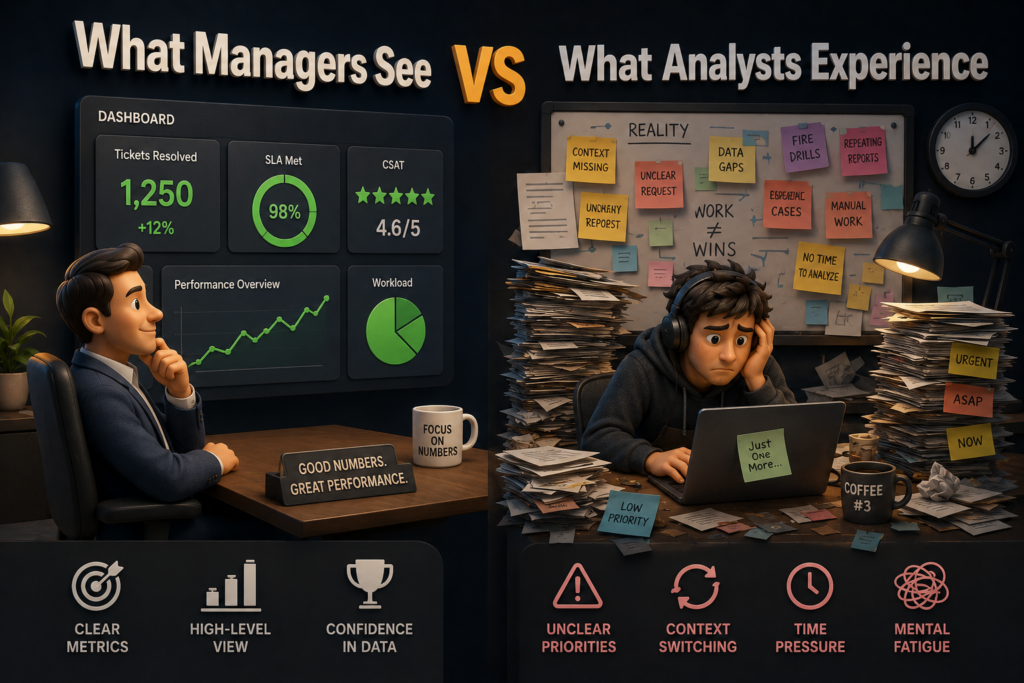
The Manager’s View: Structured, Measurable, Scalable
Managers operate through visibility systems.
Dashboards.
Reports.
KPIs.
Escalation trackers.
SLA reports.
These tools are necessary because large-scale operations cannot function without structure.
Managers need to understand:
- How many cases were completed
- Whether SLA targets were met
- Quality trends
- Escalation risks
- Productivity movement
- Queue health
From this perspective, operations become patterns and signals.
And honestly, they have to.
When you manage hundreds of thousands of decisions every week, you cannot individually experience every case analysts handle.
You depend on measurable indicators.
I’ve been in leadership review meetings where everything appeared stable:
- No major quality concerns
- No client escalations
- SLA consistently green
- Productivity aligned with targets
From a reporting standpoint, the operation looked healthy.
But over time, I learned something important.
Dashboards show operational outcomes.
They don’t always show operational effort.
And that difference changes everything.
The Analyst’s Reality: Continuous Mental Processing
For analysts, moderation work is not experienced as percentages or reports.
It’s experienced one decision at a time.
Every case requires context.
Every context requires interpretation.
Every interpretation requires judgment.
That mental process rarely appears on dashboards.
I remember one particular shift where incoming volume wasn’t unusually high.
From the manager’s side, nothing looked concerning.
But the content itself had changed.
Instead of straightforward violations, the queue was filled with borderline cases:
- Ambiguous harassment
- Context-heavy misinformation
- Edited media clips
- Content requiring intent analysis
- Cases with incomplete evidence
Each decision required deeper review.
Moderators were:
- Re-reading policies repeatedly
- Comparing similar scenarios
- Asking teammates for second opinions
- Spending longer on each decision
From the dashboard perspective, it looked like a standard workday.
From the analyst’s perspective, it was mentally exhausting.
And that gap matters more than many operations realize.
A Shift That Looked “Easy” But Wasn’t
One day, our incoming queue volume dropped significantly.
No spikes.
No urgent backlog.
No high-pressure SLA risk.
From a management view, it looked like a lighter shift.
But something else had changed.
The complexity of cases increased dramatically.
Moderators were dealing with nuanced policy edge cases where nothing was clearly safe or clearly violating.
Those are the hardest situations in Trust and Safety.
Because analysts aren’t simply following rules in those moments. They are interpreting risk.
The team spent more time discussing cases internally than usual.
There was more hesitation before final decisions.
Moderators double-checked context repeatedly.
At the end of the shift:
- SLA remained green
- Quality stayed stable
- Productivity technically met expectations
But the team was drained.
The dashboard captured the output.
It didn’t capture the cognitive effort required to achieve it.
Where the Gap Really Begins
The disconnect between managers and analysts usually doesn’t come from bad leadership or poor communication.
It comes from perspective.
Managers naturally focus on outcomes because they are responsible for operational performance at scale.
Analysts experience the process directly because they are responsible for individual decisions.
Managers see:
- Completion percentages
- Error trends
- Escalation counts
- Queue movement
Analysts experience:
- Ambiguity
- Emotional fatigue
- Decision pressure
- Constant context switching
- Policy uncertainty
Both views are valid.
But they are fundamentally different experiences of the same operation.
The Moment That Changed My Perspective
When I moved from moderation into leadership responsibilities, I slowly noticed a shift in how I viewed operations.
I started relying heavily on dashboards.
That wasn’t wrong. It was necessary.
But over time, I realized I was becoming more disconnected from the actual experience of the work itself.
One day, I decided to spend time directly with the moderation floor during a live shift.
Not for an audit.
Not for reporting.
Just to observe.
I sat with analysts, watched their decision-making process, and listened to the conversations happening around difficult cases.
That experience changed how I understood performance forever.
I realized something simple but powerful:
The effort behind moderation decisions was far greater than what operational metrics reflected.
Analysts were doing invisible work constantly.
And most of it never appeared in reports.
The Invisible Work Analysts Do Every Day
There are countless actions analysts take that improve operational quality without ever appearing in dashboards.
Things like:
- Pausing on a suspicious case
- Reviewing surrounding context carefully
- Asking teammates for another opinion
- Identifying unusual content patterns early
- Escalating uncertain situations responsibly
- Catching subtle risks before they spread
These moments rarely improve metrics immediately.
But they protect platforms in ways numbers alone cannot measure.
I’ve seen analysts prevent serious escalation issues simply because they paid attention to details others might have ignored.
And most of those contributions were never formally recognized in reports.
When Metrics Fail to Reflect Effort
One of the hardest realities in Trust and Safety is this:
Effort and output are not always connected equally.
An analyst may:
- Spend extra time on a difficult case
- Make an extremely careful decision
- Prevent a major escalation
- Protect policy consistency
And operationally, it may appear as:
- One completed case
- Slightly higher handling time
That disconnect can quietly frustrate teams.
Because the work requiring the most skill often looks the least impressive numerically.
A Scenario Managers Initially Misunderstood
There was one period where quality scores dipped slightly across part of the team.
Nothing catastrophic.
Just enough to trigger management concern.
Naturally, leadership started asking questions:
“What changed?”
“Why are decisions inconsistent?”
But once we reviewed the situation properly, the real issue became obvious.
The team had started handling a new type of content that existing guidelines didn’t fully address.
Moderators were forced to rely more heavily on interpretation and judgment.
Decision variance increased.
Not because analysts lacked skill.
But because the policy itself lacked clarity.
Once alignment sessions were conducted and examples were standardized, quality stabilized quickly.
That situation reinforced an important lesson for me:
Metrics show results.
They rarely show context.
Bridging the Gap Between Managers and Analysts
This gap between leadership and frontline moderation isn’t something that needs to disappear completely.
But it does need to be understood.
The strongest operations I’ve seen were the ones where managers stayed connected to ground reality.
What helped most was:
- Regular conversations beyond KPI reviews
- Open discussions about difficult queues
- Sitting with analysts during live workflows
- Encouraging honest operational feedback
- Reviewing complexity, not just output
Because when leaders understand the actual experience behind the numbers, decisions become far more accurate.
Leading With Both Perspectives
The best Trust and Safety operations balance both viewpoints.
Managers need structure, reporting, and measurable visibility.
Analysts need support, clarity, and understanding of operational realities.
When both perspectives work together:
- Decisions improve
- Burnout reduces
- Policy alignment strengthens
- Teams become more confident
- Operational trust increases
That balance matters more than perfect dashboards ever will.
Final Thought
Trust and Safety operations run on metrics.
But they are built on human judgment.
Managers see systems, patterns, and outcomes.
Analysts experience pressure, ambiguity, and continuous decision-making.
And the gap between those two realities is where many operational misunderstandings begin.
Close that gap, and operations become healthier for everyone involved.
Because at the end of the day, success is not only about what the dashboard shows.
It’s also about what the work actually feels like for the people doing it.
Fantastic.