In Trust & Safety, the playbook guides you — but judgment carries you across the gaps
“Just follow the SOP.”
If you’ve worked in operations long enough, you’ve probably heard that line hundreds of times. In Trust & Safety, it becomes part of daily language almost immediately. New reviewers hear it during onboarding. Team leads repeat it during escalations. Managers rely on it to maintain consistency across large moderation queues.
And to be fair, SOPs matter.
Without Standard Operating Procedures, large-scale moderation would collapse into chaos. Teams handling thousands of decisions every day need structure. Policies need interpretation frameworks. Escalation paths need clarity. Consistency matters because platforms cannot afford random enforcement.
But after years in Trust & Safety operations, I’ve learned something important that rarely gets discussed openly:
Some of the most important decisions happen when the SOP is no longer enough.
That’s the uncomfortable reality of this work.
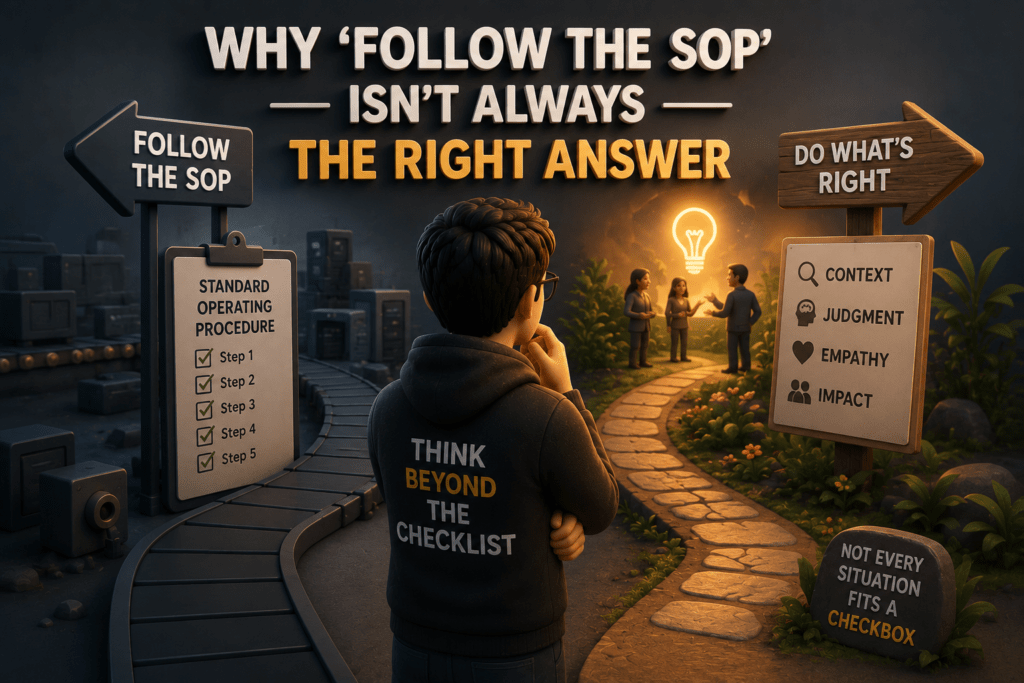
Why SOPs Exist in the First Place
Trust & Safety environments move fast.
A reviewer may process hundreds of cases in a single shift. Content arrives from different regions, cultures, languages, and contexts. Some decisions need immediate action because delays create real-world harm.
In that kind of environment, SOPs become survival tools.
They simplify complexity into repeatable actions:
- Identify the signal
- Match it to policy
- Apply the enforcement
- Document the outcome
This works extremely well for standard cases.
I’ve personally seen new moderators become confident much faster once they understood SOP structure. A good SOP reduces uncertainty. It gives reviewers a safety net. It also protects operational quality because decisions become measurable and auditable.
For routine moderation work, SOPs are incredibly effective.
But Trust & Safety is rarely routine for long.
The First Time I Realized the SOP Wasn’t Enough
I still remember a case that technically matched a violation category almost perfectly.
Every visible signal aligned with the policy language. The enforcement path was straightforward. From a purely operational perspective, it should have been an easy decision.
But something felt off.
The context surrounding the content completely changed its meaning.
If I had followed the SOP exactly as written, the enforcement would have been fast, clean, and fully defendable from a process standpoint.
It also would have been wrong.
So instead of immediately actioning the case, I paused and reviewed the surrounding indicators again. The wording, intent, engagement pattern, and account behavior told a very different story than the isolated content itself.
That moment changed how I looked at moderation forever.
Because I realized SOPs are designed to guide judgment, not replace it.
The Problem With Real-World Moderation
Most SOPs are built around known patterns.
But online behavior evolves faster than documentation.
Every experienced reviewer eventually encounters cases where:
- Content sits between two policy categories
- Signals contradict each other
- Context changes interpretation completely
- Harm exists, but policy wording lags behind it
- Coordinated abuse appears before detection systems adapt
That’s where the real challenge begins.
The public often imagines moderation as a simple “rule broken vs rule not broken” process. In reality, many cases live in gray areas where context matters more than keywords or isolated visuals.
And gray areas are where over-reliance on SOP becomes dangerous.
A Real Operational Pattern I’ve Seen Multiple Times
One of the most common operational mistakes happens during new policy rollouts.
A new SOP update gets released. Teams are told to align immediately. Everyone focuses on accuracy because audits are watching closely.
At first, reviewers become extremely literal.
And honestly, that makes sense. Nobody wants to be the person applying a new policy incorrectly.
But then edge cases start appearing.
I remember one rollout where a particular enforcement category suddenly increased across queues. Reviewers were applying the updated SOP correctly according to the written instructions.
Yet during calibration discussions, we noticed something important:
The same policy was producing inconsistent outcomes depending on contextual interpretation.
Two reviewers could follow the exact same SOP and still arrive at different conclusions because the document didn’t fully account for nuanced intent.
That wasn’t a reviewer problem.
It was a reality problem.
Policies can never perfectly predict human behavior online.
So we started discussing not just what the SOP said, but why the policy existed in the first place.
That changed the quality of decisions dramatically.
When Teams Become Too Dependent on SOPs
This is something I’ve noticed repeatedly in high-volume moderation environments.
The more pressure teams face around metrics, the more mechanical decision-making becomes.
People stop asking questions.
Discussions become shorter.
Escalations decrease, but not always for good reasons.
Reviewers begin optimizing for “safe decisions” instead of accurate decisions.
And from a dashboard perspective, everything can look healthy:
- SLA remains green
- Throughput improves
- Escalations drop
- Audit consistency increases
But underneath those metrics, critical thinking slowly disappears.
That’s one of the biggest hidden risks in Trust & Safety operations.
Because harmful patterns rarely announce themselves clearly. They usually appear as subtle anomalies first.
And if reviewers are trained only to follow steps without questioning context, those anomalies get missed.
The Shift Where One Question Changed Everything
I remember a moderation shift where multiple cases entered the queue that appeared almost identical.
Same structure. Same behavioral signals. Same apparent violation category.
Naturally, the team began processing them quickly.
Then one reviewer paused and asked:
“Why do all these accounts feel coordinated?”
That single question changed the entire investigation.
Once we looked deeper, we realized the cases were not isolated violations at all. They were part of a broader organized pattern that the SOP had not fully adapted to yet.
If we had continued processing each case individually, we would have completely missed the larger operational threat.
Instead, we escalated the trend, adjusted handling logic, and prevented wider platform abuse.
That experience reinforced something important:
Good reviewers don’t just process cases.
They notice patterns.
Experience Changes How You Read Policies
One major difference between new reviewers and experienced Trust & Safety professionals is how they interpret policy intent.
New reviewers often focus on matching visible signals directly to enforcement steps.
Experienced reviewers tend to ask deeper questions:
- What is the user actually trying to do?
- What harm could this create?
- Is the policy intent being fulfilled here?
- Does this case resemble previous edge patterns?
- Would this decision still make sense at scale?
That doesn’t mean experienced reviewers ignore SOPs.
In fact, the strongest reviewers usually understand SOPs extremely well.
But they also understand where documentation ends and judgment begins.
And that distinction matters more than most people realize.
Leadership Lessons From Moderation Floors
As someone who has worked closely with moderation teams, I’ve noticed that team culture shapes decision quality more than people expect.
If leadership rewards only strict SOP adherence, reviewers eventually stop thinking independently.
But if leaders encourage thoughtful discussion, escalation confidence improves.
Some of the best coaching conversations I’ve had with analysts were not about whether they were technically correct.
They were about how they thought.
Questions like:
- “What made you hesitate?”
- “Which signal changed your interpretation?”
- “What felt unusual about this case?”
- “Why did this not fit the normal pattern?”
Those conversations build stronger judgment over time.
And in Trust & Safety, judgment is one of the most valuable operational skills a reviewer can develop.
The Truth About “Correct” Decisions
One thing this industry teaches you very quickly is that “correct” is not always simple.
A technically compliant decision can still create the wrong outcome.
A fast decision can miss deeper harm.
A perfectly documented enforcement can still fail the intent of the policy itself.
That’s why the best moderation decisions usually balance three things together:
- Policy structure
- Contextual understanding
- Human judgment
You need all three.
SOPs provide consistency.
Experience provides perspective.
Judgment connects both.
Final Thought
Trust & Safety is often described as policy enforcement work.
But after years in the field, I think that description is incomplete.
This is really a decision-making profession operating inside structured systems.
And the hardest decisions are rarely the obvious ones.
They happen in edge cases.
They happen during uncertainty.
They happen when reality evolves faster than policy updates.
That’s when reviewers stop being checklist followers and start becoming trusted decision-makers.
Because at the end of the day, SOPs are essential.
But they are still only the starting point.
And sometimes, the most important question in Trust & Safety is not:
“Did I follow the SOP?”
It’s:
“Did I make the right call?”