AI can find patterns at incredible speed. But when context, intent, and consequences matter, humans still have a role.
Every few months, we see another headline saying AI will replace human moderators.
It sounds believable.
AI is faster. It can work 24/7. It can scan huge amounts of content without getting tired.
So, will human moderators eventually disappear?
After seeing how content moderation works in real operations, I think the question is slightly different:
Which parts of moderation should AI handle, and which parts still need people?
That is where the future becomes interesting.
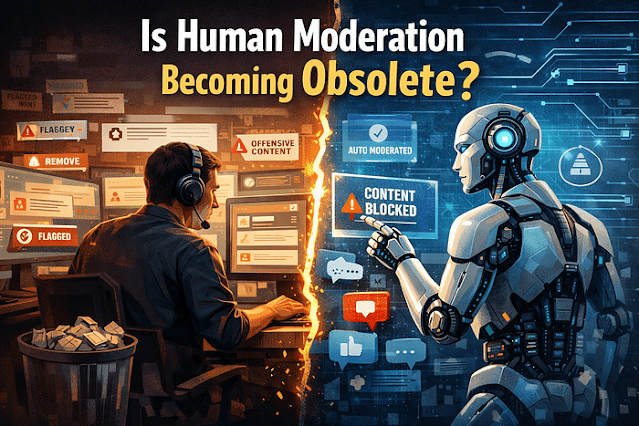
AI Is Excellent at the Repetitive Work
AI moderation is extremely useful when the violation is clear and the pattern repeats.
For example:
- Spam and scam messages
- Duplicate harmful content
- Known abusive phrases
- Certain types of explicit content
- Suspicious automated behavior
- Repeated policy violations
Imagine a platform receiving millions of pieces of content every day.
No matter how large the moderation team is, humans cannot review everything manually.
AI can filter large volumes first and send the more difficult cases for human review.
That is not replacing moderators. It is changing where their time is spent.
The Difficult Cases Are Usually Not Black and White
Here is where things get complicated.
A moderator may receive content and have to decide:
Is this satire or harassment?
Is this criticism or hate speech?
Is this documentary footage or glorification of violence?
Is this a genuine mistake or deliberate manipulation?
The words alone may not provide the answer.
You may need to understand the conversation before the post, the user’s behavior, the surrounding content, the local culture, or even why the content was created.
That is where human judgment becomes important.
A Keyword Can Tell You What Happened. Context Can Tell You Why.
Consider a video discussing extremist ideology.
An automated system sees dangerous symbols, certain phrases, and disturbing imagery.
It flags the video.
But a human reviewer watches the complete context and discovers that the video is actually criticizing extremist ideology for educational purposes.
Same keywords.
Very different meaning.
This is one of the biggest differences between automated detection and human moderation.
AI is very good at finding signals. Humans are still needed to understand meaning.
Policies Change Because Humans Find New Problems
Moderation policies are not permanent documents.
Online behavior changes constantly.
New slang appears. New scams emerge. New manipulation techniques spread. AI creates new forms of abuse that did not exist when older policies were written.
Sometimes the moderation queue itself becomes the first place where a new abuse pattern is noticed.
A reviewer may think:
“We keep seeing this. But our current policy doesn’t really explain what to do with it.”
That observation can start a larger process involving QA, policy, operations, and product teams.
This is another area where human moderators provide value beyond simply clicking Allow or Remove.
They help platforms understand how people are actually using the product.
AI Will Change the Moderator’s Job
The future of content moderation probably won’t look like thousands of people manually reviewing every obvious violation.
Instead, moderation may become more layered:
AI detects → AI prioritizes → Human reviews → Human decides → Policy improves
As automation becomes better, human reviewers may spend more time on:
- Complex edge cases
- Appeals
- Investigations
- High-risk decisions
- Policy gaps
- Cultural context
- Behavioral patterns
- AI-generated manipulation
That means the moderator role can become more analytical rather than simply more automated.
There Is Also a Human Cost
There is one part of moderation that technology cannot simply make disappear.
Some content is disturbing.
Even if AI identifies 99% of obvious violations, people may still need to review the difficult cases that require context and accountability.
That makes reviewer wellbeing, proper escalation, training, and support important parts of a modern Trust & Safety operation.
Technology can reduce exposure.
It cannot remove the responsibility completely.
So, Will AI Replace Human Moderators?
The more useful question is whether AI can replace all human judgment in content moderation.
For obvious, repetitive decisions, automation will continue to take on more work.
For ambiguous and high-impact decisions, human involvement remains important because the challenge is not always recognizing a pattern.
Sometimes it is understanding intent, context, culture, and consequences.
The future of Trust & Safety is therefore likely to be less about humans versus AI and more about how well the two work together.
AI can handle the scale.
Humans can handle the uncertainty.
And when the internet keeps changing, that combination may be more valuable than either one working alone.
The real future of moderation may not be a world without moderators. It may be a world where moderators spend less time processing content and more time understanding it.