“Keep the SLA green.”
If you’ve worked in Trust & Safety operations, you’ve probably heard this sentence more times than you can count.
During daily stand-ups, operations reviews, client calls, and performance discussions, SLA is almost always one of the first metrics everyone looks at.
Are we meeting turnaround times?
Are queues under control?
Are cases moving fast enough?
These are important questions because Service Level Agreements (SLAs) are the backbone of any moderation operation. They help platforms respond quickly to harmful content, reduce backlog, and maintain user trust.
Without SLAs, moderation systems become slow, users lose confidence, and harmful content stays online longer than it should.
But after spending more than a decade in Trust & Safety operations, I’ve learned something that isn’t written in most SOPs.
There are moments when chasing SLA is actually the wrong decision.
Not because SLA isn’t important.
But because some cases deserve something even more important:
Thoughtful human judgment.
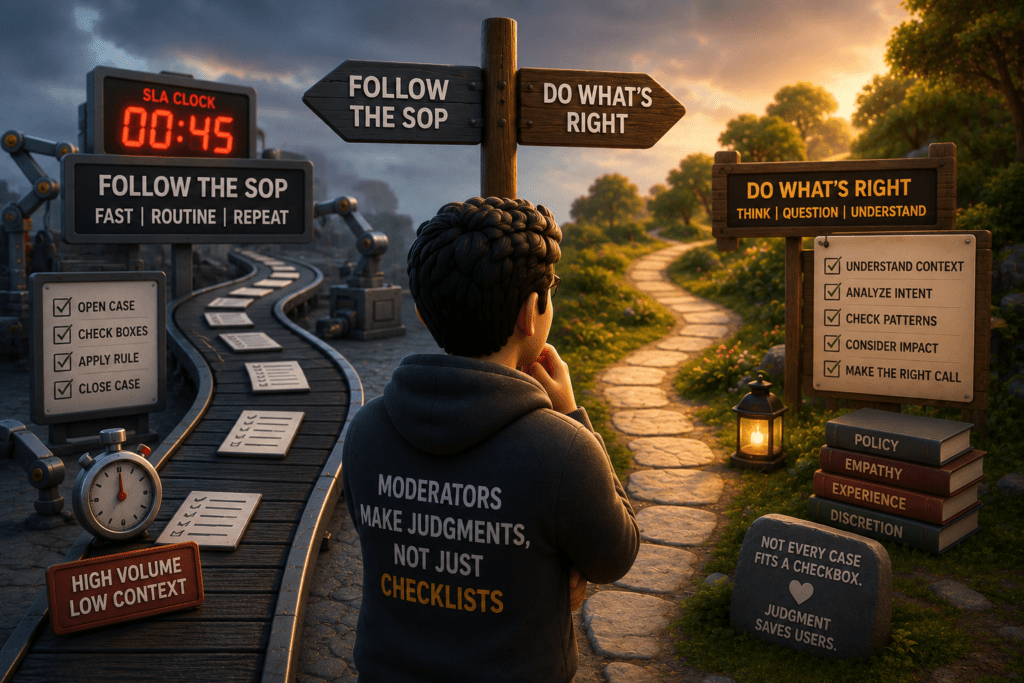
Why We Care So Much About SLA
Let’s be fair to SLA for a moment.
It exists for a reason.
Imagine a platform where every reported post waits three days before anyone reviews it.
Harassment continues.
Scams spread.
Graphic content remains visible.
Victims receive no response.
That would be unacceptable.
SLA creates accountability.
It ensures moderation doesn’t become endless waiting.
It gives operations teams measurable goals.
It allows managers to predict staffing requirements.
It helps clients understand service performance.
I’ve managed shifts where meeting SLA prevented queues from growing into operational disasters.
When volume suddenly doubled, maintaining turnaround time protected thousands of users from delayed enforcement.
So this article isn’t about ignoring SLA.
It’s about recognizing the rare moments when speed shouldn’t be the only priority.
The Case That Looked Too Easy
One shift still stands out in my memory.
It was one of those busy afternoons every Trust & Safety professional knows well.
The queue kept growing.
Dashboards were changing every few minutes.
Everyone was focused on clearing cases efficiently.
A report entered my queue.
At first glance, it looked straightforward.
The signals matched familiar patterns.
The policy seemed clear.
I could probably have completed the review in under a minute.
Then something felt unusual.
Not enough to immediately escalate.
Not enough to confidently ignore.
Just enough to make me uncomfortable.
Inside every moderator’s mind, there’s usually a silent conversation.
“If I spend more time here, my SLA increases.”
“If I move quickly, I might miss something.”
That day I decided to pause.
I checked additional context.
Compared related reports.
Reviewed surrounding activity.
What initially looked like an isolated case turned out to be connected to a broader pattern involving multiple coordinated accounts.
If I had optimized only for SLA, I would have closed the case correctly according to the visible evidence.
But I would have completely missed the bigger problem.
That experience changed how I think about operational efficiency.
Speed Is Not the Same as Effectiveness
Operations teams naturally celebrate speed.
Faster reviews.
Shorter queues.
Better turnaround.
Those are valuable achievements.
But Trust & Safety isn’t manufacturing.
We’re not assembling identical products.
Every decision involves uncertainty.
Context.
Intent.
Policy interpretation.
Human behavior.
Some cases genuinely deserve thirty seconds.
Others deserve ten minutes.
Treating every report as identical creates invisible risk.
A High-Volume Shift That Taught Our Team a Lesson
During one particularly heavy volume period, our entire operation focused on protecting SLA.
Everyone increased pace.
Reviewers processed cases quickly.
The queue stabilized.
Operationally, things looked excellent.
Then quality audits arrived.
Interestingly, the obvious cases remained accurate.
The problems appeared elsewhere.
Borderline content.
Context-heavy reports.
Emerging abuse patterns.
Those were the cases affected by rushing.
One reviewer later told me:
“I knew that case deserved another look.
I just didn’t feel like I had the time.”
That sentence highlights one of the biggest operational challenges in Trust & Safety.
Sometimes people know the right decision.
The environment simply discourages taking the time necessary to make it.
Not Every Case Deserves the Same Speed
Over the years, I’ve noticed certain categories consistently require more deliberate thinking.
For example:
Borderline Policy Cases
Some content sits exactly between allowed and violating.
A few additional seconds spent understanding context often prevent incorrect enforcement.
Emerging Abuse Trends
Bad actors constantly change tactics.
New scams.
New slang.
New manipulation techniques.
These rarely match existing patterns perfectly.
Speed alone doesn’t catch evolution.
Curiosity does.
Context-Dependent Decisions
Keywords rarely tell the whole story.
The same image, sentence, or video can mean completely different things depending on surrounding context.
Removing context from moderation usually removes accuracy as well.
Coordinated Behavior
One individual post may appear harmless.
Five similar reports reviewed together reveal coordinated abuse.
Pattern recognition sometimes requires slowing down.
The Pressure Nobody Talks About
One thing I wish more operations discussions acknowledged is psychological pressure.
Even experienced moderators feel it.
You notice:
The timer.
The growing queue.
The dashboard.
The productivity target.
The awareness that everyone else seems to be moving quickly.
I’ve experienced moments where my first instinct wasn’t based on policy.
It was based on operational pressure.
“Just finish this one.”
Whenever I catch myself thinking that, I deliberately pause.
Because rushing rarely comes from confidence.
It usually comes from external pressure.
A Small Mistake That Changed My Perspective
Early in my leadership journey, I believed strong operations meant maximizing speed wherever possible.
One day I reviewed a quality audit involving a case completed well within SLA.
Technically, the decision wasn’t incorrect.
But it lacked depth.
A little more investigation would have uncovered additional context that significantly strengthened the enforcement action.
That moment stayed with me.
Not because someone failed.
Because I realized operational success isn’t only about making correct decisions.
It’s also about making complete decisions.
Those aren’t always the same thing.
What Experienced Reviewers Do Differently
One pattern I’ve consistently noticed is that experienced moderators develop an internal rhythm.
They don’t move slowly.
They move selectively.
Straightforward spam?
Fast.
Obvious impersonation?
Fast.
Known violation patterns?
Fast.
But when something feels different, they instinctively change pace.
They investigate.
Compare.
Question.
Escalate if necessary.
That flexibility separates experienced judgment from mechanical processing.
Leading Teams Beyond the Dashboard
As I moved into leadership, I realized people naturally optimize whatever managers measure.
If every discussion focuses only on SLA, reviewers learn one lesson:
Speed matters most.
If leaders also celebrate thoughtful escalations, careful investigations, and strong judgment, behavior changes.
One sentence I started repeating to my teams was surprisingly simple:
“It’s okay to slow down on the cases that deserve it.”
That permission reduced unnecessary anxiety.
People became more willing to investigate unusual situations instead of treating every report like a race.
Ironically, quality improved without dramatically hurting operational performance.
The Cost of Never Slowing Down
Rushing every case creates hidden operational costs.
I’ve seen it lead to:
- Repeat violations being missed
- Escalations increasing
- Audit corrections
- Additional rework
- Reviewer frustration
- Client questions
- Reduced consistency
Hours spent correcting preventable mistakes usually cost far more than taking an extra thirty seconds during the original review.
Sometimes slowing down is actually the faster long-term strategy.
Redefining High Performance
Many organizations define high performance through numbers.
Cases completed.
SLA achieved.
Productivity maintained.
Those metrics absolutely matter.
But in Trust & Safety, I believe strong performance also includes something harder to measure.
Knowing when not to optimize for speed.
Because moderation isn’t simply processing content.
It’s protecting people.
Sometimes protecting people requires making difficult decisions carefully instead of quickly.
The Quiet Decisions Nobody Sees
Some of the best moderation decisions I’ve witnessed never appeared in reports.
Nobody celebrated them during meetings.
They didn’t improve a dashboard.
They didn’t create impressive statistics.
They happened quietly.
Someone paused.
Looked twice.
Checked additional context.
Asked another reviewer.
Escalated uncertainty instead of guessing.
Those moments rarely receive recognition.
But they often prevent much larger problems later.
Final Thought
SLA will always remain one of the most important metrics in Trust & Safety.
It keeps moderation systems responsive.
It protects users from unnecessary delays.
It keeps operations functioning.
But SLA was never meant to replace human judgment.
It was meant to support it.
The strongest moderators I’ve worked with aren’t the fastest.
And they aren’t the slowest.
They’re the ones who understand something experience eventually teaches every Trust & Safety professional:
Some cases deserve speed.
Some cases deserve patience.
Knowing the difference is one of the most valuable skills this profession can develop.
Because at the end of the day, users rarely remember how quickly a moderation decision happened.
They remember whether it was the right one.
And sometimes, making the right decision begins with having the confidence to slow down.