Why your Trust & Safety team feels exhausted all day but still falls behind — and what’s actually draining performance behind the scenes
“My team wasn’t slowing down because the work was too much. They were slowing down because they never got to finish thinking about anything.”
Introduction
If you ask most operations managers why productivity is dropping, you’ll hear the same answer almost every time.
“The workload is too high.”
I used to say the same thing. It felt like the obvious explanation. Volume goes up, performance goes down — the math seemed straightforward.
But a few years into leading moderation teams, I started paying closer attention to how my team was actually spending their time rather than just how much they were doing. And what I found quietly changed how I think about performance, productivity, and team wellbeing in Trust & Safety operations.
The real problem wasn’t volume.
It was context switching.
And it was hiding in plain sight — inside the workflow itself, invisible on every dashboard, quietly draining accuracy, morale, and decision quality while everyone assumed the issue was simply too many cases in the queue.
🔄 The Illusion of a “Productive” Day
Let me describe what a typical hour looks like for a moderator on a well-run Trust & Safety team.
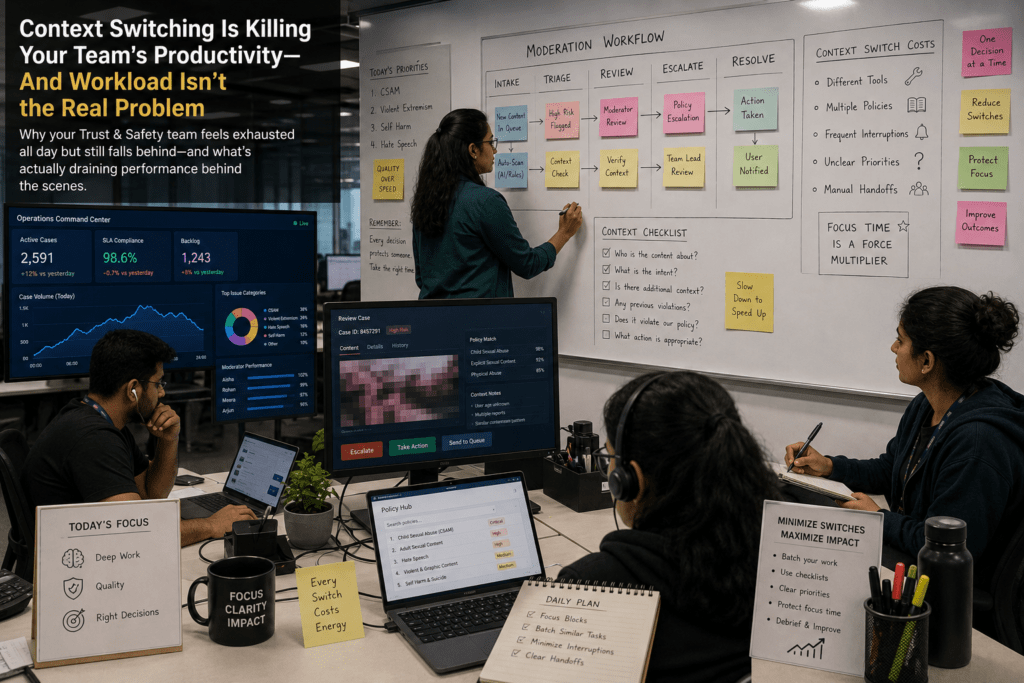
They open a graphic violence video and begin reviewing. Before completing the analysis, a ping comes in — a lead needs a quick policy clarification. They respond, return to the video, close it, and immediately pick up the next case: a spam account review. That runs for two minutes before an escalation ticket arrives marked urgent. They switch to handle it. Then a borderline nudity case appears in the queue. Then another ping. Then a self-harm report that requires a completely different policy framework and significantly more emotional care.
All of that — within a single hour.
On the operations dashboard, it looks like a productive morning. Cases are moving. SLA is being met. The team looks engaged and busy.
But here’s what’s actually happening inside every one of those transitions:
Every switch forces the brain to fully reset — to abandon the mental context it had built around the previous case, load an entirely different set of rules, recalibrate emotionally for a different content category, and rebuild decision confidence from scratch.
And that reset has a cost that no dashboard currently captures.
👤 A Real Scenario: When I Finally Saw What Was Actually Happening
A few years ago, our team started showing a gradual dip in quality scores.
Not dramatic. Not the kind of decline that triggers an immediate client escalation or a crisis review call. But consistent enough to concern me — a quiet erosion in decision accuracy that the numbers showed but didn’t explain.
My initial assumptions were the usual suspects: new hires still ramping up, recent policy updates creating temporary confusion, or simply sustained volume pressure affecting decision quality.
But when I dug into the data more carefully, something unexpected emerged.
The moderators showing the most inconsistent quality scores were not the newest members of the team. They were not the ones handling the highest volume of cases overall.
They were the ones experiencing the highest number of queue switches per hour.
One reviewer in particular stood out — I’ll call her Anjali.
Anjali was one of the fastest reviewers on the team. She consistently hit productivity targets. She knew the policies well. She had handled some of the most complex content categories we worked with.
But her decision accuracy had started becoming inconsistent in ways I couldn’t explain through policy knowledge or experience gaps. Especially in sensitive categories — minor safety, graphic content, coordinated harassment — where getting it right required sustained focus and careful contextual analysis.
When I sat down with her to understand what was happening, she said something that stopped me mid-conversation:
“I feel like I’m not thinking properly anymore. I just move from one thing to another.”
That one sentence explained everything I had been seeing in the data.
Anjali wasn’t underperforming. She was context-switching so frequently that sustained, quality thinking had become structurally impossible within her workflow.
🧠 Why Context Switching Hurts Far More Than You Think
Most people — including most operations managers — treat task switching as essentially costless. It takes a few seconds to move from one queue to another. How much impact could it really have?
The cognitive science answer is: significantly more than the transition time suggests.
When you switch from one task to another, your brain doesn’t simply close one process and open another cleanly. What actually happens is:
Your brain has to recall an entirely different rule set and policy framework. The emotional context shifts — sometimes dramatically, particularly in Trust & Safety where content categories carry vastly different psychological weights. Decision patterns that were becoming automatic for the previous task type have to be rebuilt. Attention fragments across the previous task, the current task, and the awareness that another switch is likely coming.
Even when the physical transition takes ten seconds, the mental recovery — the time it takes to reach genuine decision-making depth on the new task — takes considerably longer.
And when this cycle repeats across hundreds of cases in a single shift, the cumulative effect on performance becomes significant:
- Decision-making slows as the brain struggles to maintain depth across multiple frameworks simultaneously
- Policy mistakes increase on cases that require nuanced judgment rather than pattern matching
- Reviewer confidence erodes — not because their knowledge has declined but because their cognitive bandwidth is being constantly fragmented
- Fatigue arrives earlier and accumulates faster than workload alone would explain
The frightening part is that this degradation is often invisible until a quality audit surfaces it — by which point it has already been affecting decisions for days or weeks.
💔 The Emotional Dimension Nobody Plans For
In most industries, context switching is primarily a productivity problem.
In Trust & Safety, it’s also an emotional resilience problem — and that distinction matters enormously.
Consider the emotional journey inside a single hour of high-frequency queue switching:
A harmless spam account review. Then a graphic violence video requiring careful analysis of real harm. Then a borderline self-harm case that carries immediate user safety implications. Then back to a routine impersonation report. Then a minor safety escalation.
These are not just task switches. They are emotional gear changes — each requiring a completely different internal state to make responsible, accurate decisions.
Over time, repeated without adequate structure or recovery space, this creates a specific kind of exhaustion that moderators describe in consistent terms: feeling mechanical, feeling detached, feeling like decisions are happening faster than thinking.
I’ve watched genuinely talented, deeply committed moderators become quieter over weeks — less engaged in calibration discussions, less likely to flag something that felt slightly off, more likely to close a borderline case quickly rather than sitting with the discomfort of its ambiguity.
Not because they stopped caring.
Because their mental and emotional bandwidth had been so consistently fragmented that careful thinking had become genuinely exhausting rather than naturally engaging.
🔧 What We Actually Did — And What Changed
After identifying context switching as the core issue rather than raw workload, our team ran a structured experiment.
Instead of optimizing purely for throughput speed, we optimized for sustained focus.
The changes were relatively simple. The results were not what I expected.
We reduced queue switching frequency. Rather than rotating moderators across multiple content categories within the same hour, we assigned primary queues for longer sustained durations — allowing reviewers to build and maintain mental context rather than constantly rebuilding it from scratch.
We introduced structured time blocks. Instead of organic, reactive task switching driven by queue availability, we created deliberate blocks: two hours in one content category, a genuine recovery break, then a transition to a different category with full awareness and preparation. The switching still happened. It happened intentionally rather than constantly.
We protected focus time from interruptions. Non-urgent queries from leads stopped being sent during active focus blocks. Policy clarification threads were consolidated rather than dropped into individual conversations throughout the shift.
We grouped escalations more intelligently. Only genuinely time-critical cases broke the focus structure immediately. Others were batched, reducing the number of mid-review interruptions that had been fragmenting attention across the team.
Within two weeks, the results were clear enough to act on at scale.
Quality scores improved meaningfully. Decision accuracy became more consistent — particularly on the sensitive content categories where inconsistency had been most pronounced. Moderators reported feeling less fatigued at the end of shifts despite handling comparable case volumes.
And the finding that surprised me most:
Productivity didn’t decrease. In several cases, it measurably improved.
Because focused people don’t just work better. They frequently work faster — because they’re not spending cognitive resources constantly rebuilding mental context that frequent switching had been destroying.
📊 Why Leaders Keep Missing This
Most operations dashboards are built to track what’s easy to measure:
Volume completed. SLA compliance. Throughput per hour. Queue clearance rate.
What they don’t track — and what drives context switching’s impact — is invisible to standard reporting:
- How many times each reviewer switched between content categories per hour
- The cognitive load generated by emotional content transitions
- The cumulative fatigue of sustained attention fragmentation
- The decision confidence levels that determine whether borderline cases get the depth they deserve
So when productivity dips, the instinctive operational response is to address what the dashboard shows: push volume targets, increase monitoring frequency, add pressure to the throughput metrics.
But if context switching is the actual driver of the performance gap, adding pressure to a cognitively overloaded system doesn’t fix the problem.
It accelerates the deterioration — and burns out the people who were already struggling to maintain quality under fragmented conditions.
💡 A Simple Way to Understand What’s Happening
I use this analogy when explaining context switching to stakeholders who haven’t experienced it directly.
Think of your moderator’s brain as a browser.
Each content category, each policy framework, each emotional register required for a different content type — that’s a tab.
Now imagine that browser opening twenty tabs and switching between them every ninety seconds, all day, without ever fully loading any of them.
The system slows. Things start to crash. You lose track of what you were actually doing in the tab you were on before the last switch.
That is precisely what sustained context switching does to the human brain attempting to make high-quality decisions under pressure.
The solution isn’t a faster computer. It’s fewer open tabs — and enough time to actually load the ones that matter.
🛠️ Practical Steps for Leaders Right Now
If you’re leading a Trust & Safety team — or any operations team where decision quality matters — here’s where to start:
Measure switching, not just output. Before you can address context switching, you need to know it’s happening at a problematic frequency. Track queue rotation rates alongside quality metrics and look for the correlation.
Design workflows for focus. Audit your current task assignment structure. Are moderators being pulled across multiple content categories within single hours? What would extended single-category blocks make possible?
Reduce noise deliberately. Not every question requires an instant response. Identify which interruptions are genuinely time-critical and protect focus blocks from the ones that aren’t.
Align tasks by emotional weight. Avoid scheduling transitions directly from the highest-intensity content categories to other demanding work without recovery space between them. The emotional reset matters as much as the cognitive one.
Listen to what your team is telling you. Anjali’s observation — “I feel like I’m not thinking properly anymore” — was a precise operational diagnosis. Create space for those observations to surface and take them seriously when they do.
🏁 Final Thoughts
Workload is easy to blame because it’s visible. You can point to queue sizes, incoming report volumes, and throughput targets and make a straightforward argument that the team is simply overwhelmed.
Context switching is harder to address because it hides inside the workflow itself — disguised as normal operational activity, invisible on standard dashboards, and easy to overlook precisely because the team still looks busy while it’s happening.
But in my experience across more than eleven years of Trust & Safety operations, context switching is one of the most significant and most consistently underestimated silent drains on team performance.
If your team looks busy all day but outcomes aren’t improving — if quality is slipping despite effort, if experienced people are showing inconsistency that their knowledge doesn’t explain, if fatigue is arriving earlier than the volume justifies — don’t just ask how much work they’re doing.
Ask how they’re doing it.
Because sometimes the problem isn’t the work itself.
It’s the constant, invisible, exhausting cost of switching between it.
💬 Over to You
Have you ever noticed context switching affecting your team’s performance or your own decision quality? What changes made the biggest difference? Share your experience in the comments — these conversations help the whole industry think better about how we design work.
📚 You Might Also Like
- What Nobody Tells You About Working in Content Moderation
- Same FTE, Different Reality: What Happens When Work Changes but Headcount Doesn’t
- 100% SLA Compliance Doesn’t Mean 100% Quality
Categories: Trust & Safety | Content Moderation | Operations Leadership | Team Performance | Workforce Management
Tags: Trust and Safety Context Switching Moderator Productivity Content Moderation Operations Management Team Performance Cognitive Load Moderator Wellbeing T&S Leadership Digital Safety