“The dashboard said 100% SLA. The quality audit told a completely different story.”
“Great job team, 100% SLA achieved.”
Introduction
Every Monday morning, operations dashboards across Trust & Safety teams tell a familiar story.
Green indicators across the board. 100% SLA achieved. Zero backlog. Every queue cleared on time. Every report actioned within the agreed window.
From a purely operational standpoint — it’s exactly what every team, every manager, and every client wants to see.
I’ve been in more review calls than I can count where someone announced with genuine satisfaction:
“Great job everyone — we hit 100% SLA this week.”
And honestly? That pride is earned. Anyone who has worked inside Trust & Safety operations knows that consistent SLA compliance isn’t easy. It takes disciplined workforce planning, careful shift coordination, and a team that keeps moving even when volume spikes without warning.
But after more than eleven years in this field, I’ve learned something that no green dashboard will ever show you.
A perfect SLA report does not automatically mean perfect moderation.
Some of the most important problems I’ve encountered in my career were hiding directly behind the green metrics — invisible until someone looked past the numbers and asked harder questions.
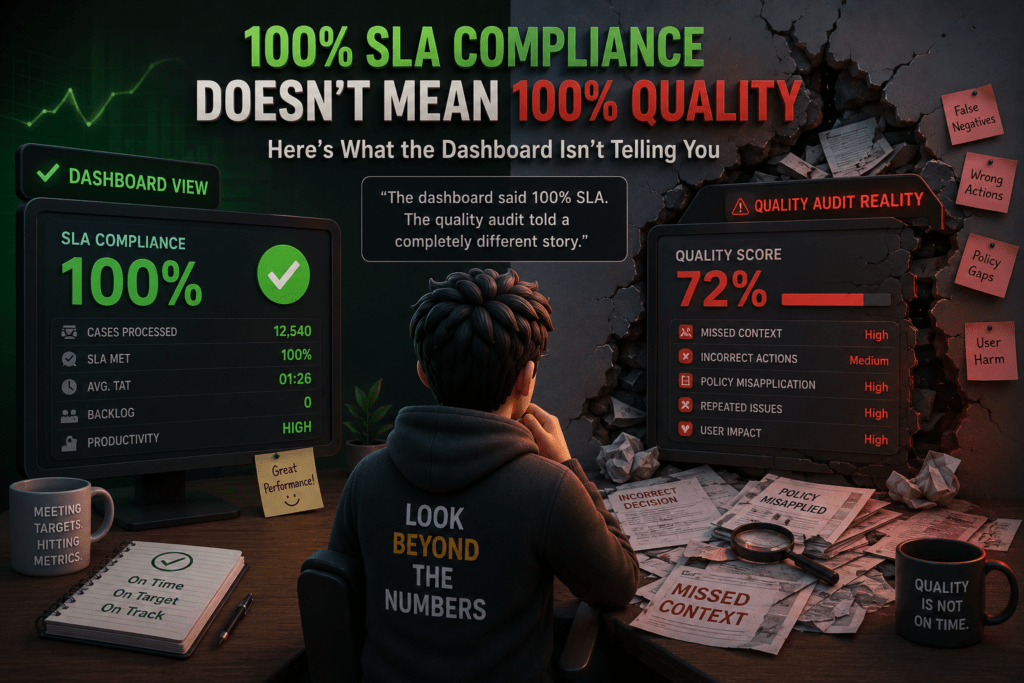
📊 The Week Everything Looked Perfect — Until It Didn’t
Let me take you back to a specific week that changed how I think about operational success.
By every measurable standard, our operation was running beautifully. No delayed queues. Every report handled within the agreed turnaround time. Escalations were low. Backlogs disappeared before the end of every shift. As the operations manager that week, it felt genuinely satisfying. The dashboards looked exactly the way clients want them to look.
Then our Quality team completed the weekly audit.
The results weren’t catastrophic. There was no major incident, no client escalation, no public platform failure.
But what the audit revealed was quietly significant.
Several decisions showed inconsistent policy interpretation across the team. A handful of borderline cases had been closed immediately when they should have been escalated for deeper review. Some reviewers had applied policy correctly and thoughtfully. Others had interpreted nearly identical situations in noticeably different ways.
Nothing triggered an alarm. But one question started circling in my mind that I couldn’t let go of:
If every case was completed on time — why weren’t all the decisions equally strong?
That question permanently changed how I evaluate what operational success actually means.
⏱️ What SLA Actually Measures — And What It Doesn’t
Here’s where I see organizations make a consistent, costly mistake.
They treat SLA compliance as a proxy for overall operational excellence.
It isn’t.
SLA measures something very specific: time.
It answers questions like — Did we review reports within the agreed timeframe? Did queues stay under control? Did users receive timely action on their reports?
These are genuinely important questions. On platforms where harmful content spreads rapidly, delays cause real damage. Victims wait longer for relief. Scams stay active. Abusive content reaches more people. Fast moderation genuinely protects users — I’ve never doubted that.
But here’s what SLA tells us almost nothing about:
- Whether the reviewer actually understood the context of the case
- Whether policy was interpreted consistently across the team
- Whether a borderline decision was escalated or quietly closed
- Whether a coordinator behavior pattern was recognized or missed entirely
- Whether the decision made at speed was the right decision
Speed and quality are related. They are not the same thing.
And treating them as equivalent is one of the most common — and most consequential — mistakes in Trust & Safety operations.
⚡ The Danger of “Flow Mode” — A Shift I’ll Never Forget
During one particularly high-volume period, our team entered what I’ve come to call “flow mode.”
Everyone understood volume was climbing. Everyone knew SLA mattered. Reviewers became exceptionally efficient — cases moved fast, queues stayed healthy, productivity numbers looked outstanding. From the outside, it looked like the operation had reached peak performance.
Then borderline cases started appearing in the queue.
Not obvious violations. Not clear false reports. The kind of content where context determines absolutely everything — where the right answer requires pausing, reading surrounding signals, and making a genuinely considered judgment.
But the team had built momentum. A rhythm. A pace.
And instead of adjusting that pace for cases that demanded more, many reviewers kept moving at the speed they’d established earlier in the shift.
It wasn’t carelessness. It wasn’t indifference. It was momentum becoming automatic.
When the quality review came back later that week, it revealed several decisions that technically followed policy — but had completely overlooked context that would have changed the outcome.
Momentum is a powerful asset in high-volume operations. It becomes a liability the moment it stops being a choice.
🔍 The Case That Needed Five Extra Minutes
I want to share a specific review from my own experience that illustrates this more clearly than any framework could.
A report came in that looked, at first glance, almost identical to hundreds I had reviewed that same week. Most reviewers — including me, initially — would have completed it in under a minute and moved on.
But something felt slightly inconsistent. Nothing I could immediately name. Just enough uncertainty to justify one more look.
So I opened related reports. Checked previous enforcement history on the account. Compared linked profiles. Reviewed surrounding activity from the same time window.
Those five additional minutes completely changed my understanding of what I was looking at.
What had appeared to be a single, isolated policy violation was actually one piece of coordinated abusive behavior spanning multiple accounts — a pattern that would have continued unchallenged if the case had been closed quickly and the queue kept moving.
Had I optimized for SLA alone, I would have finished faster.
I would also have missed something that mattered far beyond that one case.
Sometimes five minutes of deeper review protects thousands of future users. That value never appears on a dashboard.
👥 Why Teams Naturally Drift Toward Speed
One pattern I’ve observed consistently across my career is this:
Reviewers respond to whatever leadership visibly emphasizes most.
When daily huddles focus primarily on SLA numbers, people think about speed.
When productivity dominates every conversation, people process more cases.
When quality receives genuine, consistent attention, people become more thoughtful reviewers.
None of this is a character flaw. It’s human nature. We optimize for what gets measured and recognized.
The challenge is that when managers repeatedly open review calls with “How’s the SLA?” — even with the best intentions — reviewers absorb a subtle but powerful message:
Speed is what matters most here.
Even if nobody ever explicitly says it. Even if quality guidelines are clearly documented. The emphasis of the conversation shapes the behavior of the team.
This is why leadership messaging in Trust & Safety operations carries more weight than most people realize.
🧠 What Experienced Reviewers Know That New Ones Don’t
New moderators often approach their queues with the assumption that every case deserves roughly equal attention and time.
Experienced moderators know this is neither realistic nor correct.
What they develop instead — slowly, through exposure to thousands of edge cases — is something far more valuable:
Selective pacing.
Obvious spam? Fast. Duplicate reports? Fast. Clear impersonation with documented evidence? Fast.
Complex harassment with unusual patterns? Slow down. Possible coordinated abuse across accounts? Investigate. Unusual policy interpretation with real-world implications? Take another look before closing.
The biggest difference between a new reviewer and a seasoned one often isn’t policy knowledge. Both may know the guidelines equally well.
The difference is knowing when to change speed — and having the professional confidence to actually do it even when the queue is growing.
That judgment cannot be trained in a week. It develops through experience, through coaching conversations, and through working in an environment where slowing down on the right case is recognized as a strength rather than a productivity gap.
💼 What Clients Actually Value in the Long Run
Clients ask about SLA because it’s objective, measurable, and immediate. It’s easy to put in a weekly report and discuss on a Monday call.
But long-term partnerships in Trust & Safety aren’t built on SLA numbers alone.
They’re built on trust.
Clients need to know that moderation decisions are consistent, defensible, and scalable — that the team making decisions on their platform understands not just the letter of the policy but the intent behind it.
A moderation operation achieving 98% SLA with consistently strong quality decisions almost always creates greater long-term value than one hitting perfect SLA with inconsistent, shallow enforcement.
The weekly dashboard might not reflect that difference.
The relationship — and the platform’s user trust — eventually will.
🔄 Redefining What Operational Excellence Actually Means
Today, when I review operations health, SLA still matters deeply to me. It always will.
But I’ve stopped treating it as the complete picture of success.
Alongside the speed metrics, I now consistently ask:
- Are reviewers recognizing emerging abuse patterns before they scale?
- Are difficult, borderline cases being escalated appropriately — or quietly closed?
- Is policy interpretation staying consistent across the team and across shifts?
- Does quality hold under pressure — or does it quietly erode when volume climbs?
- Do reviewers feel genuinely supported when they slow down on a case that warrants it?
These questions tell me things about operational health that no turnaround time metric ever could.
🏁 Final Thoughts
100% SLA is something every Trust & Safety team should be proud of achieving.
It reflects real discipline. Careful planning. Strong coordination. A team that shows up and delivers even under pressure.
But it tells only part of the story.
Because content moderation was never simply about moving content through queues efficiently.
It’s about making decisions that protect real people — and good decisions aren’t measured only by how quickly they’re made. They’re measured by whether they remain the right decisions days, weeks, or months after the queue has been cleared and the dashboard has refreshed green again.
The next time you see a report filled with perfect SLA metrics, take a moment to celebrate the achievement.
Then ask one more question:
“Did we simply move fast — or did we actually make the right decisions?”
Because in Trust & Safety, speed keeps the system running.
Quality is what keeps users trusting it.
And in the long run, trust is the only metric that truly defines whether we did our job.
💬 Over to You
Have you ever worked in an operation where SLA numbers looked perfect but something still felt off? How did your team balance speed and quality under pressure? Share your experience in the comments.
📚 You Might Also Like
- Meeting SLA vs. Doing the Right Thing: A Trust & Safety Insider’s Honest Take
- SLA Pressure: The Invisible Force Behind Every Trust & Safety Decision
- Are We Over-Moderating the Internet? An Insider’s Honest Reflection
Categories: Trust & Safety | Content Moderation | Operations Leadership | Quality Assurance | Digital Policy
Tags: Trust and Safety SLA Compliance Content Moderation Quality Operations Management Moderation Leadership Digital Safety Quality vs Speed T&S Professionals Platform Safety Content Review