“The hardest part of content moderation isn’t the volume. It’s understanding what words actually mean to the people reading them.”
Introduction
When most people imagine the challenges of content moderation, one thing dominates the conversation.
Scale.
Billions of posts. Millions of videos. Endless comment threads. New content uploaded every single second across every major platform.
And yes — scale is a genuine, significant challenge. Platforms invest enormously in automation, workforce planning, and moderation infrastructure just to keep pace with the volume.
But after more than a decade working inside Trust & Safety operations — reviewing content, leading moderation teams, and navigating complex policy decisions — I’ve reached a different conclusion about where the real difficulty lives.
Volume isn’t the hardest part of moderation.
Language is.
More specifically — regional languages.
And if you’ve never worked inside this space, you might not realize just how deeply that statement is true.
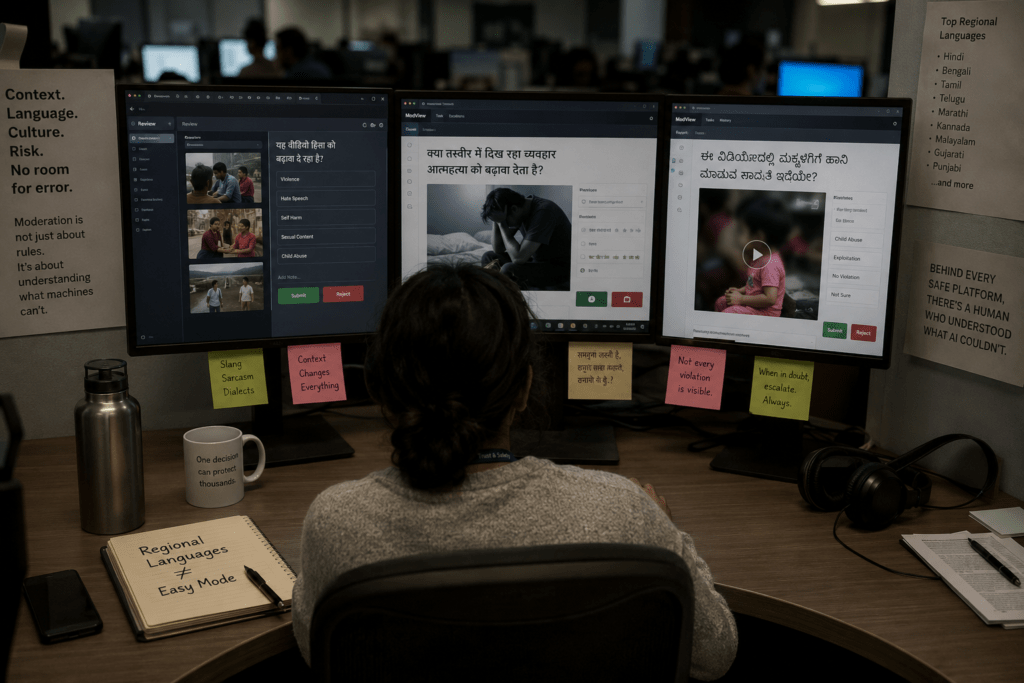
🌍 Language Is More Than Vocabulary
I’ve worked on projects where English-language moderation felt relatively manageable — clear policy matches, consistent enforcement, well-trained detection systems.
Then the same policy would need to be applied to regional language content.
And everything became more complicated.
Because language isn’t just vocabulary. It isn’t just grammar rules or dictionary definitions.
Language is culture. History. Identity. Humor. Emotion. Politics.
Sometimes all of those exist simultaneously inside a single sentence.
What looks completely harmless after translation may be deeply offensive to the community reading it in its original form.
What appears aggressive on the surface may simply be the way close friends talk to each other in that region.
What an AI system sees as random text may be a coded phrase that an entire community immediately recognizes as a call to harass someone.
This is why regional language moderation remains one of the most underestimated and underresourced challenges in the entire Trust & Safety industry.
🗣️ The Day Translation Failed Us Completely
Let me share a specific experience that I still think about regularly.
During a moderation review session, our team was discussing a piece of regional-language content that had been reported by users.
One reviewer translated the sentence into English and read it aloud.
On paper? Completely harmless. No profanity. No explicit threat. No obvious hate speech markers. Based purely on the translated version, the content looked entirely safe to action.
Then a native-speaking reviewer in the room said quietly:
“This isn’t harmless at all.”
The room went still.
The native reviewer explained that the sentence contained an old cultural expression — one that, when used in this specific context, was a well-known sarcastic insult directed at a particular community. The kind of phrase that every person from that region would immediately recognize, but that anyone outside it would completely miss.
The literal translation had preserved every single word.
But it had stripped away every layer of meaning.
Translation can explain language. It cannot always explain culture.
That afternoon fundamentally changed how I thought about regional moderation — and about what we actually owe to the communities we’re trying to protect.
📖 Why the Same Word Can Mean Completely Different Things
One of the most persistent misconceptions about content moderation is the idea that words have fixed, stable meanings.
They don’t.
The same sentence — the exact same words in the exact same order — can communicate affection, sarcasm, humor, anger, threat, or deep disrespect depending entirely on context.
Take regional languages across India as an example I’ve worked with directly.
A word used casually and affectionately among close friends from the same community can sound deeply offensive when directed at a stranger. The exact same phrase that’s playful banter inside one cultural group can be considered a serious insult somewhere else — sometimes just a few hundred kilometers away.
I’ve personally watched experienced reviewers spend fifteen minutes debating a single sentence — not because they didn’t understand the words, but because the cultural meaning behind those words was genuinely contested even among people who spoke the language fluently.
Fluency and cultural understanding are not the same thing. And in Trust & Safety, that difference matters enormously.
🗺️ Dialects Make Everything More Complicated
Here’s something that surprises people outside the industry: even within a single regional language, moderation becomes deeply complicated.
Dialects evolve differently across geography. A phrase that’s completely neutral in one state may carry offensive weight in a neighboring one. An expression that’s harmless in one city can become politically charged in another — sometimes for reasons rooted in events from decades ago.
I once worked on a project where we had reviewers supporting multiple dialects within the same language family.
What struck me wasn’t disagreement between native speakers and outsiders.
It was disagreement between two native speakers — both of whom were right from within their own regional experience.
Neither was wrong. Their cultural frames of reference were simply different.
That’s how complex regional moderation actually is — and why no single policy document can ever fully capture it.
⚡ Slang Evolves Faster Than Any Detection System Can Follow
One thing I’ve always respected about online communities — even while trying to moderate them — is their extraordinary creativity.
Unfortunately, bad actors are just as creative.
Every time a platform successfully detects and blocks a specific abusive term or phrase, communities that want to evade detection simply invent new versions:
- Different spelling or intentional typos
- Numbers replacing letters
- Emojis substituting key words
- Inside jokes only community members understand
- Coded phrases that look meaningless to outsiders
Regional language slang evolves at a pace that formal detection systems simply cannot match. By the time a moderation team has identified a pattern and updated their systems, a new variation has already emerged and spread.
I’ve personally reviewed harassment campaigns built almost entirely around words and phrases that were technically not offensive by any definition in our policy documentation — until you understood exactly how that specific online community was using them in that specific context at that specific moment.
Moderation isn’t dictionary matching. It’s continuous cultural learning — and the learning never stops.
🤖 Why AI Struggles With Regional Languages
Artificial intelligence has become genuinely impressive at detecting obvious violations — particularly in widely spoken, well-resourced languages.
English is the clearest example. AI models trained on English content benefit from massive datasets, millions of labeled examples, years of optimization, and continuous feedback loops. The results, while imperfect, are reasonably robust.
Regional languages rarely have that advantage.
Some have limited publicly available training data. Others contain dozens of distinct dialects with their own vocabularies and expressions. Many online communities switch fluidly between languages within a single sentence — combining regional language grammar with English vocabulary, Roman script, local slang, and internet abbreviations all at once.
To a human reviewer who grew up inside that culture, the sentence makes immediate, complete sense.
To an automated system encountering it for the first time, it can be genuinely incomprehensible.
The result? AI either misses harmful content entirely — or incorrectly flags completely harmless cultural expression as a violation.
Neither outcome serves the users we’re supposed to be protecting.
🔍 A Case Where the Words Said One Thing and Meant Another
One experience from my career illustrates this more clearly than any explanation could.
A user reported a comment that, after translation, appeared to reference nothing more than an animal.
A simple word. No context that would flag any automated system. Nothing that would raise concern during a standard review.
But several regional reviewers on our team immediately recognized it as a well-established coded insult targeting a specific community — one with a history rooted in local tensions that went back years.
Without that cultural knowledge in the room, the content would never have been actioned.
The words themselves weren’t violating.
The cultural meaning was entirely violating.
And that’s the core difference between moderation and translation:
Moderation asks — “What does this actually mean to the people reading it?”
Not simply — “What do these words literally say?”
🖼️ Why Regional Memes Are Even Harder
If regional language text is complex, regional memes add an entirely different layer of difficulty.
A simple image can reference local politics, historical conflicts, regional stereotypes, specific television dialogue, sports rivalries, or community tensions that only make sense if you have years of cultural context.
To someone outside that community, it looks like a harmless or even funny image.
To someone inside it, it communicates something completely different — sometimes something deeply harmful.
I’ve reviewed memes where understanding the actual message required knowing a specific film that was released more than a decade ago and the political controversy that surrounded it at the time.
Without that knowledge, moderation isn’t just difficult.
It becomes educated guesswork — and guesswork isn’t good enough when real communities are at risk.
👤 Why Native Reviewers Are Irreplaceable
This brings me to what I consider one of the most important lessons my career has taught me:
You cannot replace native cultural expertise with language fluency alone.
Someone can speak a regional language with technical proficiency — correct grammar, accurate vocabulary, smooth translation — and still completely miss:
- The local humor that inverts meaning
- The political reference that changes everything
- The historical sensitivity that makes a phrase deeply painful
- The community tension that gives a specific word its power
Experienced native reviewers aren’t simply translating content.
They’re interpreting meaning. And in Trust & Safety, meaning is the entire job.
🔧 What Actually Improves Regional Moderation Quality
Over the years, I’ve seen several practices make a measurable difference:
Regional examples in policy documentation — Real, locally-grounded examples resonate far more than literal translations of English-language policies. People understand scenarios. They remember context.
Continuous language update sessions — Regional slang evolves constantly. Teams need regular knowledge-sharing where reviewers discuss new phrases, emerging coded language, and shifting community behavior. This isn’t a quarterly update — it’s an ongoing practice.
Cross-team collaboration on gray areas — The strongest moderation decisions I’ve been part of happened through discussion. One reviewer flags unusual wording. Another recognizes the cultural reference. A third identifies the pattern. Together they reach a decision no individual could have reached alone.
Human review on culturally ambiguous content — Automation handles obvious violations efficiently. Regional language gray areas — cases where culture, history, humor, and politics all intersect — consistently require human judgment.
🏁 Final Thoughts
The internet feels global.
Online harm is often deeply, specifically local.
A platform can build world-class moderation infrastructure, invest in powerful AI, and develop comprehensive policy frameworks. But if it fails to genuinely understand regional languages — not just translate them, but understand them — users in those communities will consistently experience weaker, less reliable protection.
After more than a decade in Trust & Safety, one truth has stayed with me above all others:
Content moderation isn’t really about words.
It’s about understanding what those words mean to the people reading them — in their language, in their culture, in their community, in this specific moment.
Because protecting users isn’t simply a translation exercise.
It’s a cultural understanding exercise.
And in Trust & Safety, that understanding is often the difference between making a technically correct decision — and making the right one.
💬 Over to You
Have you ever experienced content moderation that missed something obvious within your regional community? Or seen cultural context get completely lost in translation? Share your experience in the comments — these perspectives help the industry improve.
📚 You Might Also Like
- Meeting SLA vs. Doing the Right Thing: A Trust & Safety Insider’s Honest Take
- Are We Over-Moderating the Internet? An Insider’s Honest Reflection
- SLA Pressure: The Invisible Force Behind Every Trust & Safety Decision
Categories: Trust & Safety | Content Moderation | Regional Languages | Digital Policy | Operations Leadership
Tags: Trust and Safety Regional Language Moderation Content Moderation Cultural Context Digital Safety AI Moderation Limitations T&S Leadership Multilingual Moderation Platform Safety False Positives