“There’s a clock running in every Trust & Safety operation. You don’t always see it — but you feel it in every decision you make.”
Introduction
There’s a clock running in every Trust & Safety operation.
You don’t always see it on your screen. But you feel it — in every case you open, every decision you make, and every second you pause to think.
That clock is your SLA — your Service Level Agreement.
And if you’ve ever worked in content moderation, you know exactly what I mean.
What Is SLA Pressure — And Why Should You Care?
SLA, or Service Level Agreement, defines how quickly content must be reviewed, escalated, or resolved. On paper, it’s a performance metric.
In practice? It becomes something far more powerful.
It becomes a behavior driver.
For anyone outside Trust & Safety, this might sound like a simple efficiency tool. But for professionals inside the field — reviewers, team leads, and operations managers — SLA is the silent force shaping every single decision made across a shift.
And that’s exactly what this blog is about.
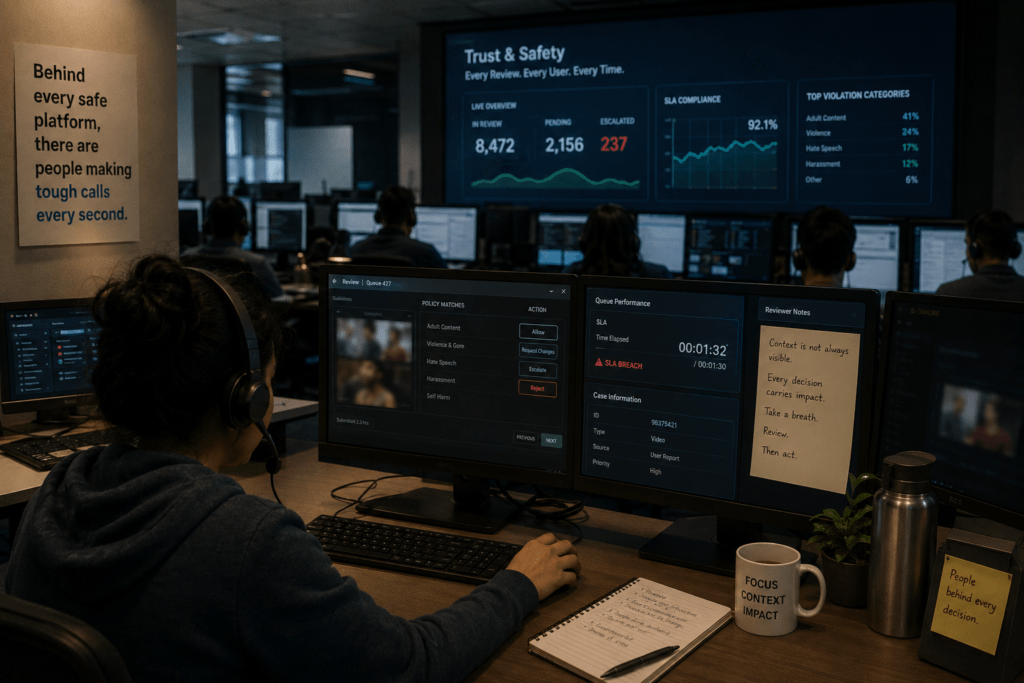
📌 The First Thing You Actually Learn on the Job
When I joined my first Trust & Safety team, I was trained on policies, violation categories, escalation workflows, and platform guidelines.
But the first thing I felt wasn’t any of that.
It was pace.
Within the first few hours, questions hit me that no training document had prepared me for:
- How quickly should I be deciding?
- What happens if I take too long?
- Is a 90-second case too slow?
These questions arrived before I even felt confident in policy. And I’ve watched it happen with every new reviewer I’ve trained since.
The clock gets into your head before the guidelines do.
This is the first — and most underestimated — way SLA pressure operates. Silently. Invisibly. From day one.
🔴 A Real Shift: When the Dashboard Turns Red
Let me paint you a picture.
It’s mid-afternoon on a Tuesday. Volume spikes unexpectedly — a viral content event triggers a flood of reports. The dashboard, which had been comfortably green, starts turning amber.
Then red.
Queue timers shrinking. Backlogs climbing.
I could feel the energy shift in the room. Conversations shortened. Decision pace quickened. Everyone leaned a little closer to their screens.
Here’s where it gets complex.
Not all content respects your SLA urgency.
During that exact shift, I opened a case that looked — at first glance — like a routine policy violation. The kind you see dozens of times a day. But something felt slightly off. The account behavior. The timing. The pattern of content.
In that moment, I faced the question every Trust & Safety professional knows but rarely talks about openly:
“Do I slow down and risk the queue — or move fast and risk missing something critical?”
I paused. Took the extra time.
What appeared to be a single violation turned out to be part of a coordinated inauthentic behavior campaign. We escalated. Took platform-wide action.
From an SLA standpoint — that case was slow.
From an impact standpoint — it was one of the most important decisions of that shift.
⚠️ The Subtle Behavioral Shifts Nobody Talks About
Here’s what years of managing moderation teams has taught me:
SLA doesn’t just change timing — it changes thinking.
Over time, I noticed patterns in how sustained pressure quietly reshapes reviewer behavior:
1. Reviewers Gravitate Toward “Safe” Decisions
When time is tight, the instinct is to choose the most defensible outcome — not always the most accurate one.
2. Borderline Cases Get Less Attention
The ambiguous cases — the ones that actually need deeper analysis — often receive the least time, precisely because they’re harder and slower.
3. Peer Discussions Get Skipped
Consultation that improves decision quality gets cut when queues are heavy.
None of this happens because reviewers don’t care.
It happens because they’re human beings operating under sustained pressure.
📊 When “High Performance” Becomes a Warning Sign
Here’s a counterintuitive truth I learned the hard way.
There was a period where our team was delivering exceptional SLA numbers. Green across the board. Turnaround times our clients loved. Management was happy.
Then we ran a quality audit.
What we found wasn’t catastrophic — but it was telling.
A cluster of edge cases had been handled too quickly. Not incorrectly in a way that caused immediate harm. But without the depth they deserved.
No major escalation. No headlines.
But it was a clear signal:
Strong SLA numbers with declining quality depth is not a success story. It’s an early warning.
🧠 The Mental Load That Nobody Measures
SLA pressure isn’t just operational — it’s psychological.
During a heavy shift, a reviewer isn’t just processing content. They’re simultaneously:
- Tracking their own pace against invisible expectations
- Estimating how long each case “should” take
- Adjusting speed in real time based on queue movement
That cognitive load is exhausting in a way that standard metrics never capture.
I’ve had shifts where the content itself was manageable — but the constant awareness of time made the day genuinely draining.
Because every case carries two questions:
What is the right decision?
How quickly can I make it?
And those two questions are often in direct conflict.
💬 What I Tell My Team — And What Every Leader Should
When I work with team members under SLA pressure, my conversations stopped being about speed a long time ago.
The most valuable coaching moments I’ve had were about three things:
① Recognizing which cases deserve more time
And having the confidence to take it — without guilt.
② Understanding that slowness on one case isn’t failure
Sometimes it’s the exact right call.
③ Knowing that experienced judgment looks like speed — but isn’t
Real accuracy comes from internalizing policy deeply enough that complex decisions happen efficiently. Not from rushing.
A team that knows when to slow down consistently outperforms a team that is simply fast.
🔄 Rethinking What SLA Really Measures
SLA keeps the system running. It ensures fairness, prevents backlogs, and maintains accountability.
But SLA alone cannot measure the quality of a decision.
It measures whether a decision was made.
Trust & Safety is not a content processing function.
It is a decision-making function.
And good decisions — especially on high-risk, nuanced, or coordinated harm cases — sometimes require space that a timer doesn’t account for.
The most dangerous version of SLA culture is one where reviewers feel that taking time equals underperforming.
Because in that environment, the cases that most need depth are the ones most at risk of being rushed.
✅ Final Thought: The Decision You Chose Not to Rush
Most users will never know what SLA is.
Most clients will see the numbers — not the moments behind them.
But if you work in Trust & Safety — as a reviewer, team lead, quality analyst, or operations manager — you live with this pressure every single day.
My philosophy, built across 11 years in this field, is simple:
Let SLA keep the system moving. Don’t let it control every decision.
Because in this work, being fast matters.
But being right — especially when it matters most — matters more.
And sometimes, the most important decision you’ll ever make…
…is the one you chose not to rush.
You Might Also Like
- Feedback Delays Are More Dangerous Than Negative Feedback
- What Nobody Tells You About Leading a Content Moderation Team
- Quality vs. Speed: The Trade-Off Every Reviewer Faces
Categories: Trust & Safety | Content Moderation | Operations Leadership
Tags: Trust and Safety Content Moderation SLA Management Digital Safety Moderation Teams T&S Leadership Operations Management Quality vs Speed Content Review
💡 If this resonated with you, share it with someone in the Trust & Safety space. The more we talk openly about these challenges, the better this industry gets.