“In Trust & Safety, speed is measured in seconds. But the impact of every decision lasts far longer.”
In Trust & Safety, time is always ticking.
Introduction
You open your dashboard.
The first thing you notice isn’t the content waiting for review.
It’s the timer.
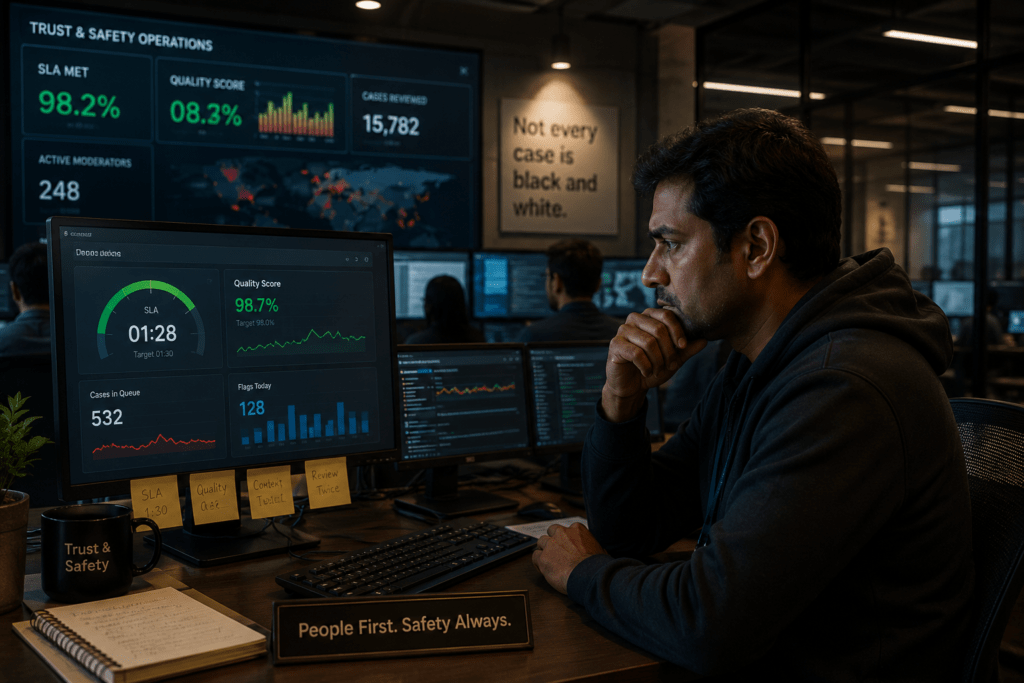
SLA is counting down. The queue is growing. Operations wants the backlog cleared. Your manager is watching productivity numbers. And somewhere in the middle of all that pressure, you’re expected to make decisions that protect millions of real people.
On paper, the job looks straightforward:
Review content. Apply policy. Take action. Move to the next case.
But after spending more than a decade in Trust & Safety operations, I’ve learned something that no dashboard will ever measure:
Sometimes the most valuable decision you’ll make is the one that takes the longest.
And that’s where the real challenge begins.
📋 Why SLA Matters — And Why It Isn’t the Whole Story
Let me be clear from the start.
SLA is not the enemy.
Without Service Level Agreements, moderation operations would collapse into chaos. Imagine a platform receiving millions of reports every single day with zero time accountability:
- Harmful content stays live for hours or days
- Critical abuse cases sit unnoticed in growing queues
- User trust in the platform quietly erodes
- Bad actors learn exactly how long they can operate freely
I’ve personally managed queues where even a thirty-minute delay created thousands of pending reviews cascading into the next shift. Speed genuinely matters. It protects people in real time.
But here’s what years of operational experience taught me:
Speed is a critical part of the job. It is not the entire job.
And the moment a team starts treating those two things as the same, the quality of decisions begins to quietly deteriorate.
🔴 The Day a “Simple” Case Wasn’t Simple At All
Let me take you back to a specific afternoon that permanently changed how I think about performance.
Our queue was unusually busy. Volume had spiked because of an ongoing online trend, and the entire team was laser-focused on keeping the dashboard green. Cases were moving fast. Most reviews were taking only a few seconds each.
Then one piece of content appeared on my screen.
At first glance? Completely ordinary.
No explicit violation. No obvious flagged keywords. No graphic imagery. Any reviewer moving at full speed would likely have approved it within seconds and moved on.
But something felt off.
The account history looked unusual. The posting pattern had a coordinated feel to it. The specific wording matched something I had reviewed earlier that same week in a completely different queue.
Instead of closing the case and maintaining my pace, I spent extra time pulling related signals — account behavior, linked profiles, posting timestamps, content similarities across accounts.
That decision pushed my handling time well beyond the expected SLA.
But what emerged from those extra minutes was impossible to ignore.
This wasn’t an isolated post. It was one piece of a coordinated campaign — multiple accounts posting nearly identical content with slightly different wording, deliberately designed to evade automated detection by looking harmless individually.
Had I treated it like every other case in that busy queue, the entire pattern would have remained invisible. The campaign would have continued. The harm would have scaled.
On the dashboard that afternoon, I looked slower than everyone else.
Operationally, it was one of the most important decisions of that shift.
That experience completely redefined what “performance” meant to me in this profession.
📊 What the Numbers Measure — And What They Miss
Operations dashboards are genuinely powerful tools.
They tell us how many cases were completed, average handling time, SLA compliance rate, queue health, and individual productivity.
What they don’t — and can’t — tell us is equally important:
- Did the reviewer actually understand the context behind the content?
- Did they notice coordinated behavior hiding across multiple accounts?
- Did they identify an emerging abuse trend before it scaled?
- Did they escalate a case that prevented a platform-wide crisis?
These decisions rarely appear in weekly performance reports.
Yet they consistently create the biggest real-world impact.
A dashboard shows you activity. It doesn’t show you judgment.
And in Trust & Safety, judgment is everything.
⚡ When Speed Becomes a Habit — And Why That’s Risky
Here’s something I’ve watched happen across every moderation team I’ve ever worked with.
After reviewing thousands of cases, speed becomes muscle memory. Reviewers naturally start pattern-matching at pace. They recognize familiar violation types instantly. They move efficiently through queues.
That’s genuinely a strength — and it’s how experienced teams handle volume without burning out.
But it carries a hidden risk that’s easy to miss until something goes wrong.
Once your brain enters full “processing mode,” everything starts looking familiar.
The question subtly shifts from:
“What’s different or unusual about this case?”
to:
“Which policy bucket does this fit?”
That shift changes everything.
The goal quietly becomes finishing the case rather than understanding it.
And that’s exactly when the most consequential mistakes begin — not from lack of knowledge, but from momentum overriding judgment.
🔍 A Borderline Decision That Needed More Than Policy Knowledge
One review still stands out clearly in my memory.
The content technically matched an enforcement category. The SOP pointed toward a clear action. Most reviewers in my team would likely have reached the same conclusion quickly.
But something made me pause and read the surrounding conversation thread.
The post wasn’t encouraging harmful behavior.
It was documenting it.
Without that context, the enforcement action would have been technically correct by policy.
With that context, it would have been completely wrong — and potentially harmful to the very person the platform should have been protecting.
The difference between those two outcomes wasn’t deeper policy knowledge.
It was taking an extra minute to actually understand the situation before acting.
That minute doesn’t improve your SLA metrics.
It improves trust — and trust is what this entire profession is built on.
🧠 The Invisible Pressure Every Moderator Understands
Every Trust & Safety professional knows this feeling, even if they’ve never said it out loud.
You don’t need a manager reminding you to move faster every five minutes.
The timer does that. The queue size does that. The productivity dashboard does that.
I’ve caught myself mid-review thinking, “I’ll just finish this quickly” — not because I didn’t care about accuracy, but because the operational pressure was genuinely real and constant.
That’s the most difficult part of this profession that nobody outside it fully understands.
Most moderation mistakes don’t happen because reviewers lack knowledge or don’t care about quality.
They happen because competing priorities create impossible choices in real time.
Do I investigate this further?
Or do I keep the queue moving?
Neither answer feels entirely comfortable. And there’s rarely enough time to feel certain before you have to decide.
👥 Leading Teams Beyond the Dashboard
When I moved into leadership, one insight reshaped how I approached managing people.
Teams naturally optimize for whatever leaders visibly celebrate.
If leadership conversations focus exclusively on SLA compliance, reviewers become faster — and only faster.
If conversations focus exclusively on quality scores, reviewers become more cautious — sometimes paralyzingly so.
But if leadership conversations focus consistently on thoughtful decision-making, reviewers start developing the judgment to know which cases deserve speed and which ones deserve patience.
Some of the most valuable coaching conversations I’ve had with team members weren’t triggered by mistakes or missed metrics.
They started with simple, genuine questions:
“What made you pause on that case?”
“What additional signal caught your attention?”
“Why did you decide this needed escalation rather than standard action?”
Those conversations build something no training module can install directly:
Operational judgment. And judgment is the one thing a stopwatch cannot measure.
⚖️ When Slowing Down Is the Most Responsible Decision
There are specific situations in Trust & Safety where taking extra time isn’t optional — it’s the professional standard.
These include:
Coordinated behavior patterns — Content that appears linked across multiple accounts requires cross-signal analysis that takes time.
Borderline policy interpretations — Cases that sit at the edge of policy categories deserve careful reading, not fast assumptions.
Emerging abuse trends — Recognizing a new pattern early requires pausing to ask whether this case looks like anything you’ve seen before.
Sensitive cases involving vulnerable users — Reports involving minors, self-harm signals, or targeted harassment warrant extra care regardless of queue pressure.
Cases with significant public interest — High-visibility situations where a wrong decision could create platform-level consequences.
Rushing through any of these simply because the timer is running doesn’t just risk a wrong outcome.
It defeats the entire purpose of having a Trust & Safety function in the first place.
💡 The Lesson I Still Carry Into Every Shift
After years in this profession, one truth has stayed with me more than any metric or performance framework:
Fast decisions feel productive. Thoughtful decisions create lasting impact.
Most users will never know how quickly a moderator reviewed their report. They will never see the timer, the queue size, or the productivity dashboard.
They only ever experience the outcome:
Was the harmful content actually removed?
Was their appeal handled with fairness and care?
Did the platform genuinely protect them when it mattered?
That’s what builds real trust. Not milliseconds.
🏁 Final Thoughts
SLA will always matter in Trust & Safety operations. It prevents dangerous backlogs. It creates accountability. It ensures harmful content doesn’t remain live while reports pile up unreviewed.
But it should never become the sole definition of what success looks like in this work.
Because Trust & Safety is not a manufacturing line where every task is identical and every output is equivalent.
Every single decision affects a real person — someone experiencing harassment, someone documenting injustice, someone simply trying to share their voice in a space that should be safe.
Our responsibility is bigger than meeting a timer.
It’s making decisions that remain correct long after the dashboard has refreshed and the shift has ended.
I’ve stopped ending my shifts by asking “Did I finish every case on time?”
Instead, I ask something that matters far more:
“If someone reviewed my decisions six months from now — would I still believe they were the right ones?”
Because in Trust & Safety, speed keeps the operation running.
But judgment is what keeps people safe.
And if I ever have to choose between being remembered for hitting an SLA or making the right call — I know exactly which one defines a real Trust & Safety professional.
💬 Over to You
Have you ever faced a moment in your work where doing the right thing meant slowing down? How did you handle the pressure? Share your experience in the comments — these conversations matter.
📚 You Might Also Like
- SLA Pressure: The Invisible Force Behind Every Trust & Safety Decision
- Are We Over-Moderating the Internet? An Insider’s Honest Reflection
- Feedback Delays Are More Dangerous Than Negative Feedback
Categories: Trust & Safety | Content Moderation | Operations Leadership | Digital Policy
Tags: Trust and Safety SLA vs Quality Content Moderation Moderation Leadership Digital Safety Operations Management T&S Professionals Decision Making Platform Safety Content Review