When the job evolves overnight — but the team size stays exactly the same
“Team size remains unchanged.”
Introduction
It’s a line that appears in planning decks, client calls, and quarterly reviews with remarkable regularity.
On paper, it sounds reassuring. Stable. Predictable. Efficient. A sign that operations are mature and under control.
But anyone who has spent real time working inside Trust & Safety operations knows exactly what that line can hide.
Because while headcount stays the same, the work almost never does.
Policies expand. Content evolves. Risk levels shift. Edge cases multiply. And the gap between what the numbers suggest and what the team is actually experiencing quietly widens — until it shows up somewhere that’s much harder to ignore.
After more than eleven years in Trust & Safety operations, I’ve watched this gap open up across multiple projects, multiple teams, and multiple client environments. And I’ve learned that the consequences of ignoring it are real, measurable, and entirely avoidable — if leadership is willing to ask the right questions.
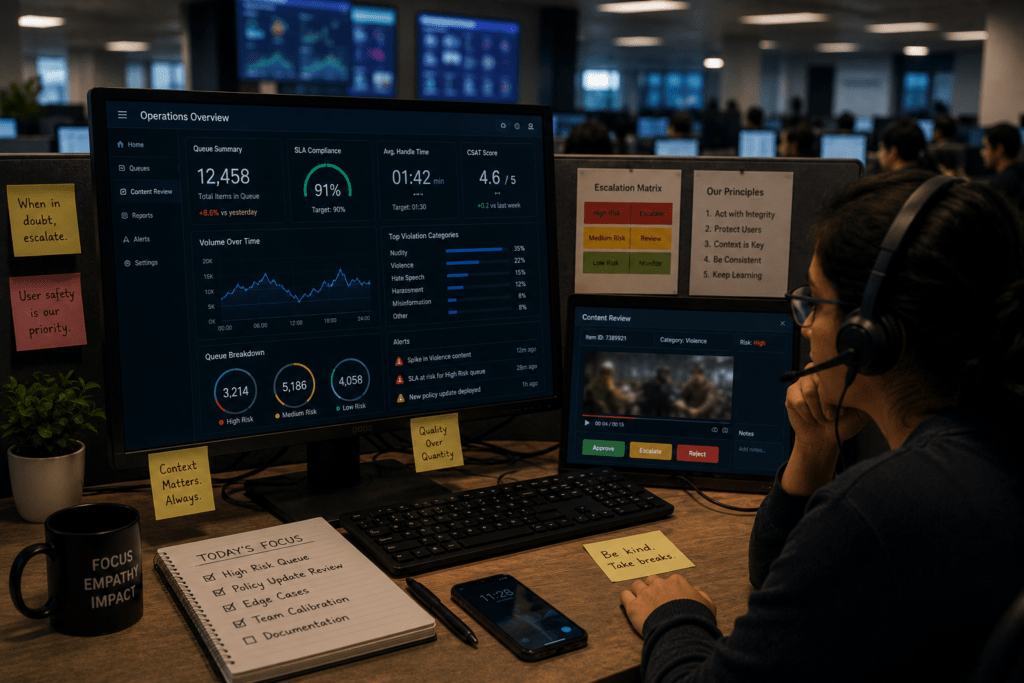
🏢 The Illusion of Stability
At first glance, maintaining the same FTE count over time looks like operational maturity.
No reactive hiring. No scaling concerns. No budget conversations. Just a steady, predictable team delivering consistent outputs.
But stability in headcount is not the same thing as stability in workload.
I’ve been part of projects where, within the span of just a few weeks, the nature of the work transformed significantly:
- Content types evolved into more nuanced, context-dependent categories
- Policy scope expanded to cover new violation types and emerging threats
- Edge cases increased in both frequency and complexity
- The risk associated with getting decisions wrong grew substantially
And through all of that — the team size remained exactly the same.
From the outside, looking at a headcount report, nothing had changed.
From the inside, sitting with the team reviewing cases every day, everything had changed.
📋 A Real Scenario: Same Team, Completely New Complexity
Let me walk you through a specific situation from my own experience that illustrates this more clearly than any framework could.
There was a phase in one of our projects where overall volume didn’t increase in any significant way. Queue sizes looked manageable. Incoming report numbers were within normal range. From a pure capacity planning perspective, everything appeared fine.
But the nature of the content had shifted.
Where the majority of cases had previously been relatively straightforward — clear violations or clear approvals that experienced reviewers could handle efficiently — the queue began filling with borderline content. Cases that required deeper reading, additional context, cross-referencing with related reports, and genuine judgment calls rather than pattern matching.
The number of cases hadn’t increased.
The effort required per case had.
And that distinction — invisible in any headcount report — is where the strain began building across the team.
⏱️ When Handling Time Quietly Expands
Most workforce planning models in client operations assume a consistent average handling time per case.
It’s a reasonable assumption when work is stable. But in Trust & Safety, handling time is not a fixed variable. It responds directly to content complexity, policy evolution, and the volume of contextual analysis each case requires.
I’ve personally watched this shift play out in real time:
A case that previously took twenty seconds to review starts taking a full minute because it requires checking account history, related reports, and posting patterns before a confident decision can be made.
A decision that used to be individual becomes a quick team discussion because the content sits in a genuinely grey area that policy doesn’t yet address clearly.
A routine review triggers an escalation because something about the pattern doesn’t match what the team has seen before — and the right call is to get more eyes on it.
Now multiply that across hundreds of cases per shift, across an entire team, across weeks.
Same number of people. Meaningfully less actual capacity. And a growing gap between what the metrics show and what the team is experiencing.
🔄 The Silent Trade-Offs Nobody Names Out Loud
Here’s what I’ve consistently observed when workload complexity increases but team size doesn’t: trade-offs begin happening. Not through any deliberate decision. Not because anyone has consciously chosen to cut corners.
But because the system is trying to balance itself under pressure it wasn’t designed to carry.
You start seeing patterns like:
Faster decisions on simpler cases to compensate for time spent on harder ones. Reviewers unconsciously accelerate through the easy cases in their queue, trying to create bandwidth for the complex ones — sometimes moving faster than the straightforward cases deserve.
Less time invested in borderline content. The cases that most need careful analysis start receiving less of it, because the team doesn’t have the capacity to slow down on everything that warrants slowing down.
Fewer internal discussions to maintain pace. The quick calibration conversations between colleagues that prevent misaligned decisions get skipped because there simply isn’t time.
None of this reflects a failure of character or commitment. It reflects a team doing what teams do under sustained pressure — adapting to survive the immediate demand.
But over time, these invisible adaptations affect decision quality in ways that eventually surface in audits, appeals, and client escalations.
📉 A Shift Where the Gap Became Impossible to Ignore
I remember a specific shift that crystallized this issue for me in a way I’ve never forgotten.
From a volume standpoint, the day looked completely normal. No spikes. No major incident driving unusual report volumes. No alerts. Everything appeared manageable on paper.
But the team was noticeably slower than usual.
Not because they were disengaged or underperforming. The effort in the room was visible and genuine. Reviewers were spending more time thinking through cases, cross-checking signals, validating their decisions before committing.
From a metrics perspective that day, productivity appeared to have dipped.
From a reality perspective, the team was working harder than they had been in weeks.
When I looked at what was driving it, the answer was clear — the case mix that day was significantly heavier in complexity than the historical average the productivity targets had been built around.
The numbers hadn’t changed. The work had. And no dashboard was capturing the difference.
🧠 When Expectations Don’t Catch Up With Reality
One of the most damaging dynamics I’ve seen in client operations is when performance expectations remain anchored to conditions that no longer exist.
If a team handled a thousand cases per day under one set of content conditions, the assumption often persists that they should handle a thousand cases under any conditions.
But what if those cases are now more nuanced? What if decisions require deeper analysis? What if the risk profile of getting a case wrong has increased because the content category carries greater harm potential?
Then producing the same output requires considerably more effort.
And without explicitly adjusting expectations to reflect that reality, the pressure on the team becomes invisible to everyone except the people experiencing it.
I’ve watched genuinely strong performers feel like they’re falling short — not because their performance had declined, but because the standard against which they were being measured hadn’t kept pace with the work.
That’s a leadership failure, not a team failure.
💬 What the Team Was Telling Me — and What I Heard
During a period when this gap was widening on one of our projects, I started hearing the same themes come up consistently in conversations with reviewers:
“These cases are taking longer than they used to.”
“I’m double-checking more before I close anything.”
“It feels like I have less time even though the queue volume looks the same.”
Every one of those observations was accurate.
Because the work had changed. The team understood exactly what was happening to their daily experience. They were telling leadership clearly and directly — in the language of their lived experience rather than the language of metrics.
The question was whether leadership was listening in a way that could translate those signals into action.
🔎 The Case That Made the Pattern Visible
There was one specific case during this period that I think about whenever this topic comes up.
On the surface, it appeared routine. The kind of case that could reasonably be closed quickly based on a straightforward policy read.
But the reviewer handling it paused. Spent extra time reviewing related content. Checked posting patterns across linked accounts. Looked at the broader context rather than just the isolated piece of content in front of them.
That case took significantly longer than average handling time would have predicted.
What it revealed was a coordinated behavior pattern that hadn’t yet been formally identified as a trend — one that, once flagged and escalated, informed how the team approached an entire category of similar cases for weeks afterward.
Now consider what would have happened if that reviewer had been operating under so much productivity pressure that slowing down felt professionally risky.
The pattern would have gone undetected. The trend would have continued. And the cost would have appeared later in a form much harder and more expensive to address.
📊 Why FTE Alone Has Never Been the Full Picture
Headcount tells you how many people are working.
It tells you almost nothing about:
- What kind of work those people are actually doing
- How complex the decisions they’re making have become
- How much cognitive effort each case genuinely requires
- How much the risk profile of their decisions has shifted
Two teams with identical FTE counts can have radically different effective capacity depending on the complexity of their content mix and the scope of their policy environment.
I’ve seen this repeatedly across different projects and client environments. The number on the org chart is the same. The operational reality is completely different.
FTE is a starting point for capacity planning. It is not the whole conversation.
🛠️ What Actually Helps When Headcount Can’t Change
Sometimes increasing team size genuinely isn’t an option. Budget constraints are real. Client agreements have structure. Hiring timelines don’t always align with operational needs.
In those situations, the answer isn’t to pretend the gap doesn’t exist. It’s to manage it deliberately:
Better prioritization frameworks — Clear guidance on which cases warrant deep analysis versus which can be handled efficiently, so the team isn’t applying the same level of effort uniformly across all complexity levels.
Explicit calibration on complex case types — Regular, focused sessions specifically on the content categories that are driving increased handling time, so reviewers build shared understanding and reduce decision uncertainty.
Honest expectation-setting with clients — Transparent conversation about how content complexity has evolved and what that means for realistic throughput targets, rather than allowing the gap to surface later through declining quality metrics.
Leadership acknowledgment — Simply naming what the team is experiencing. Recognizing that the work has become harder is not an excuse. It’s the foundation of a credible, honest conversation about what sustainable performance actually looks like.
🏁 Final Thoughts
“Same FTE” sounds like a simple operational fact.
In Trust & Safety, it rarely tells the full story.
Because in this field, work is not static. Content evolves. Policies expand. Threats become more sophisticated. And the complexity of what teams are actually doing on any given shift can look completely different from what it looked like six months ago — even when every headcount report shows exactly the same number.
The next time headcount holds steady through a period of operational change, it’s worth pausing to ask a question that no planning deck will ask on its own:
Has the work stayed the same too?
Because if it hasn’t — and in Trust & Safety, it almost never does — then the team is already living in a different reality than the one the metrics are describing.
And the sooner that gap is named, understood, and addressed, the better the outcomes for the team, the operation, and ultimately the users they’re working to protect.
💬 Over to You
Have you ever experienced a situation where your workload complexity increased significantly but your team size stayed the same? How did your team adapt — and what did leadership get right or miss? Share your experience in the comments.
📚 You Might Also Like
- 100% SLA Compliance Doesn’t Mean 100% Quality — Here’s What the Dashboard Isn’t Telling You
- Zero Errors, Zero Margin: Why Perfection Is an Unrealistic Expectation in Trust & Safety
- Meeting SLA vs. Doing the Right Thing: A Trust & Safety Insider’s Honest Take
Categories: Trust & Safety | Content Moderation | Operations Leadership | Workforce Planning | Client Operations
Tags: Trust and Safety FTE Planning Content Moderation Workforce Management Operations Leadership T&S Professionals Capacity Planning Moderation Quality Platform Safety Team Performance