You’re asked to do both — until reality forces you to choose one
“Can we improve speed without impacting quality?”
Every review call. Every quarter. Like clockwork.
Introduction
It’s one of the most consistent questions in every Trust & Safety review call I’ve ever been part of.
“Can we improve turnaround time without impacting decision quality?”
It sounds completely reasonable. It sounds achievable. With the right tools, the right training, the right workflow optimization — surely both are possible simultaneously.
And the honest answer, after more than eleven years of working inside Trust & Safety operations?
It’s complicated. More complicated than most people in that review call are willing to say out loud.
Because speed and accuracy don’t always move in the same direction. And even in operations that genuinely try to balance both — that invest in training, calibration, workflow design, and quality frameworks — there are real moments when one quietly takes priority over the other.
Not because anyone decided it should.
Because the work itself forced the choice.
That trade-off is real. It’s constant. And the fact that almost nobody names it directly is one of the most significant gaps in how Trust & Safety operations are understood, managed, and measured.
⚡ The Pressure to Deliver Both — Simultaneously
Every Trust & Safety operation is built around two core expectations that exist in permanent tension.
Handle cases quickly — because harmful content spreads fast, queues build rapidly, and SLA compliance is how platforms demonstrate accountability to users and clients alike.
Make correct decisions — because every moderation action affects a real person, wrong decisions create real harm on both sides, and trust in the platform depends entirely on the quality and consistency of enforcement.
Both expectations are legitimate. Both matter enormously. Neither can be abandoned.
But here is the reality that most people don’t say out loud in those review calls:
There is always a trade-off. Always.
The question is never whether speed and accuracy are in tension. They are. The question is how consciously and honestly that tension is being managed — and whether the people closest to the work feel safe acknowledging it when it’s affecting their decisions.
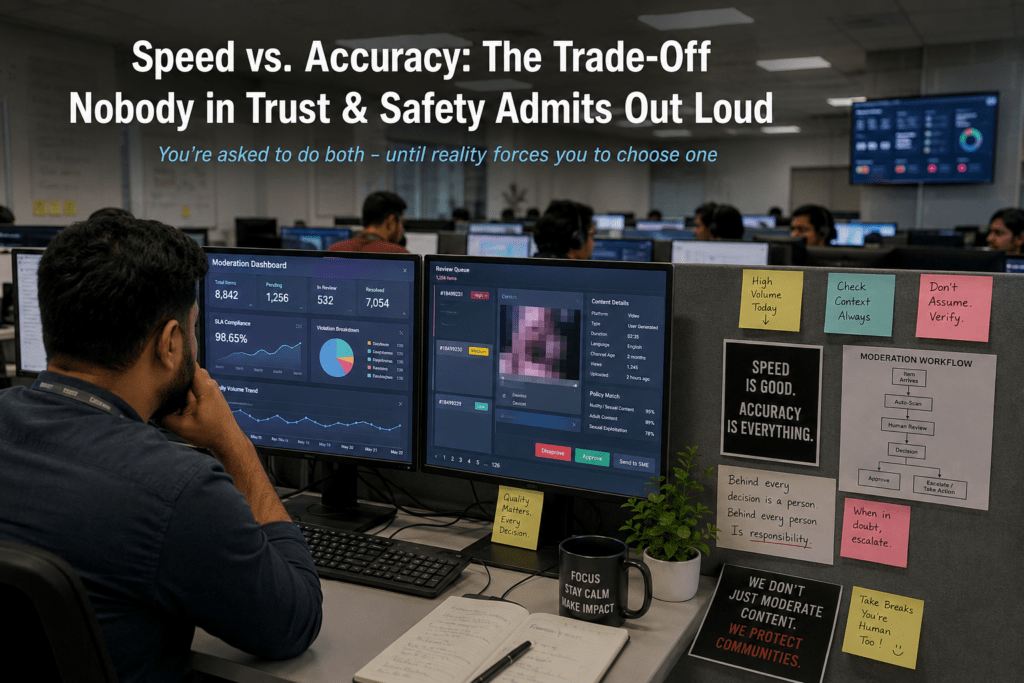
🔴 A Shift Where Speed Quietly Took Over
Let me walk you through a specific situation from my own experience.
Incoming volume started climbing steadily during one particular shift. Nothing catastrophic — no major incident driving an unusual spike. Just a gradual, persistent increase that built pressure across the team over several hours.
Queues grew. SLA timers tightened. The team adjusted — the way experienced moderation teams do. Decisions became faster. Movement through the queue became more efficient. From the dashboard perspective, everything looked controlled. SLA was holding. Throughput was strong.
It was only during the quality audit that followed that something subtle became visible.
Several cases had been handled correctly — the right policy had been applied, the right enforcement action had been taken. But they hadn’t been handled completely.
Context hadn’t been fully explored. Related signals that might have changed the outcome — or revealed a broader pattern — hadn’t been checked. The decisions were defensible. They just lacked the depth that the same reviewers, under less pressure, would naturally have brought to identical cases.
Speed had taken the lead. Not through any conscious decision. Through the accumulated pressure of a queue that kept growing and a timer that kept shrinking.
And the cost wasn’t visible on the dashboard that day. It showed up later — in the audit, in the quality scores, in the quiet realization that some decisions had been shallower than they should have been.
🔍 The Case That Made the Trade-Off Impossible to Ignore
There’s one specific review that I return to whenever this topic comes up — because it captures the tension more precisely than any framework I could describe.
It came in during a busy period when the queue was backed up and the pressure to maintain pace was real and constant.
At first glance, the case looked completely routine. The kind of review I could have closed confidently within thirty seconds and moved on without a second thought.
But something felt slightly inconsistent. Nothing I could immediately name — just enough friction to make me pause rather than close.
So I checked the account history. Looked at similar content from linked accounts. Compared posting patterns across a broader timeframe.
That decision cost me several minutes I didn’t technically have.
What it revealed was that this wasn’t an isolated case at all. It was one visible piece of a coordinated behavior pattern spanning multiple accounts — something that a quick, pace-appropriate decision would have closed and cleared, leaving the broader pattern completely invisible.
Had I chosen speed, I would have met my SLA target and missed something that mattered significantly beyond that single case.
Had I chosen accuracy from the start on every case regardless of complexity, the queue would have suffered and the pressure on my colleagues would have increased.
That is the trade-off. Not as a theoretical tension between two metrics — but as a real, specific moment where the choice had to be made and both options carried genuine cost.
🧠 Why This Trade-Off Is Structural — Not a Failure
Here’s something I want to address directly, because I’ve heard it framed incorrectly too many times:
The speed-accuracy trade-off in Trust & Safety is not primarily a training problem. It is not primarily a workflow problem. It is not something that the right tool or the right SOP will eliminate.
It is a structural feature of judgment-based work operating at scale.
Not every case requires deep analysis. The majority of content reviewed in any high-volume moderation operation is relatively straightforward — clear violations or clear approvals that experienced reviewers can handle accurately and efficiently.
But some cases require genuine depth. And the challenge — the one that makes this work fundamentally different from mechanical processing — is that you don’t always know at first glance which category you’re dealing with.
So every reviewer is making a meta-decision hundreds of times per shift: Is this a case I can handle quickly, or is this a case that deserves more time?
Getting that meta-decision right is one of the most important and least discussed skills in Trust & Safety operations.
And the pressure of a growing queue consistently biases that meta-decision toward speed — even when the case in front of you is quietly asking for something different.
📊 The Hidden Way This Trade-Off Shapes Behavior Over Time
When I look back at how sustained speed pressure changes moderation teams over weeks and months, the pattern is consistent and concerning.
Decisions become more standardized — reviewers develop quick-match patterns for common violation types and apply them broadly, reducing the cognitive effort required per case at the cost of sensitivity to the cases that don’t quite fit the pattern.
Edge cases receive less attention — the cases that most need depth are precisely the ones most likely to be rushed, because their ambiguity makes them slower and the pressure to maintain pace is constant.
Discussion gets skipped — the brief calibration conversations between colleagues that catch errors before they become decisions get compressed out of the workflow when the queue is demanding throughput.
None of this is intentional. None of it reflects a team that has stopped caring about quality.
It reflects a team that is responding rationally to the incentive structure the metrics create — and whose rational response to that structure is gradually moving them away from the decisions the work actually requires.
🧪 The Experiment That Proved It
During one operational period, our team ran what amounted to an unplanned experiment — though we didn’t call it that at the time.
We tightened SLA targets in response to client feedback about turnaround time. The goal was straightforward: demonstrate improved response speed without compromising decision quality.
The speed improvement worked. Queues were cleaner. Turnaround times genuinely improved. The client was satisfied with the metric movement.
But quality checks over the following weeks revealed something that the SLA numbers hadn’t shown.
Not a dramatic drop. Not the kind of decline that triggers a crisis conversation. Just consistent, quiet inconsistency emerging in edge case handling — small variations in how similar borderline situations were being approached, subtle reductions in the depth of contextual analysis on cases that warranted it.
We adjusted. Introduced explicit flexibility for complex case types — clear guidance that certain content categories warranted extended handling time without SLA penalty. Quality stabilized. The speed gains were partially retained.
The lesson wasn’t that speed and accuracy are incompatible. It was that pushing one without explicitly protecting the other produces exactly the kind of quiet degradation that audits eventually surface.
💭 The Emotional Reality Nobody Reports
Here’s the dimension of this trade-off that never makes it into performance reports but shapes the daily experience of every reviewer doing this work.
The tension isn’t just operational. It’s personal and constant.
You’re aware of the time you’re taking. You’re aware of the queue behind you. You’re aware of the SLA timer. And simultaneously you’re aware of the case in front of you — the specific signals that don’t quite align, the account history that needs one more check, the pattern that might mean something or might mean nothing.
That simultaneous awareness — of operational pressure and decision quality, pulling in opposite directions — is the lived experience of Trust & Safety work that dashboards don’t capture.
I’ve had moments where I knew a case needed more time. I also knew the queue was growing. I made a choice. Sometimes I chose speed and it was fine. Sometimes I chose depth and found something that mattered.
And sometimes I chose speed and have wondered since whether I missed something I would have caught with five more minutes.
That particular uncertainty is part of this profession. Nobody who has worked in it for long has escaped it entirely.
🏆 What Experienced Reviewers Actually Learn
New moderators tend to approach the speed-accuracy tension as a fixed problem — something to solve once and then operate without.
Experienced moderators understand it differently. They stop looking for a permanent resolution and start developing something more valuable:
Calibrated judgment about which cases deserve which pace.
Routine spam? Apply established pattern, move efficiently.
Clear impersonation with documented evidence? Straightforward, fast.
Coordinated behavior with subtle signals? Slow down regardless of queue pressure.
Borderline content where context determines everything? Take the time. The queue can wait.
That calibration — knowing instinctively when to accelerate and when to pause — is not documented in any SOP. It develops through exposure to thousands of edge cases, through calibration discussions with colleagues, and through working in an environment where slowing down on the right case is recognized as skill rather than underperformance.
I’ve watched the best reviewers I’ve worked with move faster than almost anyone else on routine cases — and stop completely, without hesitation or apology, when something in a case didn’t feel right. That ability to shift gears deliberately is the real performance indicator.
📋 Rethinking How We Measure Performance
The way most operations currently measure performance treats speed and accuracy as parallel, independent metrics.
SLA compliance in one column. Quality scores in another. Both tracked, both reported, both discussed — but rarely analyzed together in ways that surface the trade-off happening between them.
A more honest performance framework would consider:
Case complexity as a variable — not all cases are equivalent, and handling time should be evaluated relative to what the specific case actually required.
Risk level as a weighting factor — a fast decision on a low-risk case is different from a fast decision on a case with significant harm potential. Both might show the same handling time. They are not the same achievement.
The relationship between speed metrics and quality trends — when quality scores dip, the first question shouldn’t be “what policy was misapplied?” It should be “were these cases being reviewed under conditions that made depth possible?”
Because not all delays are failures. And not all fast decisions are successes.
🏁 Final Thoughts
Speed keeps the Trust & Safety system moving.
Accuracy keeps it meaningful.
And every person doing this work — from the newest reviewer finding their pace to the most experienced operations manager designing the workflows — is navigating the tension between those two things every single shift.
The trade-off is real.
It doesn’t disappear with better tools or clearer policies or smarter automation — though all of those make it more manageable.
It persists because as long as Trust & Safety decisions require human judgment, time will always be a factor in how much of that judgment gets applied to any given case.
The most honest thing I’ve learned about this tension over eleven years is also the simplest:
Acknowledge it. Name it. Build systems around it rather than pretending it doesn’t exist.
Because when teams understand that speed matters and accuracy matters more when risk is high — when that understanding is explicit rather than assumed — they make better individual decisions across every shift.
And at the end of every shift, in Trust & Safety operations, the question that actually matters was never:
“Was it fast?”
It was always: “Was it right?”
💬 Over to You
Have you ever faced a moment in Trust & Safety — or any operations role — where you had to choose between speed and accuracy and still think about which way you went? Share your experience in the comments. These are the conversations that help the whole industry make better decisions.
📚 You Might Also Like
- Context Switching Is Killing Your Team’s Productivity — And Workload Isn’t the Real Problem
- 100% SLA Compliance Doesn’t Mean 100% Quality
- Zero Errors, Zero Margin: Why Perfection Is an Unrealistic Expectation in Trust & Safety
Categories: Trust & Safety | Content Moderation | Operations Leadership | Quality Assurance | Decision Making
Tags: Trust and Safety Speed vs Accuracy Content Moderation SLA Management Operations Leadership Decision Making Moderation Quality T&S Professionals Platform Safety Quality Assurance