Speed can scale. Judgment still can’t.
“AI handles the front line. But there’s always someone behind it — making sure it actually got it right.”
Introduction
AI moderation has genuinely changed the game in Trust & Safety.
What once required hours of human review now happens in seconds. Content is scanned, classified, filtered, and sometimes removed before any human ever sees it. At the scale modern platforms operate — millions of posts per hour, content in dozens of languages, threats evolving in real time — this isn’t just impressive.
It’s necessary.
Without automation, moderation systems would collapse under their own volume. No workforce on earth could manually review everything that gets uploaded to a major platform in a single day. AI makes the entire enterprise of online safety possible at scale.
But if you’ve worked inside Trust & Safety long enough — not in the press releases about AI capabilities, but in the actual queues where real decisions get made — you know the full picture looks different from the headline.
AI is fast. But it isn’t final.
Because behind every automated decision, there is still a layer of human judgment that keeps the system grounded, corrects what the algorithm misread, catches what it missed entirely, and quietly ensures that what looks seamless from the outside is actually working the way it should.
That layer is invisible to most people. It is essential to everyone.
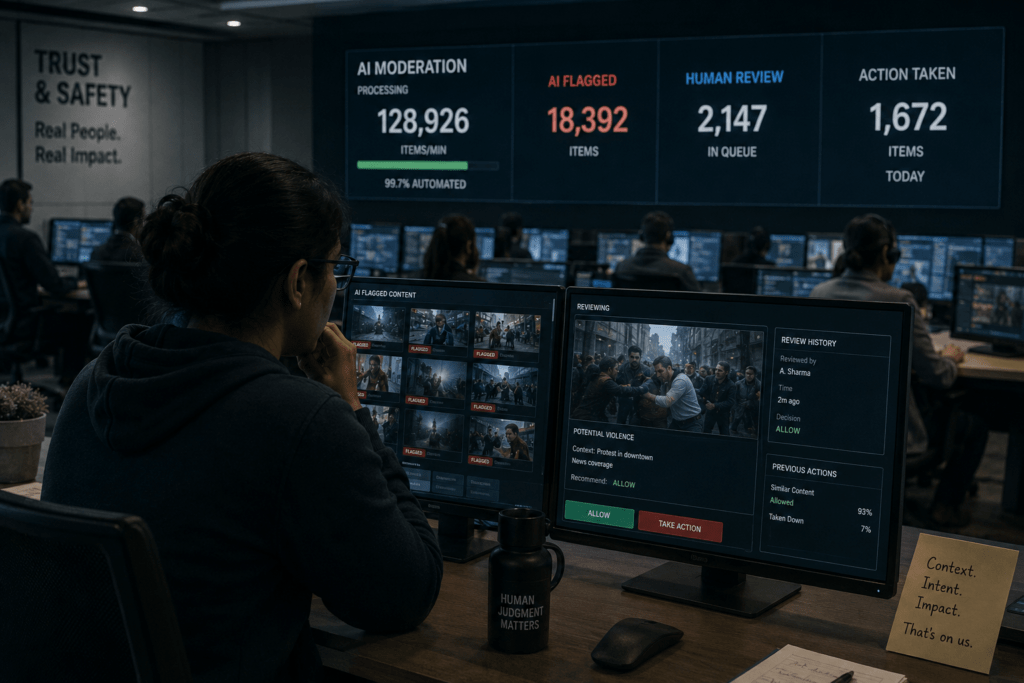
🤖 The First Time I Watched AI Get It Meaningfully Wrong
Let me take you to a specific moment that shaped how I think about the relationship between automation and human review.
I was working through a batch of escalations — cases that had been auto-flagged by an automated detection system and were queued for human review before final action. Most of the batch made complete sense. Clear violations. Easy decisions. The kind of content that automated systems are genuinely good at catching.
Then one case stopped me.
It had been auto-flagged, auto-actioned, and was sitting in the escalation queue because the removal had triggered a user appeal. On the surface, the keyword signals were there. The structural pattern matched the model’s training. From a pure detection standpoint, the system had done exactly what it was designed to do.
But when I read the full content in context — the surrounding conversation, the user’s posting history, the framing of the specific post — something was clearly off about the action that had been taken.
The content wasn’t promoting a harmful topic. It was explaining it — specifically, a user providing educational context about a sensitive subject for people in their community who had been encountering it without understanding what it was.
The AI had correctly identified the signals. It had completely misread the intent.
We reversed the decision. Restored the content. And — critically — flagged the pattern to the team so that similar cases in that content category could be routed for human review rather than auto-action going forward.
The AI wasn’t broken. It was doing exactly what pattern-matching systems do: detecting signals without understanding meaning. That’s not a flaw to eliminate — it’s a limitation to design around. And designing around it is precisely what human reviewers are for.
✅ Where AI Genuinely Excels — And Why That Matters
Before going further, I want to be clear about something that’s easy to lose in a conversation about AI limitations.
Automated moderation systems do extraordinary things that human teams alone simply cannot.
They process massive content volumes instantly — not quickly, instantly — across a scale that would require an impossible number of human reviewers to match. They identify known violation patterns with high accuracy and remarkable consistency. They catch repeat violations faster than any manual process could. They dramatically reduce the volume of genuinely harmful content that human reviewers have to be directly exposed to.
I’ve managed queues that would have taken a full team multiple days to clear manually being handled in minutes with automation support actively working alongside human review.
That efficiency isn’t optional in modern Trust & Safety. It’s foundational.
The question was never whether to use AI in moderation. The question has always been where human judgment needs to remain in the loop — and what happens when that line gets drawn in the wrong place.
🌫️ Where AI Struggles: Not Detection, But Interpretation
Here’s the distinction that I think gets lost most often in public conversations about AI moderation:
AI’s limitation is not detection. It’s interpretation.
And Trust & Safety is full of interpretation.
I’ve reviewed cases where the exact same words carried completely different meanings depending on who posted them, to whom, in what community context, during what current event. I’ve seen phrases that were harmful in one cultural context and completely standard in another. I’ve reviewed content where the stated meaning and the actual intent were entirely different — and where understanding that difference required context that no pattern-matching system had been trained to recognize.
AI works on patterns. It identifies signals. It matches content against known examples of violation categories.
Humans work on meaning. We bring cultural context, situational awareness, and the kind of judgment that comes from understanding not just what something says but what it’s actually doing in the specific context it was posted.
And meaning is where the most consequential decisions live.
🔍 A Scenario That Required Connecting Dots AI Couldn’t See
Let me share an experience that illustrates the gap between pattern detection and judgment more clearly than any abstract explanation could.
Our team was reviewing a queue where AI had already done a first pass — filtering out obvious violations, flagging borderline content for human review, and allowing a significant portion of content through as clearly acceptable.
What remained after automation looked, at the case level, relatively clean. Individual posts that had been assessed and mostly passed. A normal review queue.
But during manual review, something started emerging that I almost missed because I was looking at cases individually rather than as a group.
A specific phrase — unremarkable on its own — was appearing repeatedly. Different accounts. Slightly different contexts. Spacing that varied just enough to look unrelated. Each instance, evaluated individually, fell below the threshold for any enforcement action.
Something felt off. I flagged it to the team. We started looking at the accounts behind the posts rather than just the posts themselves.
What we found was the early formation of a coordinated activity pattern — accounts that had been created recently, with similar posting behaviors, gradually seeding specific messaging across different community spaces in a way that was clearly building toward something more organized.
No single post had violated policy. The pattern absolutely did.
We escalated. Took coordinated action across the linked accounts. Documented the emerging tactic for the policy team.
AI hadn’t flagged it because the pattern was still forming — still below the threshold any model trained on completed violations would recognize. A human caught it because experience creates sensitivity to the early signals that precede the patterns, not just the patterns themselves.
🧹 The Cleanup Layer Nobody Talks About
Here’s a part of Trust & Safety operations that rarely makes it into any public conversation about AI moderation — and that I think deserves significantly more acknowledgment than it receives.
After AI does its job, there is always a second layer.
The cleanup.
This includes reviewing false positives — content that was incorrectly actioned and needs to be restored, often with an explanation owed to the user who experienced the wrong decision. Catching false negatives — content that passed automated detection but contains genuine harm that a human reviewer recognizes. Handling edge cases — content that doesn’t fit cleanly into any established violation category and requires judgment about how policy principles apply to genuinely novel situations.
And — perhaps most importantly — feeding back into the system itself. Every pattern that human reviewers identify. Every category of false positive that reveals a model miscalibration. Every edge case that exposes a gap in policy coverage. All of that feeds back into making the automated systems better over time.
AI doesn’t improve on its own. It improves because human reviewers keep refining it — catching what it missed, correcting what it got wrong, and generating the feedback loops that drive model improvement.
That work is not glamorous. It doesn’t generate headlines. It doesn’t appear in transparency reports as a distinct line item.
It is what keeps automated moderation from drifting — slowly and invisibly — toward either over-enforcement that silences legitimate users or under-enforcement that allows harm to scale.
⚠️ The Real Cost of Over-Relying on Automation
There is a genuine and understandable temptation to trust automated systems completely.
They’re fast. They’re scalable. They produce clean metrics. They reduce human exposure to disturbing content. They operate continuously without fatigue or emotional weight.
From an operational efficiency standpoint, leaning heavily on automation makes intuitive sense.
But I’ve seen what happens when that lean becomes over-reliance — when the human oversight layer gets reduced in ways that the clean metrics don’t immediately reveal.
False positive rates climb quietly. Legitimate users start experiencing removals they don’t understand and can’t easily appeal. Communities with specific cultural contexts start noticing that enforcement in their spaces feels inconsistent or tone-deaf. Subtle harmful patterns that don’t match known violation signatures persist and scale because nothing is looking for the signals that precede the patterns.
None of this announces itself dramatically. It accumulates — in user trust erosion, in appeal volumes, in the slow divergence between what moderation is supposed to do and what it’s actually doing on the ground.
AI needs feedback loops. Those loops require human reviewers actively in the system — not as a backup for the cases AI can’t handle, but as an integral part of how AI gets better at handling the cases it currently can’t.
🧠 The Human Advantage That Experience Builds
Let me describe something that I’ve experienced repeatedly over eleven years in this field — something that I don’t know how to fully explain in technical terms but that shapes how I think about the relationship between human and automated moderation.
There are moments when something feels off about a case before any specific signal has justified that feeling.
No clear violation. No obvious red flag. The content would pass any automated filter. A less experienced reviewer would close it and move on.
But something — accumulated pattern recognition, contextual awareness, the specific texture of this case against everything else I’ve reviewed — says: look closer.
And often, looking closer reveals something that fast processing would have missed.
That instinct doesn’t come from data alone. It comes from sustained exposure to how harm manifests across different content types, communities, and tactics over time. It comes from developing a sensitivity to the early signals — the slight inconsistencies, the subtle coordination indicators, the phrasing choices that don’t quite fit the stated context — that precede the obvious violations automated systems are trained to catch.
Human reviewers bring context awareness, cultural understanding, sensitivity to nuance, and the ability to question a decision that looks technically correct but feels wrong in ways that matter.
Those aren’t soft skills. They are core operational capabilities that no current automated system fully replicates.
🤝 Building the Relationship That Actually Works
The framing I find least useful in conversations about AI moderation is the one that treats human and automated review as alternatives — as if the question is which one to rely on rather than how to integrate them effectively.
The goal has never been to replace AI with human review. At current content volumes, that’s not possible.
The goal has also never been to replace human review with AI. At current AI capability levels, that’s not responsible.
The goal is a system where both contribute what they’re genuinely best at — and where the integration between them is designed thoughtfully enough that each compensates for the other’s limitations.
AI handles scale, speed, and consistent detection of known patterns. Human reviewers handle complexity, ambiguity, emerging threats, and the judgment calls that require understanding meaning rather than matching signals.
When that balance works — when automation is trusted for what it does well and questioned when it doesn’t — the overall system becomes significantly stronger than either component would be independently.
I’ve seen teams perform at their best when this relationship is working correctly: using automation to manage volume efficiently, trusting their own judgment on the cases that require it, and treating the feedback loop between human review and model improvement as an ongoing operational priority rather than an afterthought.
🏁 Final Thoughts
AI moderation is fast. Genuinely, impressively fast — and that speed is what makes online safety at platform scale possible at all.
But speed is not the same as accuracy. Scale is not the same as understanding. Efficiency is not the same as judgment.
And Trust & Safety — at its core — is not just about detecting patterns in content.
It’s about understanding people. Understanding intent. Understanding context. Understanding the difference between what something says and what it’s actually doing in the specific community where it was posted.
That understanding still requires a human in the loop. Not as a backup for edge cases. Not as a quality check on outputs. But as an essential, integrated part of how the system functions, improves, and remains accountable to the users it exists to protect.
From the outside, AI moderation looks seamless. Content disappears. Harmful material is reduced. The platform feels clean and safe.
What’s not visible is the continuous human effort that makes that seamlessness real — the reviewers correcting what automation got wrong, catching what it missed, questioning what feels off, and feeding everything they learn back into making the system better tomorrow than it was today.
Speed can scale. Judgment still can’t. And that’s why there will always be someone behind the AI — making sure it actually got it right.
💬 Over to You
Have you experienced a situation where automation got something meaningfully wrong — or where human review caught something an AI system missed? Share your experience in the comments. These conversations help the industry build better systems.
📚 You Might Also Like
- Are Transparency Reports Actually Telling the Full Story?
- Context Switching Is Killing Your Team’s Productivity — And Workload Isn’t the Real Problem
- Why Moderating Regional Language Content Is One of the Hardest Jobs in Trust & Safety
Categories: Trust & Safety | AI Moderation | Content Moderation | Operations Leadership | Digital Safety
Tags: Trust and Safety AI Moderation Content Moderation Human Review Automated Moderation Digital Safety T&S Professionals Platform Safety AI Limitations Moderation Quality
Bài viết rất hữu ích, cảm ơn đã chia sẻ! Letco là công ty tư vấn du học Hàn Quốc uy tín, hỗ trợ trọn gói từ hồ sơ, visa đến học bổng. Tham khảo thêm tại letco.vn nhé.