Why global rules need local context, human judgment, and cultural understanding
When people hear “content moderation,” they may imagine something simple:
Read the content. Check the policy. Take action.
That sounds straightforward.
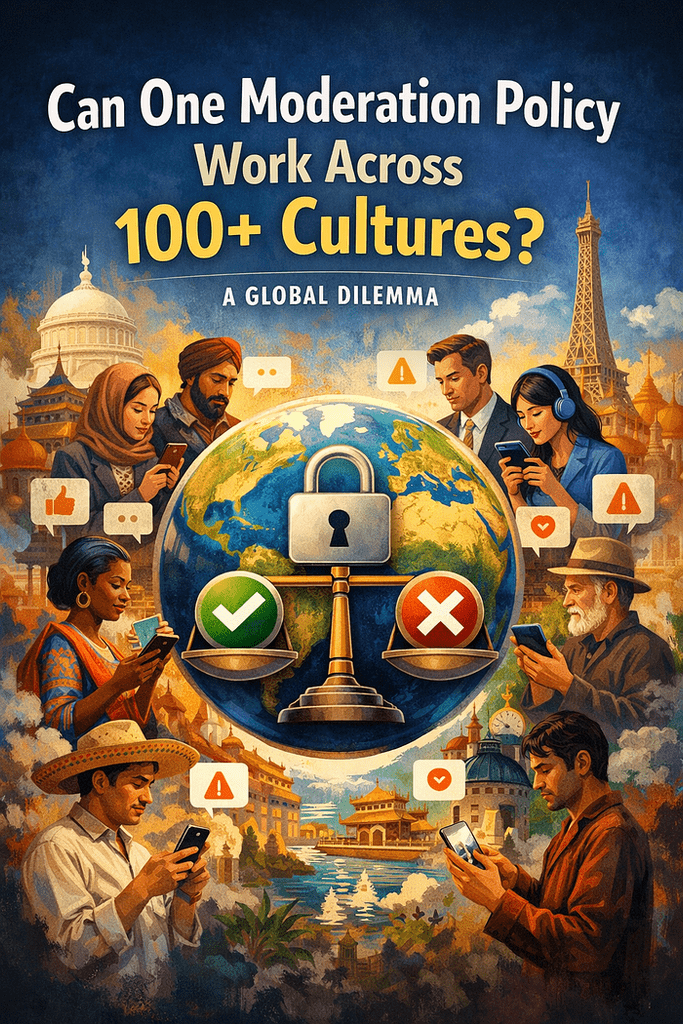
But try doing that across 100+ cultures, hundreds of languages, different traditions, different types of humor, and completely different social norms.
Suddenly, the decision is not so simple.
In Trust & Safety operations, I have seen situations where a piece of content looked completely harmless at first. A second review, a local-language explanation, or a little cultural context could completely change how we understood it.
That is where global moderation becomes difficult.
The Same Words Can Mean Something Different
One of the biggest challenges is language.
A phrase may look harmless when translated into English but have a completely different meaning in its original language.
I remember situations where a moderator initially found no clear violation. Later, someone familiar with the local language explained that the phrase was actually being used as a coded insult.
The words had not changed.
The context had.
This is why translation alone cannot solve every moderation problem. A translator can tell you what words mean. A regional expert can sometimes explain what people actually mean by using them.
That difference matters.
Humor Is Even Harder
Have you ever shared a joke with someone from another country and had to explain why it was funny?
Moderators face the same problem, but with much higher stakes.
A meme may look like ordinary humor to someone outside a particular community. Inside that community, however, it may refer to a historical event, stereotype, social conflict, or sensitive group identity.
So the question is not always:
“Is this a joke?”
Sometimes the better question is:
“Who is the joke about, and how is it being understood by the people who see it?”
That extra layer of context can completely change a moderation decision.
One Global Rule, Many Local Realities
Politics, religion, social identity, traditions, and even acceptable ways of speaking can vary significantly between regions.
Something considered normal criticism in one country may be interpreted very differently somewhere else.
That does not mean every local interpretation should automatically override a global policy.
It means moderators need enough context to understand what they are actually reviewing.
This is where global policies and local expertise have to work together.
So, Can One Policy Really Work?
Yes, but probably not as a one-size-fits-all rulebook.
A global policy can provide the foundation. It can define what the platform considers harmful, unsafe, or unacceptable.
But the application of that policy often needs local knowledge.
Think of it like this:
Global policy sets the boundary.
Local context helps you understand what is happening inside that boundary.
That distinction is important.
Without a common policy framework, enforcement can become inconsistent. But without cultural understanding, a common framework can also be misunderstood.
What Moderators Actually Need
From an operational perspective, three things make a big difference:
1. Clear policy guidance
Moderators need examples, edge cases, and clear escalation paths, not just definitions.
2. Regional knowledge
Language experts and people who understand local culture can help identify meanings that are easy to miss.
3. Good escalation practices
When something does not fit neatly into the policy, asking for clarification is often better than making a confident but incorrect decision.
Sometimes the strongest moderation decision is simply:
“I’m not sure. Let’s check the context before taking action.”
The Real Challenge Is Not the Policy
The internet may be global, but human communication is still deeply local.
People use slang, humor, references, sarcasm, symbols, and cultural shortcuts that may mean very different things to someone thousands of miles away.
That is why effective moderation cannot depend only on rules.
It depends on interpretation, context, and people who understand both.
So, can one moderation policy work across 100+ cultures?
One policy can create a common standard. But people and context are what make that standard work in the real world.
And sometimes, the most important question a moderator can ask is not:
“What does the policy say?”
It is:
“What does this content actually mean here?”