Same rules, different realities
In Trust and Safety, one principle is repeated everywhere:
“Be consistent.”
Apply the policy the same way.
Treat similar cases equally.
Avoid subjectivity.
It sounds right. It is right — at least in theory.
But if you’ve spent enough time moderating real-world content, you’ve probably felt this tension:
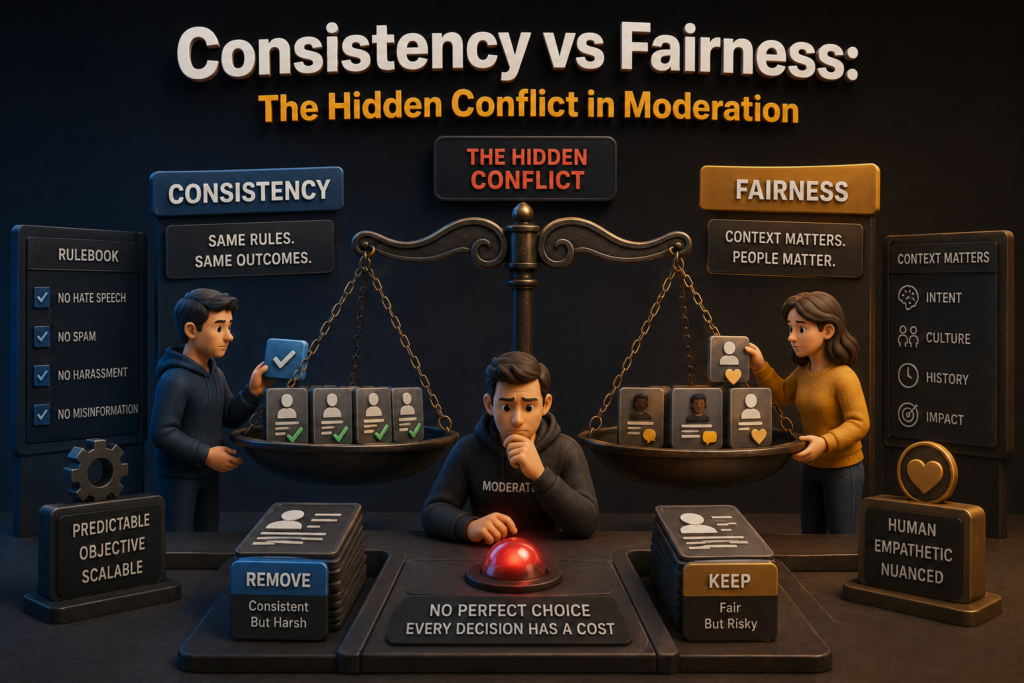
Sometimes, being consistent doesn’t feel fair.
And being fair doesn’t look consistent.
This is the hidden conflict most moderation teams deal with — but rarely talk about openly.
The Ideal vs The Reality
On paper, moderation is simple:
- Policy defines what’s allowed
- Moderators apply the rules
- Outcomes are consistent
But real content doesn’t follow clean rules.
It comes with:
- Context
- Intent
- Cultural nuance
- Edge cases
And that’s where things start to get complicated.
A Real Scenario: Same Violation, Different Context
We once had two cases flagged under harassment.
Case 1:
A user directly insulting another individual with abusive language.
Case 2:
A user using similar language — but in a sarcastic tone within a close community conversation.
Policy-wise, both triggered the same rule.
If we focused purely on consistency:
- Both should receive the same action
But when we looked deeper:
- The first was clearly harmful
- The second was contextual, with no reported harm and mutual engagement
The team was divided.
Some argued:
“Rules are rules. If we allow exceptions, consistency breaks.”
Others said:
“This doesn’t feel fair. Context matters.”
This is where moderation becomes more than rule application.
It becomes judgment.
When Consistency Feels Unfair
Strict consistency can sometimes create outcomes that feel off.
I’ve seen cases where:
- Satirical content gets removed alongside genuine harm
- Educational discussions get flagged because of keywords
- Cultural expressions are misunderstood and penalized
From a system perspective, it’s consistent.
From a user perspective, it feels unfair.
And that gap matters.
Because fairness is what builds trust.
Another Scenario: The Repeat Offender Dilemma
This one comes up often.
Two users commit the same violation.
- One is a first-time offender
- The other has a long history of violations
If we apply consistency strictly:
- Both get the same action
But is that fair?
Most teams instinctively adjust:
- First-time user → warning
- Repeat offender → stricter action
Now the outcome is fair.
But it’s no longer consistent in a strict sense.
This is where policy meets reality.
Why This Conflict Exists
At its core, consistency and fairness operate on different principles.
Consistency focuses on:
- Standardization
- Predictability
- Equal application of rules
Fairness focuses on:
- Context
- Intent
- Impact
In moderation, you need both.
But they don’t always align.
The Risk of Over-Optimizing Consistency
Many platforms lean heavily toward consistency.
Why?
Because it’s:
- Easier to measure
- Easier to audit
- Easier to scale
But over time, this creates problems.
Moderators start:
- Ignoring context to avoid mistakes
- Making “safe” decisions instead of thoughtful ones
- Escalating more cases to avoid responsibility
I’ve seen moderators say:
“I know this feels okay, but I’ll still take it down to be safe.”
That’s not good moderation.
That’s risk avoidance.
The Risk of Over-Optimizing Fairness
On the flip side, if you lean too much into fairness:
- Decisions become inconsistent
- Different moderators interpret cases differently
- Policy enforcement becomes unpredictable
This creates a different problem:
Users don’t understand where the line is.
And inconsistency at scale leads to trust issues.
What I Learned Managing This Balance
There’s no perfect solution.
But there are ways to manage the conflict better.
1. Define “Bounded Flexibility”
Instead of rigid rules or complete freedom, create space for judgment within limits.
For example:
- Clear rules for high-risk violations
- Flexibility for low-risk, context-heavy cases
This keeps the system stable without ignoring reality.
2. Document Edge Cases
Whenever a tricky decision comes up, capture it.
Over time, this builds a shared understanding:
- When to apply strict consistency
- When context should influence decisions
This reduces confusion across the team.
3. Encourage Explanation, Not Just Decisions
Instead of only asking “What action was taken?”
Ask “Why was this decision made?”
This helps moderators think beyond rules.
4. Align on Principles, Not Just Policies
Policies can’t cover everything.
But principles can guide decisions:
- Minimize harm
- Protect users
- Respect context
When moderators understand why rules exist, decisions improve.
5. Accept That Perfect Alignment Is Impossible
This was the hardest lesson.
You won’t achieve 100% consistency and 100% fairness at the same time.
Trying to do so creates more confusion.
The goal is not perfection.
It’s balance.
A Simple Analogy
Think of moderation like refereeing a sport.
Consistency means:
- Applying the same rules every time
Fairness means:
- Understanding the context of the game
A good referee does both.
They follow rules.
But they also understand intent, flow, and impact.
If they only follow rules blindly, the game feels rigid.
If they only follow judgment, the game feels unpredictable.
Balance is what makes it work.
What Leaders Should Watch For
If you’re leading a moderation team, pay attention to:
- Are moderators afraid to use judgment?
- Are decisions technically correct but feel off?
- Are similar cases getting very different outcomes?
- Are users confused about enforcement?
These signals show where imbalance exists.
Final Thought
Consistency builds structure.
Fairness builds trust.
You need both.
But they will always pull in different directions.
The role of a Trust and Safety professional isn’t just to enforce rules.
It’s to navigate that tension thoughtfully.
Because moderation isn’t just about being right.
It’s about being right in the right way.
And that’s where the real challenge lies.
rufufnfvmiwrjhlrervnuguzrvyezj