When people ask what I do for a living, I usually say, “I work in Trust & Safety.”
Most of the time, the response is the same.
A confused look.
A short pause.
Then a follow-up question: “What exactly is that?”
Considering how much of our lives happen online, it’s surprising how few people know that Trust & Safety teams even exist. Yet these teams are responsible for protecting users, enforcing platform policies, and responding to some of the most serious risks on the internet.
So why does such an important function remain largely invisible?
After working in this field, I’ve realized there are a few key reasons.
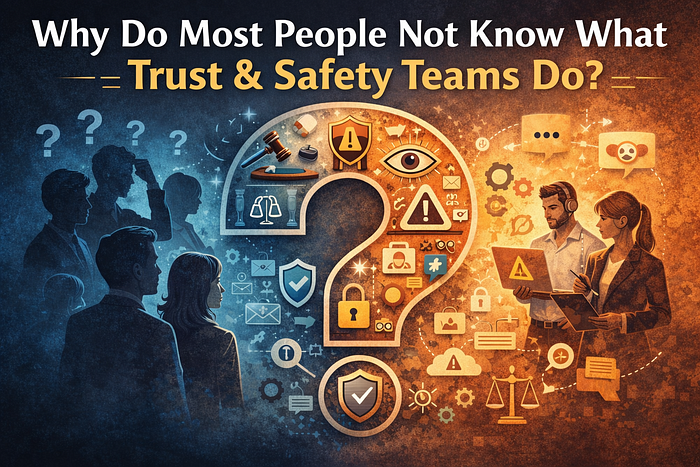
The Work Is Designed to Be Invisible
Trust & Safety operates behind the scenes.
When moderation works well, users don’t notice anything. Harmful posts disappear quickly. Spam accounts get suspended. Dangerous content never reaches a wide audience.
From a user’s perspective, the platform simply feels normal.
But that “normal” experience is often the result of thousands of moderation decisions happening quietly in the background every day.
Ironically, the better Trust & Safety teams do their job, the less visible their work becomes.
People Only Notice When Something Goes Wrong
Most users become aware of moderation only during controversies.
A harmful video goes viral.
A dangerous rumor spreads.
A major account gets banned.
Suddenly the public starts asking questions: Why wasn’t this removed earlier? Who is responsible for these decisions?
But these moments represent only a tiny fraction of the work Trust & Safety teams actually do.
Every day, moderators review reports, investigate suspicious behavior, enforce policies, and prevent harmful content from spreading further. Those routine actions rarely make headlines.
The Job Is Often Misunderstood
Another reason the field remains obscure is because the role is frequently oversimplified.
Many people assume moderation means someone scrolling through posts and clicking “remove.”
In reality, the work is far more complex.
Moderators analyze context, evaluate policy violations, review user reports, and make judgment calls under strict timelines. Teams work with legal frameworks, safety policies, and constantly evolving online threats.
The job combines policy interpretation, risk assessment, and operational discipline.
It’s not just about removing content. It’s about protecting digital ecosystems.
Companies Rarely Talk About It Publicly
There is also a structural reason for the lack of visibility.
Most technology companies do not openly discuss the details of their moderation systems. Part of this is necessary. Transparency must be balanced with security.
If every enforcement method or detection system were fully public, bad actors could easily exploit them.
But this also means the people doing the work often remain in the background, even though their role is critical to the platform’s safety.
The Emotional Side Is Often Hidden
Another part of Trust & Safety that the public rarely sees is the human impact.
Moderators regularly review disturbing or highly sensitive content. Violence, exploitation, harassment, and manipulation appear in review queues every day.
To continue doing the job effectively, moderators learn to stay calm and objective while making decisions.
But the emotional weight of that exposure is real, and it’s rarely visible from the outside.
Why Awareness Matters
As social media platforms continue to shape global communication, the role of Trust & Safety is becoming more important than ever.
These teams protect users from harm, enforce community guidelines, and maintain the integrity of online spaces.
Yet most people only become aware of them during moments of crisis.
Perhaps that invisibility is part of the job.
But understanding the work behind safer platforms helps people appreciate the complex decisions required to manage digital spaces at global scale.
And behind those decisions are teams working every day to make the internet a little safer than it would be otherwise.