If you’ve spent even a few weeks in Trust & Safety, you’ve heard it everywhere:
“Where are we on SLA?”
“Why is SLA dipping?”
“Can we recover SLA before EOD?”
It’s the most visible metric. The most discussed. The easiest to measure.
And yet… one of the most misunderstood. 🤔
Let me explain this through real scenarios I’ve lived through as a Trust & Safety professional.
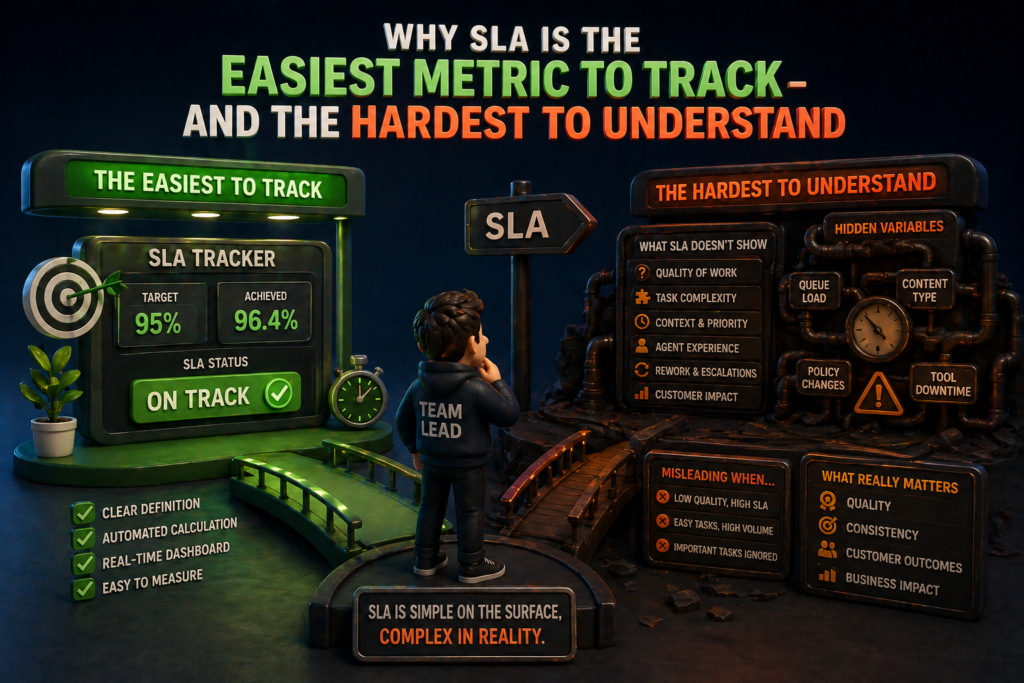
What Makes SLA Look So Simple? 📊
At its core, SLA (Service Level Agreement) is straightforward:
👉 Did you complete the task within the defined time?
That’s it.
No complex formulas. No interpretation debates. No grey areas.
If a task has a 24-hour SLA:
- Done in 20 hours → ✅ Met
- Done in 25 hours → ❌ Missed
Clean. Binary. Easy to track.
This is why leadership loves SLA. It gives instant visibility.
But here’s where the illusion begins…
Scenario 1: “We Met SLA… So Everything Is Fine, Right?” 🙂
Early in my career, I had a team that consistently hit SLA targets. Every dashboard was green. Leadership was happy.
But when we looked deeper…
- Appeals were increasing
- User complaints were rising
- Quality scores were fluctuating
What was happening?
The team had optimized for speed, not accuracy.
They were closing cases quickly just to stay within SLA. But decisions weren’t always correct.
💡 Lesson: SLA tells you when work was done, not how well it was done.
Scenario 2: “We Missed SLA… But Did We Really Fail?” 😐
Another time, we had a sudden spike in high-risk content.
The team slowed down. SLA dropped.
On paper, it looked bad.
But in reality:
- Reviewers were being extra cautious
- Complex cases were escalated properly
- Decisions were more accurate
We were actually doing better work, just slower.
💡 Lesson: Missing SLA doesn’t always mean poor performance.
Scenario 3: The “Hidden Queue” Problem 😶
This one is very common.
A queue looks under control because SLA is being met. But what’s not visible?
- Tasks sitting just under SLA threshold
- Backlogs slowly building
- Uneven workload distribution
Everything looks fine… until one day it isn’t.
Suddenly:
- SLA crashes
- Teams panic
- Firefighting begins 🔥
💡 Lesson: SLA is reactive. It shows problems after they start forming.
Why SLA Is Misleading (If Used Alone) ⚠️
Here’s the uncomfortable truth:
SLA doesn’t measure effort, complexity, or decision quality.
Two cases may both meet SLA:
- One took 2 minutes
- One took 45 minutes
But SLA treats them equally.
That’s where teams get into trouble. They assume SLA = performance.
It doesn’t.
The Real Challenge: Context 🧠
SLA only makes sense when you understand the context behind it.
Ask questions like:
- What kind of content is being reviewed?
- Is there a spike in volume?
- Are policies changing?
- Is the team experienced or new?
Without context, SLA is just a number.
With context, it becomes insight.
Scenario 4: The “New Joiner Effect” 🙂
I once onboarded a batch of new hires.
Week 1:
- SLA dropped
- Productivity slowed
Expected? Yes.
But leadership saw only the numbers.
We had to explain:
- New hires take longer
- They double-check decisions
- They need guidance
By Week 4:
- SLA stabilized
- Quality improved
💡 Lesson: SLA doesn’t reflect learning curves.
Scenario 5: Policy Changes = SLA Chaos 😅
Every Trust & Safety professional knows this pain.
A new policy update drops.
Suddenly:
- Review time increases
- Doubts increase
- Escalations increase
SLA dips instantly.
But it’s not inefficiency. It’s adaptation.
💡 Lesson: SLA doesn’t capture uncertainty.
The Psychology Behind SLA Pressure 😬
Here’s something we don’t talk about enough.
SLA creates pressure.
When teams are constantly monitored on SLA:
- They rush decisions
- They avoid complex cases
- They prioritize speed over judgment
Over time, this impacts:
- Confidence
- Morale
- Decision quality
I’ve seen great reviewers become average… just because they were chasing SLA.
So, How Should You Actually Use SLA? ✅
SLA is not useless. Far from it.
It’s powerful when used correctly.
Here’s how I approach it now:
1. Pair SLA with Quality 🎯
Never look at SLA alone.
Always ask:
- Are we meeting SLA and maintaining quality?
That’s the real win.
2. Segment the Data 📊
Break SLA down by:
- Queue type
- Complexity
- Experience level
This gives a much clearer picture.
3. Watch Trends, Not Snapshots 📈
One bad day doesn’t mean failure.
Look at patterns:
- Is SLA consistently dropping?
- Or was it a one-time spike?
4. Talk to the Team 💬
Numbers don’t tell stories. People do.
Ask your team:
- What’s slowing you down?
- Where are you stuck?
- What’s confusing?
You’ll get insights no dashboard can provide.
5. Balance Speed and Judgment ⚖️
Make it clear:
👉 Accuracy matters as much as speed
This changes how teams approach work.
Final Thought 🙂
SLA is like a stopwatch.
It tells you how fast you ran.
But it doesn’t tell you:
- If you ran in the right direction
- If you avoided obstacles
- If you made the right decisions along the way
In Trust & Safety, speed matters.
But judgment matters more.
So the next time someone asks,
“Where are we on SLA?”
Pause for a second and ask back:
👉 “What’s the story behind it?” 😊