The quiet reality of Trust & Safety, where success sounds like silence
“Everything looks good. No errors.”
That’s what the client said on the call.
On our side, the team just nodded. No celebrations. No excitement. Someone updated the tracker, someone else moved to the next queue, and within minutes, it was business as usual.
Because in Trust & Safety, “no errors” doesn’t feel like a big win.
It feels like just another day.
The Kind of Success That Doesn’t Make Noise
In most roles, success is visible.
A product launches. A deal closes. A campaign goes viral.
In our world, success is the absence of problems:
- No policy breaches slipping through
- No quality drops
- No escalations from the client
- No sudden spikes in harmful content
And when all of that holds steady, the feedback is simple: “No errors.”
It sounds small. But it rarely is.
What “No Errors” Actually Means
Let me translate that from a Trust & Safety perspective.
“No errors” means:
- Hundreds or thousands of decisions made correctly
- Edge cases handled without inconsistency
- Policies applied with precision
- Reviewers staying aligned even under pressure
It means the system worked.
And systems don’t just work on their own.
A Day Behind That One Line
I remember a day when we were preparing for a routine quality review.
Nothing unusual was expected. The queues were stable. Metrics looked normal. From the outside, it was a smooth operation.
But internally, the day had been anything but easy.
We had:
- A sudden influx of borderline content
- Multiple cases that didn’t clearly fit into existing policy buckets
- New reviewers still getting calibrated
Every decision required a bit more attention than usual.
There were discussions happening in parallel:
- “Would you classify this as X or escalate?”
- “Does this fall under updated guidelines or old interpretation?”
- “Is this a one-off or part of a pattern?”
It slowed us down. Not dramatically, but enough to feel the pressure.
Still, the team stayed aligned.
We checked with each other. Validated decisions. Took a few extra seconds where needed.
At the end of it, quality held strong.
The client’s feedback? “No errors.”
Why the Team Doesn’t Celebrate
If you walked into the room at that moment, you might expect some kind of reaction.
But there isn’t one.
Because the team knows what went into that outcome.
They know:
- Which decisions were difficult
- Where they had to double-check
- When they chose accuracy over speed
And they also know that tomorrow will bring a new set of challenges.
So instead of celebrating, they reset.
The Gap Between Effort and Recognition
One of the realities of this field is that effort and recognition don’t always match.
A reviewer might:
- Spend extra time analyzing a complex case
- Catch a subtle pattern others might miss
- Prevent a potential escalation
And the result still shows up as… no error.
There’s no separate metric for:
- “Critical thinking applied”
- “Potential issue prevented”
- “High-risk case handled correctly”
Everything compresses into a simple outcome.
That can be frustrating, especially for people who care deeply about the work.
A Moment That Could Have Gone Wrong
There was another situation where we almost missed something.
A piece of content passed through initial review without issue. On the surface, it met policy guidelines.
But during a routine audit, one of the team members paused on it.
Not because it was clearly wrong. But because something didn’t feel right.
The tone, the phrasing, the context, it hinted at something more.
We pulled a few more samples.
That’s when the pattern started to appear.
It wasn’t a single case. It was part of a broader trend that hadn’t fully surfaced yet.
We adjusted quickly:
- Updated internal guidance
- Flagged similar content
- Aligned the team
From the outside, nothing happened.
No escalation. No complaint.
From the inside, that one pause made the difference.
And again, the final report said: “No errors.”
The Discipline Behind Consistency
Consistency is one of the hardest things to maintain in Trust & Safety.
It’s not just about making the right decision once. It’s about making the same right decision across:
- Different reviewers
- Different shifts
- Different levels of experience
That takes:
- Strong calibration
- Clear communication
- Continuous feedback
I’ve seen how even small misalignments can create confusion.
One reviewer interprets a case one way. Another sees it differently. Over time, that inconsistency shows up in quality metrics.
So when a team delivers no errors, it usually means they were aligned.
And alignment doesn’t happen by accident.
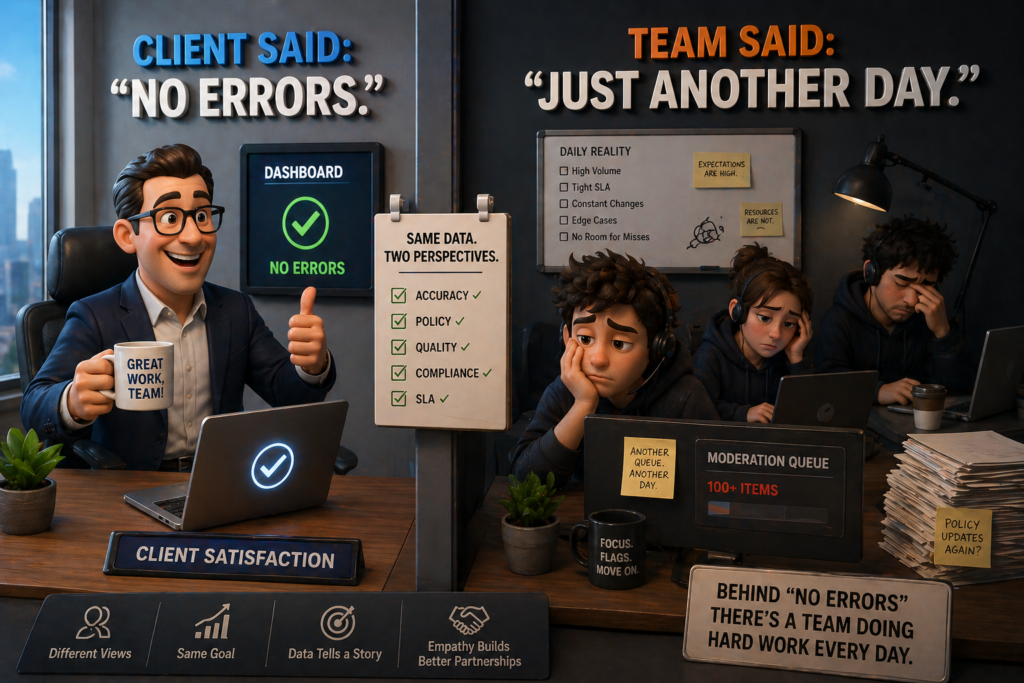
What Clients See vs What Teams Experience
Clients see outputs:
- Quality scores
- Error rates
- SLA adherence
Teams experience the process:
- Ambiguous cases
- Time pressure
- Mental fatigue
- Continuous decision-making
Both perspectives are valid. But they’re not the same.
When a client says “no errors,” they’re seeing a clean result.
When a team says “just another day,” they’re acknowledging the effort it took to keep it that way.
Leading Through Invisible Wins
As someone who has worked closely with teams, I’ve learned that these quiet wins need to be recognized internally, even if they’re not visible externally.
Because motivation doesn’t come from dashboards alone.
It comes from understanding impact.
Sometimes that means calling out:
- A well-handled edge case
- A smart escalation
- A moment where someone chose accuracy over speed
These are small things, but they build a stronger team.
Redefining What a “Good Day” Looks Like
In Trust & Safety, a good day is not one where something big happens.
It’s a day where:
- The system holds steady
- The team stays aligned
- Decisions are made thoughtfully
- Nothing escalates unnecessarily
It doesn’t look exciting.
But it is meaningful.
Final Thought
“Client said: no errors. Team said: just another day.”
That line captures the reality of this work.
Because behind every uneventful day is a team that made hundreds of decisions, handled uncertainty, and stayed consistent under pressure.
The platform feels safe.
The system feels stable.
And no one outside notices.
That’s not a lack of impact.
That is the impact.