Control the queue, control the outcome
In Trust and Safety operations, SLA is treated like the ultimate performance metric.
Are we meeting turnaround time?
Are we clearing cases within the defined window?
Are we staying in the green?
Most teams try to manage SLA directly. They push for faster reviews, increase targets, and monitor dashboards more closely.
I used to do the same.
But over time, I realized something important:
You don’t manage SLA directly.
You manage queues.
And if your queue management is weak, no amount of pressure on SLA will fix it.
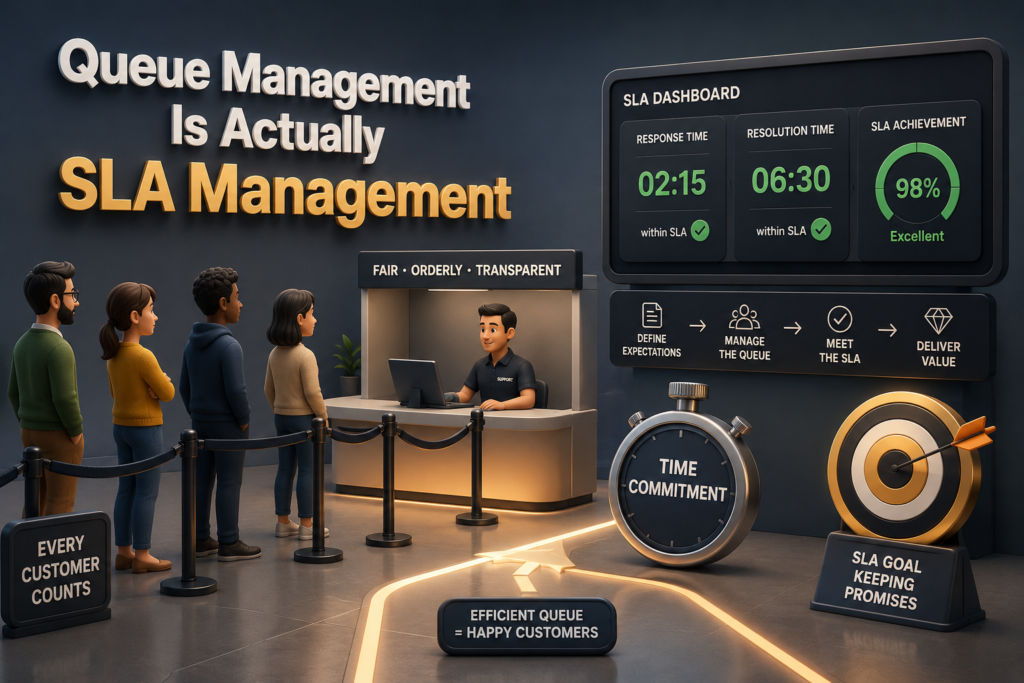
The Common Mistake
When SLA starts slipping, the usual reactions are predictable:
- “Increase productivity”
- “Reduce idle time”
- “Push the team harder”
- “Add more monitoring”
These actions focus on people performance.
But SLA issues are rarely just about people.
They are almost always about how work is flowing through the system.
And that flow is defined by queue management.
A Real Scenario: SLA Was Dropping
We once had a situation where SLA compliance dropped from 98% to 91% within a few days.
Naturally, alarms went off.
The initial assumption:
- Team is slowing down
- Productivity is dropping
- Maybe engagement is low
But when we checked:
- Productivity was stable
- Login hours were consistent
- No unusual absenteeism
So why was SLA failing?
We looked at the queue.
And that’s where the problem was hiding.
What We Found
A large volume of cases had entered a mid-priority queue.
This queue had:
- Moderate SLA timelines
- Mixed complexity
- No strict monitoring compared to high-priority queues
Because of this:
- High-priority queues were being cleared first
- Low-priority queues were being parked
- Mid-priority queue kept growing silently
Cases sat there longer than expected.
By the time we noticed, many were already close to breaching SLA.
It wasn’t a productivity issue.
It was a queue prioritization failure.
Why Queue Management Defines SLA
SLA is simply a time promise.
Queue management decides whether that promise can be kept.
Here’s how:
1. Prioritization Controls Time
If the wrong cases are picked first, the right ones get delayed.
Even a highly productive team can miss SLA if priorities are misaligned.
2. Distribution Impacts Speed
If work is unevenly distributed:
- Some moderators are overloaded
- Others are underutilized
This imbalance slows down overall throughput.
3. Visibility Prevents Surprises
Queues don’t fail suddenly.
They build pressure over time.
Without visibility into:
- Aging cases
- Queue size trends
- Time-to-breach
You only react when it’s too late.
Another Scenario: The “Last Hour Rush”
This is something I’ve seen in multiple teams.
Throughout the day:
- Work flows normally
- No visible issues
But towards the end of the shift:
- Panic starts
- Teams rush to clear aging cases
- Decisions become faster, sometimes careless
Why?
Because queue aging wasn’t managed proactively.
Cases were allowed to sit too long.
And then suddenly became urgent.
This creates:
- SLA risk
- Quality risk
- Stress on the team
All at once.
The Hidden Impact on Quality
Poor queue management doesn’t just affect SLA.
It directly impacts decision quality.
When cases pile up and become urgent:
- Moderators rush
- Edge cases get less attention
- Escalations increase
I’ve seen situations where:
- SLA was recovered
- But quality dropped significantly
Which created a new problem.
This is why queue management isn’t just operational.
It’s strategic.
What Changed My Approach
After dealing with repeated SLA issues, I stopped focusing on SLA as the primary problem.
Instead, I started focusing on how queues were behaving.
Here’s what made a difference:
1. Aging-Based Prioritization
Instead of just priority labels, we tracked:
- How long cases had been sitting
- How close they were to breach
This ensured older cases got attention early.
2. Real-Time Queue Monitoring
We didn’t wait for end-of-day reports.
We tracked:
- Queue size trends
- Inflow vs outflow
- Sudden spikes
This helped us act before problems escalated.
3. Smarter Queue Allocation
Instead of fixed assignments, we adjusted dynamically:
- If one queue was growing → more resources shifted there
- If another was stable → fewer resources assigned
This kept the system balanced.
4. Clear Queue Ownership
Each queue had accountability.
Someone was always responsible for:
- Monitoring health
- Flagging risks
- Taking action early
Without ownership, queues get ignored.
5. Reducing “Invisible Queues”
Some queues don’t look critical but can become risky over time.
We started reviewing:
- Mid-priority queues
- Mixed-complexity queues
These are often where SLA issues hide.
A Simple Analogy
Think of queues like traffic signals in a city.
SLA is your promise that people will reach their destination on time.
But if:
- Signals are not timed properly
- Some roads get ignored
- Traffic builds unevenly
You’ll have jams.
No matter how fast the cars are.
Managing drivers won’t fix traffic.
Managing flow will.
What Leaders Should Watch For
If SLA is becoming unpredictable, don’t just look at productivity.
Look at your queues.
Ask:
- Which queues are growing silently?
- Are we prioritizing correctly or just reactively?
- Do we know where the next breach will come from?
- Are some queues consistently ignored?
These questions reveal the real issue.
The Shift in Thinking
Once you understand this, your mindset changes.
Instead of asking:
“Why is SLA dropping?”
You start asking:
“Which queue is causing this — and why?”
That shift moves you from reactive to proactive management.
Final Thought
SLA is the outcome.
Queue management is the system.
If the system is strong, the outcome follows.
If the system is weak, no amount of pressure on the team will sustain results.
In Trust and Safety, where volumes fluctuate and complexity varies, managing queues effectively is not just an operational task.
It’s the foundation of performance.
Because at the end of the day, you don’t meet SLA by working faster.
You meet it by making sure the right work gets done at the right time.
kympzfuwzpzjurjhsngkhwjkreqisp