Most people imagine moderation policies being written by a few executives sitting in a room deciding what the internet can and cannot say.
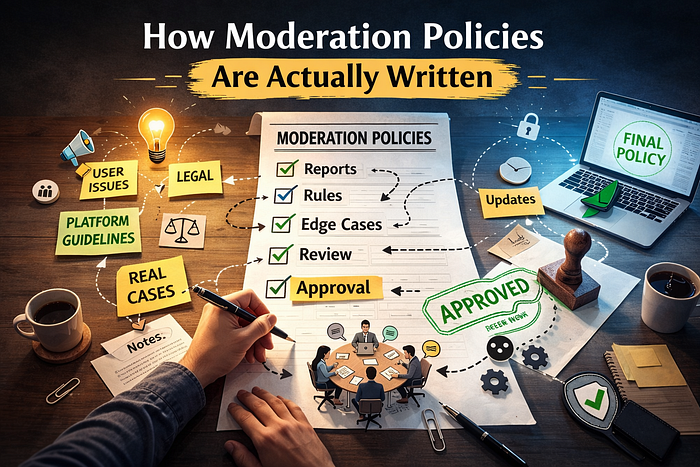
From the outside, it feels political. Arbitrary. Sometimes even personal.
But after working in Trust and Safety, I can say the reality is far less dramatic and far more complicated.
Policies are not random rules invented overnight.
They are layered systems built through:
- Research
- Risk analysis
- Operational testing
- Legal review
- Cultural debate
- Escalation feedback
- Real-world harm patterns
And one thing surprised me the most when I entered this field:
Moderation policies are never truly finished.
They constantly evolve because the internet itself never stops changing.
Every Policy Usually Starts With a Problem
Most moderation policies don’t begin as abstract ideas.
They begin because something harmful starts happening repeatedly online.
Sometimes it’s:
- A rise in targeted harassment
- A new scam tactic
- Coordinated misinformation
- AI-generated abuse
- Exploitation loopholes
- Violent content trends
- Manipulated engagement behavior
At first, these issues often appear as isolated moderation cases.
Then patterns emerge.
I remember working on review queues where moderators kept escalating similar edge cases repeatedly because existing policy language didn’t fully cover the behavior. That repetition became an operational signal that the rules needed clarification.
That’s how many policy discussions begin internally.
Not with ideology.
With operational gaps.
When harmful behavior evolves faster than written guidelines, platforms are forced to adapt.
Because bad actors constantly test boundaries.
Moderators Usually Don’t Write the Rules
This is one of the biggest misconceptions online.
People often assume moderators personally decide platform standards.
In reality, moderators mostly enforce policies rather than create them.
Policy development usually involves multiple specialized teams working together.
That often includes:
- Trust and Safety specialists
- Legal teams
- Public policy advisors
- Product managers
- Regional experts
- Risk analysts
- Safety researchers
Each group brings different concerns.
For example:
- Legal teams focus on regulatory exposure
- Product teams focus on technical implementation
- Regional experts focus on cultural context
- Safety teams focus on harm reduction
- Operations teams focus on enforcement feasibility
And all those perspectives sometimes conflict.
I’ve seen situations where a policy sounded good conceptually but became extremely difficult operationally because moderators could not apply it consistently at scale.
That’s why policy writing becomes much more technical than most users expect.
Every Word Matters More Than People Realize
One thing working in Trust and Safety taught me is this:
Small wording changes can completely change enforcement outcomes.
Take a category like harassment.
A policy cannot simply say:
“Don’t harass people.”
It must define:
- What counts as harassment
- What evidence matters
- What severity thresholds exist
- What exceptions apply
- How context changes interpretation
The same challenge exists for:
- Hate speech
- Threats
- Violent extremism
- Misinformation
- Sexual exploitation
- Dangerous organizations
I remember policy calibration discussions where teams debated individual phrases for hours because vague wording creates inconsistent moderation decisions globally.
Too broad, and platforms risk over-censoring legitimate speech.
Too narrow, and harmful content slips through constantly.
Precision becomes everything.
And achieving precision across billions of users speaking different languages is incredibly difficult.
Definitions Are Constantly Debated Internally
A huge portion of policy development revolves around one thing:
Definitions.
What qualifies as:
- Harassment?
- Coordinated abuse?
- Violent threat?
- Extremist praise?
- Harmful misinformation?
- Hate speech?
- Manipulated media?
These are not just philosophical debates.
They become operational decisions moderators must apply every day under pressure.
I once saw teams spend extensive time discussing whether a certain behavior represented targeted harassment or aggressive political criticism because the distinction directly affected enforcement severity.
That nuance matters.
Because policies need to be:
- Clear enough for consistency
- Flexible enough for context
- Scalable enough for automation
- Defensible enough legally
And those goals don’t always align easily.
Policies Must Actually Work Operationally
One thing users rarely think about is enforcement feasibility.
A policy that sounds morally correct may still fail operationally if it cannot be enforced consistently.
Policy teams often ask questions like:
- Can AI systems detect this reliably?
- Can human reviewers identify it consistently?
- Will this work across multiple languages?
- Can regional teams apply this uniformly?
- Will users understand the rule?
Because if enforcement becomes unpredictable, trust breaks down quickly.
I’ve personally seen policies revised not because the goal changed, but because reviewers across regions interpreted the same language differently during real moderation cases.
Operational reality shapes policy much more than public perception realizes.
Moderation is not just about deciding what is harmful.
It’s also about designing systems that can apply decisions consistently at internet scale.
Real Cases Often Change Policies
One of the most interesting things about Trust and Safety work is how often real moderation cases influence future policy updates.
Moderators escalate difficult edge cases constantly.
Over time, patterns emerge:
- New abuse tactics
- Loopholes in existing rules
- Ambiguous language
- Enforcement inconsistencies
- Cultural interpretation gaps
Those patterns become feedback loops for policy teams.
I remember situations where repeated escalations from moderation queues eventually triggered formal policy clarifications because the existing guidelines no longer matched evolving platform behavior.
The internet changes quickly.
Policies must evolve with it.
Community Guidelines Are Living Documents
Many users assume community guidelines are static.
They’re not.
They change constantly.
Because online behavior changes constantly.
New risks emerge every year:
- AI-generated misinformation
- Deepfakes
- Coordinated manipulation
- Financial scams
- Synthetic identity abuse
- Evolving extremist tactics
- Platform exploitation methods
At the same time:
- Cultural norms shift
- Political environments change
- Laws evolve
- Public expectations change
That means moderation policies require continuous revision.
What worked five years ago may fail completely today.
From inside Trust and Safety, policy writing feels less like creating permanent rules and more like maintaining a constantly evolving system under pressure.
The Public Usually Sees Only The Outcome
One reason moderation policies feel arbitrary to users is because most people only see the final enforcement action.
They don’t see:
- Internal debates
- Escalation reviews
- Legal analysis
- Risk assessments
- Operational testing
- Regional consultations
- Training calibration sessions
I’ve seen single policy paragraphs take months of discussion before approval because every sentence needed to balance:
- Safety
- Free expression
- Legal defensibility
- Cultural sensitivity
- Technical feasibility
That invisible complexity rarely appears publicly.
Users see:
“This post was removed.”
They don’t see the years of policy evolution behind the rule itself.
The Hard Reality Of Writing Rules For Billions Of People
One of the hardest lessons in Trust and Safety is realizing there is no perfect moderation policy.
No document can fully anticipate:
- Human creativity
- Cultural nuance
- Political complexity
- Internet behavior
- Rapidly evolving abuse tactics
Policies are structured attempts to reduce harm while preserving expression at impossible scale.
And that balance constantly shifts.
Some users will always believe platforms moderate too much.
Others will believe platforms moderate too little.
Policy teams operate permanently between those pressures.
Final Thoughts
Before working in Trust and Safety, I imagined moderation policies were mostly fixed rulebooks.
Now I understand they are living systems shaped by:
- Real-world harm
- Operational experience
- Cultural complexity
- Technical limitations
- Constant adaptation
Moderators apply the rules.
Policy teams build and refine them.
And both are trying to keep pace with an internet that evolves faster than any policy document ever can.
Behind every sentence inside a community guideline is usually far more debate, research, operational planning, and revision than most users will ever realize.
Awesome