One of the most common accusations platforms face today is this:
“You don’t enforce the rules equally.”
If you spend enough time reading comment sections after any moderation controversy, you’ll see it everywhere.
A harmless post gets removed while a hateful comment stays online.
A small creator gets suspended while a celebrity account survives repeated violations.
One user gets penalized instantly while another seems untouched for weeks.
From the outside, enforcement can absolutely look inconsistent.
And honestly, as someone working in Trust and Safety, I understand why users feel frustrated.
But the reality behind moderation decisions is much more complicated than most people realize.
So let’s talk honestly about it.
Are community guidelines applied equally?
The intention is yes.
The operational reality is far more complex.
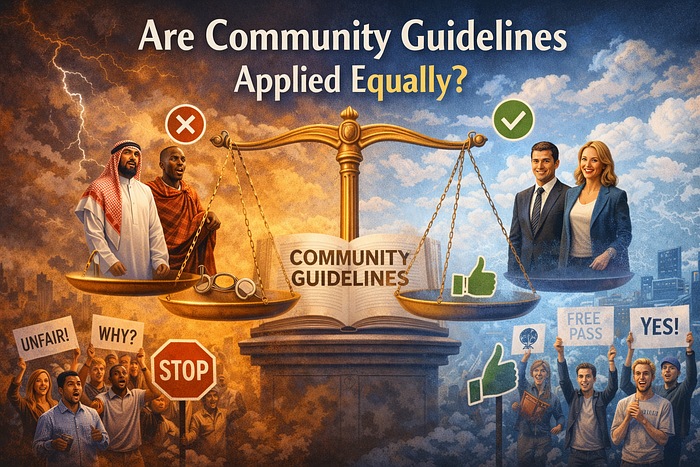
Every Moderation System Starts With Policy
Before moderators review a single post, there are already layers of policy frameworks in place.
Most platforms build moderation systems around:
- Written guidelines
- Enforcement definitions
- Severity levels
- Escalation paths
- Penalty structures
- Risk classifications
Moderators are trained to apply these policies consistently across users.
At least in theory, your:
- Follower count
- Political views
- Nationality
- Popularity
- Personal identity
…should not affect enforcement outcomes.
The focus is supposed to remain on:
- The content
- The context
- The behavior
- The potential harm
That principle is taken seriously inside Trust and Safety teams.
I remember during one calibration session, reviewers spent nearly an hour discussing a borderline harassment case because the language itself was ambiguous. The goal wasn’t speed. It was consistency.
Moderation systems rely heavily on alignment because inconsistent enforcement damages trust quickly.
But alignment becomes difficult at global scale.
Similar Posts Can Have Completely Different Meanings
This is where public perception and moderation reality start separating.
Two posts can look almost identical while requiring completely different decisions.
For example:
One user may quote harmful language while criticizing discrimination.
Another user may use the exact same language to directly target someone abusively.
From the outside, screenshots look similar.
Inside moderation systems, context changes everything.
I once reviewed two videos containing aggressive speech:
- One was a documentary exposing extremist ideology
- The other was actively promoting hate toward a vulnerable group
Same keywords. Different intent. Different enforcement outcome.
This is why moderation cannot operate purely on surface-level comparisons.
Moderators often evaluate:
- Intent
- Historical behavior
- Audience targeting
- Coordination signals
- Satire indicators
- Risk of real-world harm
Users usually see one isolated post.
Moderators often see months of account behavior behind it.
And that broader behavioral context can significantly change enforcement decisions.
Enforcement Is Not Happening At Human Scale
One thing many users underestimate is the scale modern platforms operate under.
Millions of pieces of content are reviewed every single day:
- Comments
- Videos
- Livestreams
- Memes
- Images
- Audio
- Stories
- Ads
Some reviews happen through:
- AI systems
- User reports
- Automated detection
- Human moderation
- Escalation teams
No matter how strong training systems become, scale introduces variability.
Humans make mistakes.
AI models miss context.
Policies evolve slower than internet culture.
I’ve personally seen harmless satire incorrectly flagged by automation while genuinely harmful content bypassed detection because users intentionally manipulated spelling, visuals, or coded language.
These inconsistencies are frustrating.
But they are not always evidence of intentional bias.
Sometimes they are consequences of operating moderation systems at internet scale.
That doesn’t excuse errors.
But it explains why “perfect consistency” is operationally unrealistic.
Why Big Accounts Create Bigger Controversies
This is where public distrust becomes strongest.
When a regular user violates policy and gets suspended, the story rarely trends.
When a celebrity, politician, influencer, or public figure violates policy, enforcement suddenly becomes global news.
People immediately ask:
“Why are they getting special treatment?”
Inside Trust and Safety, high-profile accounts are usually handled differently, but not necessarily because platforms want to protect them personally.
The reason is impact.
Removing or restricting major public accounts can affect:
- News coverage
- Public discourse
- Elections
- Financial markets
- Public safety concerns
- Real-world behavior
That means these cases often go through:
- Escalation teams
- Legal review
- Policy leadership
- Risk assessment groups
I remember one high-visibility escalation where reviewers weren’t only analyzing policy violations. They were also evaluating potential offline consequences of enforcement itself.
From the outside, this slower process can appear like favoritism.
From inside moderation systems, it often looks more like high-risk decision management.
Bias Is Always A Risk
No moderation system is completely immune from bias.
And internally, Trust and Safety teams know this.
That’s why serious moderation operations invest heavily in:
- Calibration sessions
- Quality audits
- Cross-regional reviews
- Policy testing
- Enforcement trend analysis
- Bias monitoring
- Language specialization teams
The goal is not perfection.
The goal is reducing inconsistency as much as possible.
Because moderation decisions are made by humans interpreting human behavior. And humans naturally carry:
- Cultural assumptions
- Regional perspectives
- Language interpretations
- Social conditioning
I’ve seen situations where moderators from different regions interpreted humor differently because local cultural context changed the perceived severity.
That’s why alignment work never stops inside moderation teams.
Fairness isn’t something platforms “achieve” once.
It’s something they constantly attempt to improve.
Users Often Judge Enforcement Through Visibility
Another major reason moderation appears unequal is visibility bias.
Users only see the content that remains online.
They rarely see:
- Quiet removals
- Prevented uploads
- Hidden enforcement actions
- Account warnings
- Reduced distribution penalties
- Internal escalations
- Safety interventions happening behind the scenes
Moderation success is often invisible.
But enforcement failures become screenshots shared across the internet instantly.
That creates a perception gap where moderation appears absent even when massive amounts of enforcement are happening continuously.
The Hard Truth About “Equal Enforcement”
Here’s the honest answer from inside Trust and Safety:
Community guidelines are designed to be applied equally.
Moderators are trained to apply them consistently.
Systems are audited to reduce disparities.
But equal enforcement at global scale is incredibly difficult.
Because moderation is not only about rules.
It’s about applying judgment across:
- Different cultures
- Different laws
- Different contexts
- Different risk levels
- Different behavioral patterns
- Different public impacts
And those variables don’t always produce identical outcomes.
Two cases may look similar publicly while containing very different internal context signals.
That complexity is often invisible to users.
Moderation Is More Than Rule Enforcement
One thing working in Trust and Safety taught me is this:
Moderation is not simply deleting bad content.
It’s managing competing risks in real time.
Protecting expression while reducing harm.
Maintaining consistency while adapting to context.
Moving quickly without creating unnecessary mistakes.
And every decision is made under enormous public scrutiny.
That pressure is something most users never fully see.
Final Thoughts
So, are community guidelines applied equally?
The honest answer is:
They are built with that goal in mind.
But achieving perfect equality across billions of users, cultures, languages, and behaviors is incredibly challenging.
Moderation systems are imperfect because human communication itself is imperfect.
Still, inside most Trust and Safety teams, one principle remains constant:
Consistency is not optional.
Because without consistent enforcement, platforms lose the one thing moderation systems are built to protect in the first place:
Trust.