From someone working in Trust & Safety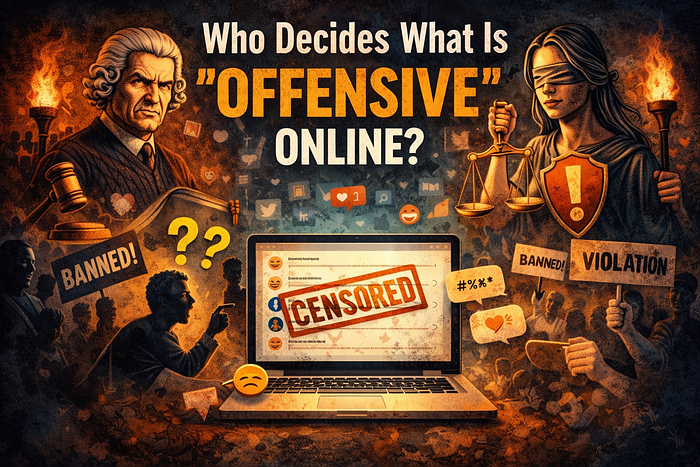
“Who are you to decide what’s offensive?”
Honestly, it’s a fair question.
From the outside, content moderation can look like a hidden group of anonymous people sitting behind screens deciding what billions of users are allowed to say online.
And when a post gets removed, limited, demonetized, or banned, people naturally assume a moderator personally disliked it.
But working in Trust and Safety taught me something very different.
Moderation is not built around personal opinion.
At least, it’s not supposed to be.
The real system is far more layered, structured, and complicated than most users imagine.
And the hardest part?
“Offensive” itself is one of the most subjective words on the internet.
Moderators Don’t Create the Rules
One of the biggest misconceptions about moderation is that moderators invent policies themselves.
They don’t.
Moderators are trained to apply written enforcement guidelines developed through multiple layers of review. These policies are usually shaped by:
- Platform policy teams
- Legal advisors
- Safety experts
- Regional specialists
- Public pressure
- Advertiser standards
- Local laws
- Government regulations
Moderators enforce the rules. We rarely create them.
I remember one situation where a user appealed a removal decision and accused the moderation team of being “personally offended” by their political opinion.
But the actual enforcement had nothing to do with politics.
The post included targeted harassment toward a protected group, which directly violated policy language. Whether a moderator personally agreed or disagreed with the opinion was irrelevant.
That distinction matters more than most people realize.
Trust and Safety operations depend heavily on separating personal belief from policy enforcement.
“Offensive” Means Different Things to Different People
Here’s where things get difficult.
What one person considers harmless humor, another person may experience as hate speech.
What feels normal in one culture may feel deeply offensive in another.
And online platforms operate globally.
I once reviewed content involving slang that was considered friendly banter in one region but an offensive slur in another country entirely. The moderation decision required escalation because context completely changed the meaning.
This happens more often than people think.
Language evolves constantly:
- Memes change meaning
- Symbols get repurposed
- Slang becomes weaponized
- Communities reclaim harmful language
- Political climates shift interpretation
Moderation cannot rely only on dictionary definitions anymore.
That’s why Trust and Safety teams focus heavily on context.
Moderators Are Trained to Look Beyond Emotion
Most people assume moderators simply ask:
“Does this offend me?”
That’s not how modern moderation works.
Moderators are trained to assess several factors:
- Intent
- Target
- Severity
- Context
- Credibility
- Impact
- Risk of harm
For example:
- Is the content attacking someone directly?
- Is it targeting a protected characteristic?
- Is it satire?
- Is it educational commentary?
- Is it incitement?
- Is it part of coordinated harassment?
Those distinctions completely change enforcement outcomes.
I remember reviewing a video where offensive language was repeatedly used. On the surface, it looked like an obvious policy violation.
But after reviewing the full context, we realized it was a documentary discussing online radicalization and exposing extremist behavior critically.
Without context, the content would likely have been removed incorrectly.
That experience reinforced how dangerous oversimplified moderation can become.
Moderation Is Rarely Binary
Users often think moderation works like this:
- Offensive = Remove
- Not offensive = Allow
Reality is much messier.
Most platforms operate with multiple enforcement layers:
- Clearly violating content
- Borderline content
- Context-dependent content
- Distasteful but allowed speech
- Harmful coordination patterns
- Escalation-required edge cases
And many cases fall into gray areas.
For example, a post may not violate policy alone, but repeated behavior across multiple posts might indicate harassment campaigns or targeted abuse.
Moderation decisions are often based on cumulative behavior, not isolated screenshots.
That nuance is difficult to explain publicly, especially when users only see one removed post without understanding the broader account history.
The Internet Compresses Complex Decisions Into Seconds
One thing many users underestimate is the speed of moderation environments.
Platforms receive enormous content volumes every minute:
- Videos
- Livestreams
- Comments
- Images
- DMs
- Ads
- Audio clips
Moderators often review content under strict productivity and accuracy expectations simultaneously.
I’ve personally worked queues where decisions had to be made within minutes while handling emotionally intense content continuously.
Now imagine balancing:
- Policy interpretation
- Cultural context
- Legal risk
- User safety
- Consistency standards
- Platform guidelines
All while millions of users expect perfect fairness.
That’s the reality behind many moderation systems.
Most Platforms Don’t Ban Content For Being “Offensive”
This surprises many people.
Platforms rarely use “offensive” as a standalone enforcement category because the term itself is too subjective.
Instead, policies focus on measurable forms of harm such as:
- Hate speech
- Harassment
- Violent threats
- Graphic violence
- Exploitation
- Terrorism
- Misinformation risks
- Self-harm promotion
- Dangerous organizations
Something can offend thousands of people and still remain allowed under platform policy.
And something that appears harmless at first glance may violate policy due to coded harassment or harmful targeting.
Moderation is usually less about emotional discomfort and more about risk assessment.
Human Subjectivity Never Fully Disappears
Even with structured guidelines, moderation can never become completely objective.
Human reviewers still bring:
- Cultural knowledge
- Language understanding
- Regional awareness
- Personal experiences
- Social interpretation skills
That’s why moderation teams invest heavily in:
- Training programs
- Calibration sessions
- Quality audits
- Escalation reviews
- Policy refreshers
- Consistency checks
I remember calibration meetings where moderators debated edge cases for nearly an hour because interpretations varied slightly between regions.
The goal wasn’t to eliminate all disagreement.
The goal was to reduce inconsistency as much as possible.
But complete consistency across billions of users and cultures?
That’s probably impossible.
The Real Conflict: Safety vs Expression
Most moderation debates are actually about one core tension:
How much harmful speech should platforms tolerate in the name of free expression?
That balance changes constantly.
Some users believe platforms remove too much.
Others believe platforms don’t remove enough.
And both sides often criticize the exact same moderation systems.
From inside Trust and Safety, I’ve learned that moderation is rarely about “good versus bad.”
It’s usually about competing harms.
- Remove harmful speech too slowly and users get hurt.
- Remove aggressively and people accuse platforms of censorship.
That tension exists in almost every major moderation decision online today.
So, Who Actually Decides What’s Offensive?
In practice, it’s not one person.
It’s a layered system involving:
- Governments
- Platform executives
- Policy teams
- Legal departments
- Safety experts
- Advertisers
- Community feedback
- Regional regulations
- Moderation operations teams
Moderators are only one part of that structure.
And despite public perception, most moderators are not trying to “control opinions.”
They are trying to apply policies consistently in environments where culture, language, politics, humor, and harm constantly overlap.
Final Thoughts
From inside Trust and Safety, I can say this confidently:
The goal of moderation is not to eliminate disagreement.
It’s to reduce harm while preserving as much legitimate expression as possible.
And that line between expression and harm is where the hardest decisions on the internet are made.
So maybe the real question isn’t:
“Who decides what’s offensive?”
Maybe the deeper question is:
How do we define harm in a world where billions of people speak, joke, argue, provoke, and communicate all at once?
Because that’s the challenge moderation systems are actually trying to solve every day.