Every time something harmful trends online, the same question appears:
“Where were the moderators?”
As someone working in Trust and Safety, I’ll say something unpopular:
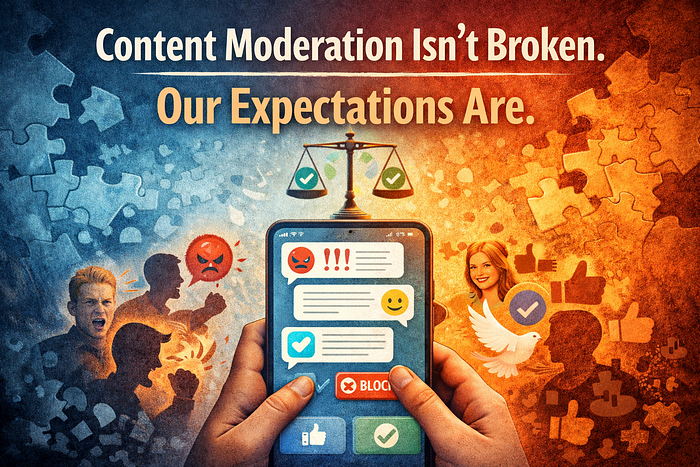
Content moderation is not failing the internet.
The internet is failing moderation.
And honestly, we need to talk about why.
Because from the outside, moderation looks simple. Users see one harmful post, one viral misinformation clip, one abusive comment thread, and assume the system failed.
But inside moderation teams, the reality looks very different.
The problem isn’t that platforms are doing nothing.
The problem is that the internet was designed for speed, engagement, and scale long before it was designed for safety.
And moderators are often asked to fix the consequences of that design in real time.
The Myth of Perfect Safety
One of the biggest misconceptions online is the belief that platforms can stop all harmful content before anyone sees it.
They can’t.
At scale, platforms process millions, sometimes billions, of uploads every single day:
- Videos
- Livestreams
- Comments
- Images
- Stories
- Ads
- Messages
Moderation systems operate in a nonstop race against upload velocity.
I remember working on a high-volume queue during a major global event. Content was flooding the platform faster than review systems could process it. By the time one harmful clip was removed, dozens of reuploads already existed with edited captions, mirrored visuals, or cropped frames to avoid detection.
That experience taught me something important:
Moderation is rarely about “catching everything.”
It’s about reducing harm as quickly as possible in an environment moving faster than humans can react.
But public expectations rarely account for that reality.
Online discourse often treats the existence of harmful content as proof that moderation is broken.
In reality, some exposure windows are operationally unavoidable.
We Want Free Speech. And Perfect Safety.
This is where moderation becomes deeply complicated.
Users want platforms to protect freedom of expression.
At the same time, they expect immediate removal of harmful content.
Those expectations conflict constantly.
Inside Trust and Safety teams, nearly every decision exists between competing pressures:
- Protect users
- Preserve expression
- Reduce harm
- Avoid over-enforcement
- Move fast
- Stay accurate
And there’s no magical balance point.
Remove too much content and platforms get accused of censorship.
Remove too little and they’re accused of enabling harm.
I’ve personally reviewed borderline cases where neither decision felt fully “correct.”
One case involved political satire using extremely aggressive language. Some reviewers felt it promoted harassment. Others argued it was legitimate commentary protected under platform policy.
The final decision required escalations, policy interpretation, historical context review, and regional sensitivity analysis.
Most users never see this side of moderation.
They see a single outcome.
Moderators see layers of risk assessment behind it.
AI Didn’t Break Moderation
Another popular belief is that automation ruined content moderation.
Not true.
Without AI systems, modern platforms would collapse under their own scale.
Imagine manually reviewing every uploaded video, comment, image, and livestream globally. It would be impossible.
AI helps:
- Detect known harmful patterns
- Prioritize dangerous content
- Identify spam networks
- Flag exploitation risks
- Reduce response times
But here’s the real issue:
People expect AI to behave like a human with moral judgment.
That’s not what it does.
AI recognizes patterns.
It does not truly understand:
- Intent
- Cultural nuance
- Satire
- Ethics
- Emotional context
- Evolving social behavior
I once saw an automated system flag a harmless educational post discussing hate speech academically. Meanwhile, another harmful post avoided detection because users intentionally misspelled keywords to bypass filters.
The technology wasn’t “broken.”
It was limited.
The bigger problem happens when platforms or users treat algorithmic decisions as perfect moral conclusions.
That’s not a technology failure.
That’s a governance problem.
Moderation Is Often Cleaning Up Product Decisions
Here’s the uncomfortable truth many people avoid discussing:
A huge amount of harmful content online is amplified by platform design itself.
When engagement becomes the primary success metric, emotionally extreme content naturally performs better.
Anger spreads faster than calm discussion.
Outrage drives comments.
Fear increases shares.
Moderators often handle the downstream consequences of systems optimized for virality.
I’ve seen harmful narratives spread incredibly fast simply because recommendation systems rewarded engagement spikes before moderation systems could respond.
And moderation teams are expected to contain the damage afterward.
That’s why safety cannot depend only on enforcement.
It also depends on:
- Product design
- Recommendation systems
- Account creation friction
- Reporting tools
- Platform incentives
- Virality controls
If platforms truly want safer ecosystems, moderation alone cannot carry the entire responsibility.
The Internet Reflects Human Behavior
Another reality people rarely acknowledge:
Moderators do not create harmful content.
People do.
Harassment, exploitation, hate speech, scams, violent extremism, coordinated abuse, misinformation. These behaviors begin with human choices.
The internet simply amplifies them faster.
One of the hardest realizations I had working in Trust and Safety was understanding that moderation is fundamentally reactive.
Moderators usually encounter harm after someone has already decided to upload it.
That doesn’t mean moderation is useless.
It means moderation addresses symptoms of larger societal behavior.
Expecting moderation alone to “fix the internet” oversimplifies the problem dramatically.
Moderation Success Is Mostly Invisible
Here’s something interesting about Trust and Safety work:
When moderation succeeds, nobody notices.
Users never see:
- The harassment campaign stopped early
- The scam network removed quietly
- The child safety escalation intercepted quickly
- The misinformation cluster prevented from trending
- The coordinated fake accounts disabled before reaching users
Success looks like absence.
Failure looks like screenshots shared publicly.
That creates a perception imbalance where moderation only becomes visible when something goes wrong.
And because failures are public while successes are invisible, moderation teams are constantly judged through incomplete visibility.
The Human Side Nobody Talks About
Behind every moderation decision is usually a human reviewer operating under intense pressure.
Moderators handle enormous content volumes daily while balancing:
- Accuracy
- Policy compliance
- Emotional resilience
- Speed expectations
- Escalation protocols
And unlike public opinion online, moderation decisions cannot rely purely on emotion.
Policies matter. Context matters. Consistency matters.
I’ve had days where I reviewed disturbing content for hours continuously while still needing to maintain objective decision-making. That emotional pressure is something most users never think about when criticizing moderation systems.
The people behind these systems are not detached robots.
They are humans making difficult judgment calls in environments with imperfect information and enormous stakes.
The Real Conversation We Should Be Having
Instead of asking only:
“Why did this post stay online?”
We should also ask:
- Are platform incentives aligned with safety?
- Is virality being prioritized over responsibility?
- Are moderation teams adequately supported?
- Are policies transparent?
- Are users educated about digital risks?
- Are appeals systems fair?
- Are product teams building with safety in mind from the start?
Because blaming moderators alone ignores the larger ecosystem creating these challenges.
Final Thoughts
Content moderation is not perfect. It never will be.
But expecting flawless enforcement inside systems built for frictionless global communication is unrealistic.
From inside Trust and Safety, the real challenge is not incompetence.
It’s contradiction.
We want:
- Global scale without risk
- Freedom without harmful speech
- Instant communication without mistakes
- Open platforms without abuse
- Automation without errors
Those are not simple technical problems.
They are structural tensions built into the modern internet itself.
And until platforms, users, and policymakers address those deeper realities, moderation teams will continue being asked to solve problems that were never created by moderation in the first place.