What I wish someone told me before I entered the field
Every week, someone asks me the same question:
“How do I break into Trust & Safety?”
It’s a growing field. Platforms are expanding their safety teams. Regulations are increasing. Online risk is evolving.
But unlike software engineering or marketing, there’s no single, obvious pathway into Trust & Safety.
Most of us didn’t study “online harm prevention” in college.
We arrived here from different directions.
Here’s what actually works.
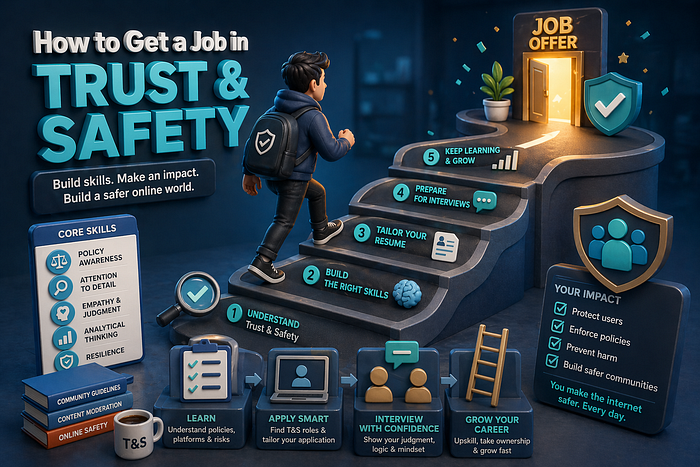
1. Understand What Trust & Safety Really Is
Before applying, understand the scope.
Trust & Safety isn’t just content moderation. It includes:
Content policy
Risk investigation
User safety operations
Quality assurance
Abuse trend analysis
Crisis response
Regulatory compliance
Research real job descriptions. Notice the language they use: risk mitigation, enforcement consistency, policy interpretation, cross-functional collaboration.
This isn’t just clicking approve or reject. It’s structured decision-making at scale.
2. Start Where Entry Is Possible
Many professionals begin as content moderators or safety reviewers.
It may not sound glamorous. It may not pay exceptionally at first.
But it gives you exposure to policy application, case handling, and platform dynamics.
That foundation matters.
Once you understand enforcement from the ground level, you can move into quality, policy, or operational leadership roles.
Treat entry roles as a stepping stone, not a final destination.
3. Build Relevant Skills Intentionally
Trust & Safety rewards specific competencies:
Policy interpretation
Analytical thinking
Pattern recognition
Clear documentation
Emotional resilience
If you’re outside the industry, highlight transferable experience.
Worked in compliance? Emphasize regulatory thinking.
Customer support? Showcase conflict resolution and documentation.
Data analysis? Focus on trend identification.
Frame your experience in terms of risk, consistency, and decision-making.
That’s the language hiring managers understand.
4. Learn the Ecosystem
Follow conversations around online safety.
Read transparency reports from major platforms.
Study how enforcement decisions are explained publicly.
Understand global digital regulations.
You don’t need to be an expert on every law.
But awareness shows seriousness.
Trust & Safety is constantly evolving. Curiosity is a strong signal.
5. Tailor Your Resume Strategically
Generic resumes rarely stand out.
Highlight measurable impact:
Improved quality metrics
Reduced escalation errors
Led training sessions
Identified abuse trends
Improved documentation accuracy
Even if your role wasn’t labeled Trust & Safety, align your achievements with safety outcomes.
Make it easy for recruiters to see the connection.
6. Network Quietly but Consistently
This field is more interconnected than it appears.
Engage thoughtfully in professional communities. Share insights. Ask smart questions. Build credibility over time.
Many opportunities come through referrals.
Not because of favoritism, but because safety work requires trust.
7. Be Prepared for the Reality
Trust & Safety is meaningful work.
It can also be intense.
You’ll face gray areas. Ambiguous cases. Policy debates. Sometimes difficult content.
If you’re entering only because it’s trending, you may burn out.
If you’re entering because you care about online ecosystems being healthier, you’ll find purpose.
There is no single door into Trust & Safety.
There are multiple entry points.
What matters most is positioning yourself as someone who understands risk, values fairness, and can make consistent decisions under pressure.
That combination is rare.
And that’s exactly why the field needs more thoughtful professionals.