It Started Like Any Other Shift
Then within minutes, it wasn’t.
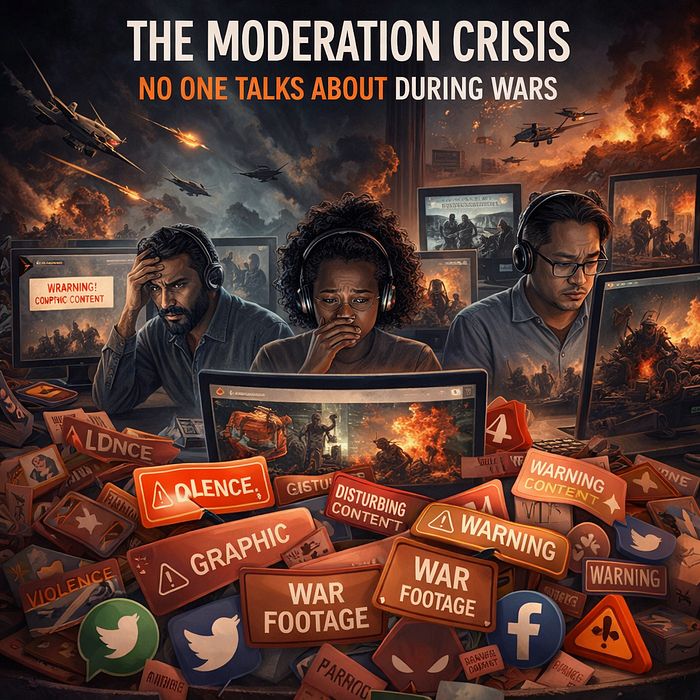
My dashboard started filling up with war-related content. Videos of explosions, screenshots of breaking news, voice notes claiming “insider updates.” The volume didn’t just increase, it spiked.
I remember opening one video. A blast. Smoke rising. People running.
The caption said: “Happening right now.”
At that moment, nothing about it looked suspicious.
The First Crack: Real Content, Wrong Context
A few minutes later, I came across the same video again.
Different account. Different caption.
This time: “Government hiding this. Share before it’s deleted.”
That’s when doubt crept in.
After digging deeper, we found the truth. The video was real, but it wasn’t recent. It was from an older conflict, reposted as if it was happening live.
This is where moderation gets complicated.
The content isn’t fake. The context is.
And verifying that in real time, while thousands of similar posts are flooding in, is not as simple as people think.
When Volume Becomes the Real Enemy
Within an hour, the queue was overwhelming.
Every refresh brought in hundreds of new posts. Some were clips from news channels. Others were cropped images, edited slightly, or reshared with emotional captions.
I remember thinking, even if we review faster, can we catch up?
Because moderation isn’t just about identifying violations. It’s about doing it at scale.
And during conflicts, scale becomes the real enemy.
The Rumors That Don’t Look Like Rumors
In between graphic content, there was another pattern forming.
Text posts.
“Fuel supply may be affected.”
“Stock up essentials now.”
“This will get worse in the next 24 hours.”
None of them made extreme claims. None of them clearly broke policy.
These are the posts that quietly build panic.
Individually harmless. Collectively powerful.
When Panic Moves Offline
A few hours into the shift, something changed.
New posts started appearing. Photos of long queues. Empty shelves. Crowded petrol pumps.
The captions now read: “See? It’s already happening.”
But from experience, I knew the sequence.
The panic didn’t come from confirmed shortages. It came from the fear created earlier.
People reacted to uncertainty. Their reactions became visuals. Those visuals reinforced the original fear.
A perfect loop.
The Part No One Sees
By the time we started taking action on certain content, it felt late.
Not because we were slow, but because the system itself has limits.
Even after removal, the same content reappeared. Screenshots circulated. Messages moved into private groups where visibility dropped, but influence didn’t.
From the outside, it might look like platforms aren’t doing enough.
From the inside, it feels like trying to slow down something that’s already in motion.
What This Crisis Really Is
The moderation crisis during wars isn’t about missing obvious violations.
It’s about dealing with:
Real content used in misleading ways.
Massive volume in very little time.
Human reactions that amplify everything faster than systems can respond.
It’s messy. It’s fast. And it’s rarely visible.
Why This Matters
By the end of my shift, the queue was still full.
But what stayed with me wasn’t the content.
It was the realization that most of the damage doesn’t come from clearly false information.
It comes from uncertainty, urgency, and repetition.
War doesn’t just play out on the ground.
It plays out on screens, in queues, in conversations, and in decisions people make without waiting for confirmation.
And by the time moderation catches up, the world outside has already reacted.
That’s the crisis no one really talks about.