From someone working inside Trust & Safety
I work in Trust and Safety.
So when someone asks me, “Are children actually safe on social media?” I can’t answer casually.
Because I’ve seen what most parents never will.
Let me start with something uncomfortable:
Social media platforms are not inherently built for children.
They are built for engagement. Growth. Retention. Speed.
Safety is layered on top of that.
And while those layers are improving every year, the risks haven’t disappeared. They’ve just evolved.
The Risks Aren’t Always Obvious
When parents think of danger online, they imagine the extreme cases.
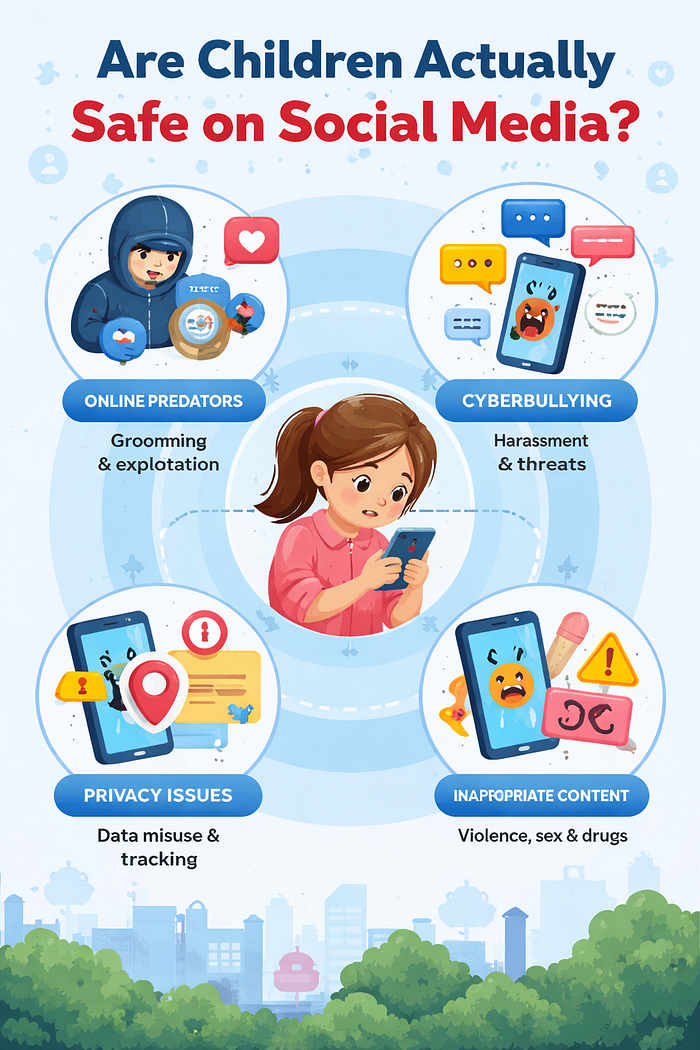
Predators. Explicit content. Criminal behavior.
Those exist. And platforms invest heavily in detecting and removing them.
But the more common risks are quieter.
- Grooming that begins as “innocent” conversation
- Peer harassment that escalates privately
- Algorithmic exposure to content that slowly distorts body image or self-worth
- Viral trends that normalize risky behavior
The danger is often gradual, not dramatic.
It doesn’t look like a crime scene.
It looks like a comment thread.
AI Helps. But It Doesn’t Understand Childhood
Modern platforms use advanced AI systems to detect harmful content at scale. Without automation, moderation would be impossible.
But AI works on signals and patterns.
Children operate on emotion, curiosity, and impulse.
A machine can flag explicit content.
It struggles to detect manipulation wrapped in kindness.
A grooming interaction rarely starts with something illegal. It starts with trust-building.
And intent is much harder to detect than keywords.
That’s where human reviewers come in. But even then, moderation is reactive. It often relies on reports or detectable signals.
And children don’t always report.
The Algorithm Problem
Here’s another uncomfortable truth.
Recommendation systems optimize for engagement.
If a child watches one video about dieting, they might get ten more.
If they click on dramatic content, the system feeds intensity.
No one designs platforms to harm children.
But optimization systems don’t inherently understand developmental vulnerability.
A 13-year-old and a 30-year-old may use the same app.
They should not experience it the same way.
Yet the architecture is often shared.
Safety Is a Shared Responsibility
From inside Trust & Safety, I can say this clearly:
Platforms are investing more than ever in child safety.
Age detection systems.
Stricter default privacy settings.
Dedicated child safety teams.
Proactive detection models.
Escalation partnerships.
But no system is perfect at scale.
Which means safety doesn’t live in one place.
It lives in:
- Platform design
- Parental awareness
- Digital literacy education
- Clear reporting systems
- Responsible product decisions
When one of those fails, children feel the impact.
So, Are They Safe?
The honest answer is nuanced.
Children are safer online today than they were ten years ago in terms of enforcement and detection.
But “safer” does not mean “fully safe.”
The internet amplifies everything. Good and bad.
And childhood is a stage of exploration without full risk awareness.
From my perspective in Trust & Safety, the question shouldn’t be “Are kids safe?”
It should be:
Are we designing systems that assume they are vulnerable?
Until that assumption becomes foundational rather than reactive, the work isn’t done.
And neither is the conversation.