From someone working in Trust & Safety
If you’ve ever had your account suspended and thought, “This makes no sense,” you’re not alone.
And I’ll say something that might surprise you.
Sometimes, suspensions are unfair.
Not because platforms want to silence people. Not because moderators enjoy banning accounts. But because moderation at scale is complex, imperfect, and constantly evolving.
From inside Trust & Safety, I’ve seen how these situations happen.
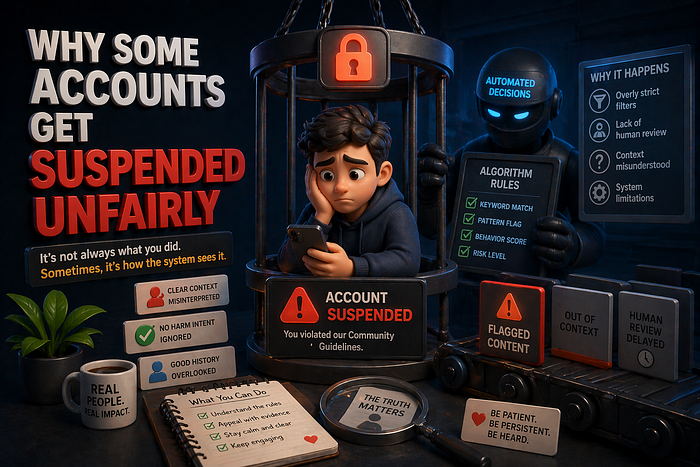
1. Automation Moves Faster Than Context
Most large platforms rely heavily on automated systems to detect violations.
These systems scan for patterns. Keywords. Behavioral signals. Network connections. Risk scores.
They are designed to move fast.
But speed has trade-offs.
AI does not understand tone. It struggles with sarcasm. It can misinterpret educational discussions as promotion. It can flag reclaimed language as hate speech.
When automation is tuned aggressively to catch harmful content, false positives increase.
And sometimes, that leads to unfair suspensions.
2. Patterns Can Be Misleading
Enforcement decisions often consider account behavior patterns.
If an account suddenly posts at high volume, connects to flagged networks, or uses language statistically linked to violations, it may trigger risk thresholds.
But patterns don’t always tell the full story.
A new creator growing quickly may look like spam.
An activist discussing sensitive topics may resemble coordinated behavior.
A journalist covering extremism may trigger detection systems.
Context matters. And context isn’t always immediately visible to automated tools.
3. Policy Gray Areas Exist
Not all suspensions are black and white.
Some cases fall into policy gray zones where interpretation matters. Different reviewers may evaluate the same content slightly differently based on training and nuance.
Moderation teams work hard to align decisions through calibration sessions and quality audits. But perfect consistency across millions of cases is unrealistic.
When thresholds are tight, borderline content can tip into suspension territory.
From the user’s perspective, it feels sudden and unfair.
From inside, it may have crossed a technical line.
4. Report Campaigns Can Influence Systems
Another reality people don’t talk about enough is coordinated reporting.
If a group of users mass-reports an account, it can elevate the case in review queues. Automation may assign higher risk scores based on report volume.
Human reviewers still make the final call in serious cases. But report surges can increase scrutiny.
Sometimes that scrutiny leads to enforcement that feels disproportionate.
5. Appeals Matter More Than People Realize
This is why appeal systems exist.
Moderation teams know errors happen. Suspensions can be reversed. Accounts can be reinstated. Policies can be clarified.
In my experience, appeals are not meaningless. They are part of quality control.
A system that never corrects itself is more dangerous than one that admits mistakes.
The Honest Truth
Why do some accounts get suspended unfairly?
Because moderation is a balance between speed, safety, and accuracy.
When you operate at global scale, small error rates still affect thousands of people.
That doesn’t make the experience less frustrating.
But it explains why perfection is unrealistic.
From inside Trust & Safety, I can say this: no serious team aims to suspend people unfairly.
The goal is harm reduction.
The challenge is doing it consistently in an ecosystem moving faster than any rulebook.
And that tension is where most of these cases live.