When an account gets banned online, reactions are usually immediate.
Some people say:
“Finally. That account should’ve been removed long ago.”
Others say:
“This is censorship.”
Rarely does anyone stop to ask what actually happened behind the scenes before that ban occurred.
As someone working in Trust and Safety, I can tell you this:
Most bans are not impulsive.
They are usually the result of layered systems, policy reviews, historical analysis, risk assessments, and multiple rounds of enforcement happening quietly in the background long before users ever notice.
From the outside, a ban can look emotional or politically motivated.
From the inside, it’s usually procedural.
And the gap between those two perspectives is where many misunderstandings begin.
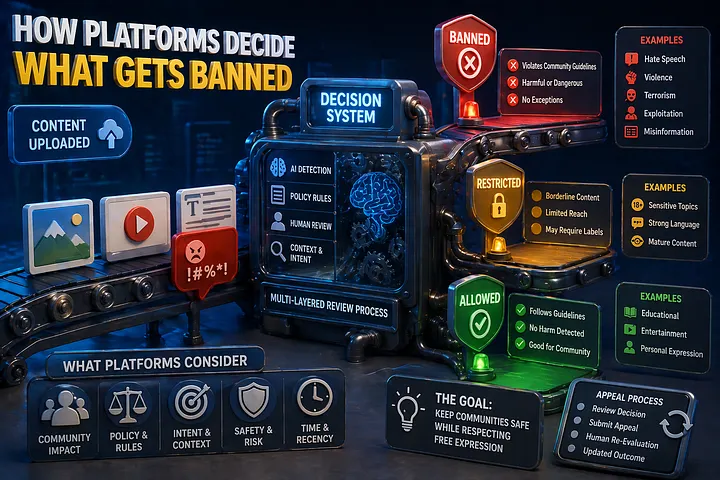
The Internet Sees One Moment. Moderation Sees a Timeline.
One thing users often forget is that moderators rarely evaluate accounts based on one isolated screenshot.
Platforms typically see:
- Previous violations
- User reports
- Behavioral patterns
- Network activity
- Escalation history
- Repeated enforcement actions
- Risk indicators over time
I remember reviewing an account that looked harmless if you viewed only one post. Nothing obvious violated policy directly.
But after reviewing the broader account behavior, the pattern became clear:
- Repeated harassment toward multiple users
- Coordinated targeting
- Ban evasion attempts
- Reuploaded removed content
- Escalating aggression over several weeks
What users saw publicly was one suspension.
What moderation teams saw internally was a long behavioral history.
That difference matters.
1. Every Ban Starts With Policy
Contrary to popular belief, moderators do not wake up and ban people because they personally dislike their opinions.
Every enforcement system begins with written policy.
Platforms create detailed guidelines defining prohibited behaviors such as:
- Hate speech
- Harassment
- Threats
- Violent extremism
- Exploitation
- Fraud
- Impersonation
- Coordinated manipulation
- Dangerous organizations
Moderators are trained to apply those policies consistently.
If a rule is vague or undefined, enforcement becomes inconsistent quickly.
That’s why policy language matters so much inside Trust and Safety operations.
I’ve personally seen escalation discussions where reviewers debated the exact interpretation of one policy sentence because wording determines enforcement outcomes at scale.
Users often assume moderation is emotional.
In reality, it’s heavily documentation-driven.
2. Severity and Behavioral Patterns Matter More Than One Mistake
Most platforms don’t permanently ban users for a single minor violation.
Enforcement systems usually operate progressively.
A typical escalation path may look like this:
- Warning
- Content removal
- Temporary restriction
- Reduced visibility
- Feature limitation
- Temporary suspension
- Permanent ban
Account history becomes extremely important.
Someone who accidentally violates policy once is treated differently from an account repeatedly engaging in harmful behavior.
I remember handling a case involving repeated misinformation uploads. Individually, each post existed in borderline territory. But together, the behavior showed a clear pattern of coordinated harmful activity.
That pattern changed the enforcement decision entirely.
Moderation systems care deeply about repeat behavior because repeated violations signal intent, not accident.
And intent significantly affects risk assessment.
3. Automation Usually Detects Problems First
At internet scale, human moderators cannot review everything manually.
That’s impossible.
So platforms rely heavily on automation systems for first-layer detection.
AI systems scan for:
- Known harmful imagery
- Violent content
- Extremist signals
- Spam patterns
- Coordinated behavior
- Ban evasion attempts
- Keyword patterns
- Behavioral anomalies
Some high-confidence violations may trigger automatic action instantly.
But many cases still require human confirmation.
I’ve seen automation flag harmless educational content discussing hate speech academically. I’ve also seen harmful coordinated abuse avoid detection because users intentionally altered spelling or visuals to bypass systems.
That’s why human review remains essential.
Moderators evaluate:
- Context
- Intent
- Severity
- Credibility
- Escalation risk
Automation detects patterns.
Humans interpret meaning.
And the combination of both systems drives most enforcement decisions online today.
4. High-Profile Accounts Go Through More Review
This is where public skepticism becomes strongest.
When a large creator or public figure violates policy, users often ask:
“Why aren’t they banned immediately?”
Inside Trust and Safety, the answer is usually complexity.
High-profile enforcement decisions carry larger consequences:
- Public backlash
- Media scrutiny
- Legal exposure
- Political implications
- Regulatory attention
- Real-world safety concerns
That doesn’t necessarily mean platforms want to protect influential accounts.
It means those decisions often require stronger internal defensibility.
I once observed an escalation involving a major public-facing account where enforcement discussions involved:
- Policy teams
- Legal reviewers
- Senior escalation specialists
- Risk assessment groups
Not because the rules were different.
Because the consequences of enforcement were bigger.
From the outside, this can look like favoritism.
From inside moderation systems, it often looks like high-risk governance.
5. Banning an Account Is a Risk Decision
Most users think bans are purely about content.
In reality, bans are often about risk.
Moderators and escalation teams may assess:
- Potential real-world harm
- Threat credibility
- Coordinated abuse patterns
- User safety risks
- Manipulation networks
- Legal concerns
- Public impact
For example, an account repeatedly organizing targeted harassment campaigns may pose greater platform risk than a single offensive comment.
Similarly, misinformation during sensitive events can carry higher enforcement urgency because timing changes impact.
I remember working during a high-tension global event where escalation thresholds shifted because harmful narratives spreading quickly could create immediate offline consequences.
Moderation decisions are not always static.
Risk environments matter.
6. Appeals Exist Because Moderation Is Not Perfect
One misconception online is that bans are final and unquestionable.
Most major platforms actually allow appeals.
Appeals usually involve separate review layers where decisions may be:
- Upheld
- Modified
- Reversed
- Escalated further
And yes, reversals happen.
I’ve personally seen bans overturned after:
- New context emerged
- Earlier reviews missed important details
- Policy interpretation changed
- Automation errors were identified
No moderation system is flawless.
A platform that never reverses decisions isn’t necessarily accurate.
It may simply lack strong correction mechanisms.
Appeals are important because moderation operates under uncertainty more often than users realize.
The Reality Behind the Ban
From the outside, bans often appear sudden.
From the inside, they are usually the final step in a longer enforcement timeline.
Most bans happen after:
- Repeated policy violations
- Escalation reviews
- Behavioral investigations
- Coordinated abuse analysis
- High-confidence risk detection
- Documented enforcement history
And contrary to internet narratives, most moderators are not trying to silence unpopular opinions.
The actual goal is usually much simpler:
Reduce harm at scale while maintaining platform integrity.
That doesn’t mean moderation systems are perfect.
Mistakes happen.
Bias exists.
Context can be difficult.
Policies evolve.
Judgment calls remain complicated.
But behind nearly every ban is far more structure than users ever see publicly.
Final Thoughts
One of the biggest lessons I’ve learned working in Trust and Safety is this:
The internet moves emotionally.
Moderation moves procedurally.
Users react to moments.
Moderation systems analyze patterns.
And because the public usually sees only the final action, not the months of signals behind it, enforcement can easily appear random or politically motivated.
But most bans are not impulsive decisions made by one moderator behind a screen.
They are usually the result of layered reviews, documented policies, behavioral analysis, and risk evaluation happening quietly behind the platform itself.
That complexity may not always be visible.
But it exists behind almost every major enforcement action online today.