From inside Trust & Safety
On the surface, protecting minors online sounds straightforward.
Detect harmful content. Remove it. Ban bad actors.
If only it were that simple.
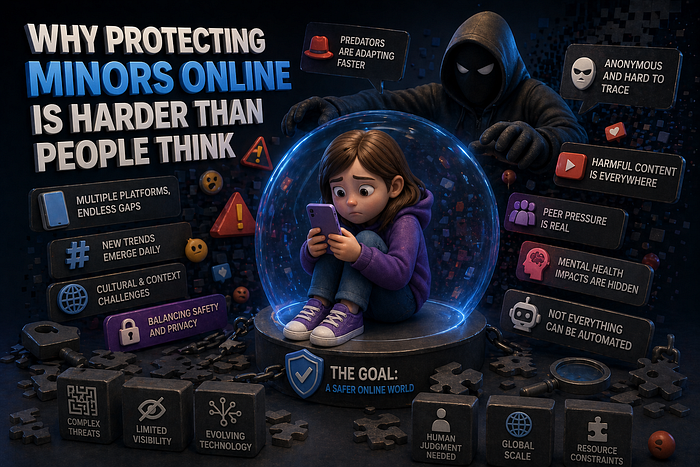
Working in Trust & Safety, I’ve learned that protecting minors isn’t just about taking down obvious violations. It’s about navigating scale, ambiguity, privacy, evolving tactics, and human behavior all at once.
And that complexity is often invisible to the public.
1. Harm Rarely Looks Obvious at First
When people imagine online harm targeting minors, they picture explicit exploitation.
In reality, risk usually begins subtly.
An adult consistently engaging with young users.
Conversations that slowly become personal.
“Friendly” attention that shifts over time.
Early-stage grooming often doesn’t violate clear policy thresholds. It exists in gray areas where intent is difficult to prove.
By the time behavior becomes clearly malicious, trust may already be established.
Prevention requires detecting patterns, not just posts.
And patterns are harder to catch.
2. Platforms Operate at Massive Scale
Billions of interactions happen daily across major platforms.
Even with advanced detection systems, reviewing everything proactively is impossible.
Automation helps flag high-risk content. But AI models rely on signals, keywords, and behavioral data. They don’t fully understand nuance.
False positives affect innocent users. False negatives allow harmful behavior to continue.
Balancing precision and recall in child safety systems is one of the toughest challenges in digital safety.
Small error rates at scale still affect thousands.
3. Privacy Limits Surveillance
There’s a constant tension between safety and privacy.
Users expect private messaging to remain private. Many regions have strict data protection laws. Platforms cannot simply monitor every conversation in real time without ethical and legal consequences.
Harm often migrates to direct messages or smaller groups. By the time reports surface, damage may have already occurred.
Protecting minors while respecting privacy is not a binary decision. It’s a careful balancing act.
4. Age Verification Is Imperfect
Another overlooked challenge is age detection.
Many minors misrepresent their age to access platforms. Some adults pretend to be minors.
Age signals can be unreliable unless verified through strong identity systems, and those systems raise their own privacy concerns.
Without accurate age data, enforcement decisions become harder.
You can’t always protect someone effectively if you don’t know they’re a minor.
5. Harm Evolves Faster Than Policies
Bad actors adapt quickly.
New slang. New symbols. New evasion tactics.
As soon as detection systems improve, methods shift.
Policy teams constantly update definitions and enforcement guidance. Moderators receive updated training. Risk teams analyze trends.
But the internet moves fast.
Child safety frameworks must evolve continuously to keep up.
6. Emotional Impact on Enforcement Teams
This part is rarely discussed.
Protecting minors requires human review in many cases. That means real people are exposed to deeply disturbing content.
Burnout is a real risk.
And decision fatigue can impact enforcement quality.
Strong child safety systems require not just technology, but sustainable human support.
The Reality Behind the Headlines
From the outside, it can look like platforms simply need to “do better.”
From the inside, I can say this: many teams are working relentlessly to improve detection, response time, and prevention mechanisms.
Protecting minors online isn’t a single feature. It’s an ecosystem of policy, technology, human judgment, education, and constant adaptation.
It’s harder than people think.
But it’s also one of the most important responsibilities in Trust & Safety.
And it’s work that has to keep evolving, no matter how complex it becomes.