When people talk about content moderation, the conversation usually goes in two directions.
Either platforms are accused of censoring too much, or they’re blamed for not doing enough.
From the outside, moderation often looks simple. Many people imagine moderators scrolling through obviously harmful posts and clicking a delete button. In reality, that picture is far from accurate.
After working in Trust and Safety operations, I’ve learned that the hardest part of moderation is not identifying obvious violations. The real challenge is dealing with everything that sits in the gray area.
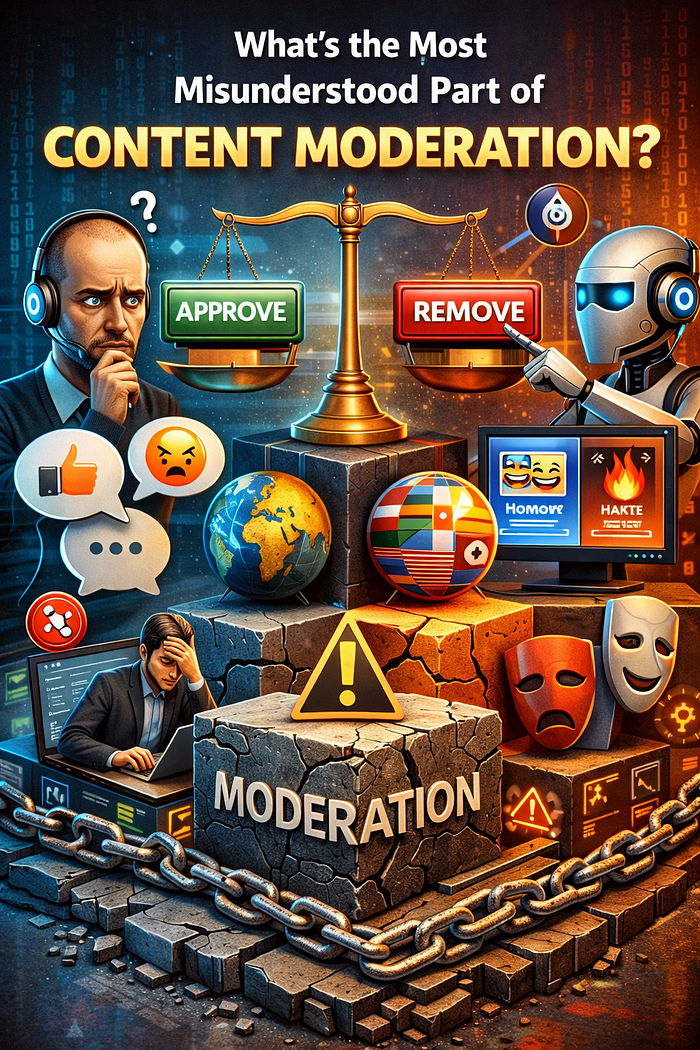
Most Decisions Aren’t Obvious
One of the biggest misunderstandings is that harmful content is always easy to identify.
In practice, a large portion of the content moderators review isn’t clearly good or clearly bad. It sits somewhere in between.
For example, imagine a video showing violence.
At first glance, it might look like a clear violation. But context changes everything.
Is the video promoting violence?
Is it documenting a real-world event?
Is it part of a news report?
Is it educational?
Is it satire?
The exact same piece of content can fall into different policy categories depending on the surrounding context. Moderators often have only seconds to make these decisions.
The Scale Is Hard to Imagine
Another misunderstood part of moderation is the sheer volume of content.
Every day, millions of videos, images, comments, and live streams are uploaded across platforms. Without automation, it would be impossible to manage.
Artificial intelligence helps detect obvious violations. But the most complicated cases almost always end up in front of human moderators.
And those complicated cases are exactly where interpretation matters the most.
Moderation Is More Than Removing Content
Many people assume content moderation simply means deleting posts.
In reality, platforms use a wide range of actions depending on the situation. Content might be:
- Age restricted
- Given a warning label
- Reduced in visibility
- Demonetized
- Blocked in certain regions
- Escalated to specialized safety teams
Removing content is only one option among many.
Moderation is often about reducing risk, not just removing posts.
The Emotional Reality of the Work
Something that rarely gets discussed publicly is the emotional side of moderation.
Content moderators regularly review material that most people would never want to see. This can include graphic violence, exploitation, harassment, and disturbing real-world incidents.
Seeing this type of content repeatedly can take a psychological toll.
Many platforms now provide wellness support and mental health resources for moderators. Still, the emotional impact of the job is something many professionals quietly manage behind the scenes.
Moderators Don’t Make Random Decisions
Another common belief is that moderators personally decide what they like or dislike.
In reality, moderation decisions follow detailed policy frameworks. These policies try to balance several competing priorities:
- User safety
- Freedom of expression
- Cultural differences
- Local laws and regulations
Moderators work within these guidelines while trying to apply them consistently at scale.
Moderation Is About Managing Risk, Not Achieving Perfection
Perhaps the most misunderstood truth about content moderation is this: perfection isn’t possible.
At the scale of the internet, mistakes will happen. Harmful content may slip through, and some decisions will always be debated.
Content moderation is ultimately about reducing harm as much as possible while keeping platforms open for conversation and creativity.
From the outside, the system can look messy.
From the inside, it’s a constant effort to make responsible decisions in a fast moving environment where context, scale, and human judgment all collide.