The First Time I Couldn’t Tell
I remember pausing on a video longer than usual.
It showed a missile strike. Clean visuals. Perfect angle. No shake, no distortion. Almost cinematic.
The caption said: “Happening right now.”
For a moment, even with experience in Trust & Safety, I wasn’t sure.
Then came the doubt.
Not because it looked fake, but because it looked too real.
That was the moment I realized the rules had changed.
When AI Started Creating the Story
Earlier, misinformation had patterns. Blurry edits. Mismatched audio. Obvious inconsistencies.
Now, AI-generated content blends in.
During recent conflict-related spikes, I started seeing videos, images, even voice notes that felt authentic but lacked verifiable origin.
A destroyed building rendered with precision. A voice clip claiming insider updates. A map animation showing troop movement.
All of it believable.
From a moderation perspective, this shifts the problem.
We’re no longer just identifying misleading content.
We’re questioning reality itself.
The Speed Advantage of Propaganda
AI-generated propaganda has one major advantage.
Speed.
I’ve tracked how quickly such content appears after a major event. Within minutes, narratives start forming. Within hours, visuals appear to support those narratives.
Some are speculative. Some are fabricated. But all of them arrive before verification catches up.
Meanwhile, AI moderation systems are still processing inputs, checking signals, and applying rules.
That gap matters.
Because in wartime, the first version of a story often sticks.
The Illusion of Volume
Another pattern I’ve noticed is volume.
AI doesn’t just create one piece of content. It creates many.
Variations of the same story. Slightly different visuals. Multiple captions. Different languages.
I’ve reviewed queues where similar narratives appeared repeatedly, giving the impression that something was widely confirmed.
But in reality, it was the same idea, multiplied.
This creates perceived credibility.
And perceived credibility drives belief.
When Detection Becomes Uncertain
AI moderation systems rely on patterns.
But AI-generated propaganda is designed to avoid patterns.
Clean visuals. neutral language. no obvious violations.
I’ve seen posts that didn’t trigger any automated flags, even though the narrative was misleading.
From a system perspective, nothing was wrong.
From a human perspective, everything felt off.
That gap is difficult to bridge at scale.
The Human Layer Still Matters
There have been moments where human judgment made the difference.
I remember reviewing a clip that had already gained traction. It passed initial checks. No clear violations.
But something about it didn’t align.
After deeper investigation, we found inconsistencies. Not obvious ones, but enough to question its authenticity.
That’s the thing about AI propaganda.
It doesn’t always fail loudly.
Sometimes, it only fails under scrutiny.
When Platforms Become the Battlefield
At some point, the conflict extends beyond geography.
It becomes a battle of narratives.
AI-generated content pushes one version of reality. Moderation systems try to contain harmful spread. Users react, share, and interpret.
I’ve seen how quickly one narrative can dominate simply because it arrived first and looked convincing.
And once it spreads, correcting it becomes harder.
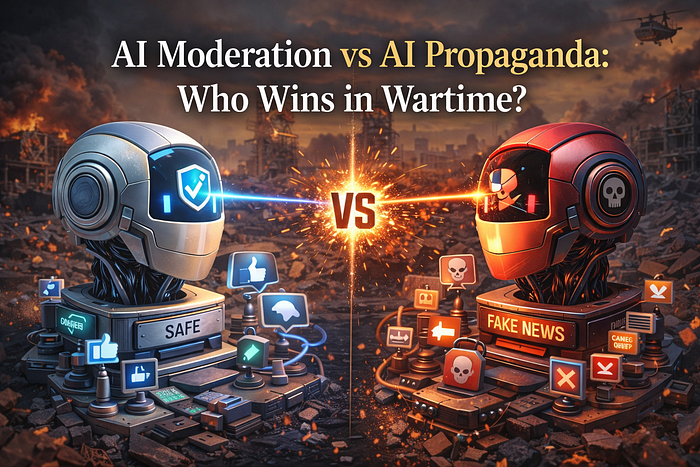
So, Who Wins?
In the early stages, AI propaganda often has the advantage.
It’s faster. Scalable. Designed to engage.
AI moderation, on the other hand, is careful. Structured. Reactive.
But that doesn’t mean it loses completely.
Over time, patterns emerge. Systems improve. Context builds. Corrections happen.
But the damage from the initial wave can still linger.
The Real Challenge Isn’t Technology
From my experience, this isn’t just a technology problem.
It’s a human behavior problem.
People trust visuals. They react to urgency. They share before verifying.
AI propaganda taps into that.
And moderation, no matter how advanced, has to work within those realities.
Final Thought: A Moving Target
Wartime moderation isn’t a fixed battle.
It evolves.
As AI becomes more capable, propaganda becomes more convincing. And as that happens, moderation has to adapt continuously.
From what I’ve seen, there’s no clear winner.
Only a constant race.
One side trying to shape perception faster.
The other trying to protect it before the impact becomes real.
And in that race, timing is everything.