What I’ve learned working in Trust & Safety
When people think about online child safety, they imagine obvious threats.
Explicit messages. Clear intent. Immediate red flags.
But grooming rarely looks obvious in the beginning.
That’s why it slips through.
Working in Trust & Safety, I’ve seen how grooming behavior hides in plain sight. It doesn’t start with explicit harm. It starts with attention. Validation. Patience.
And that subtlety is exactly what makes detection difficult.
1. Grooming Is a Process, Not a Single Post
Most enforcement systems are designed to evaluate individual pieces of content.
One image. One video. One message.
Grooming doesn’t operate in single posts.
It unfolds gradually.
An adult consistently interacting with minors.
Private conversations that slowly become more personal.
Boundary testing disguised as jokes.
If you look at any single message in isolation, it may appear harmless.
The risk emerges only when behavior is viewed over time.
That behavioral pattern recognition is far harder to automate.
2. Language Is Often Ambiguous
Groomers rarely begin with explicit language.
They use compliments. Shared interests. Emotional support.
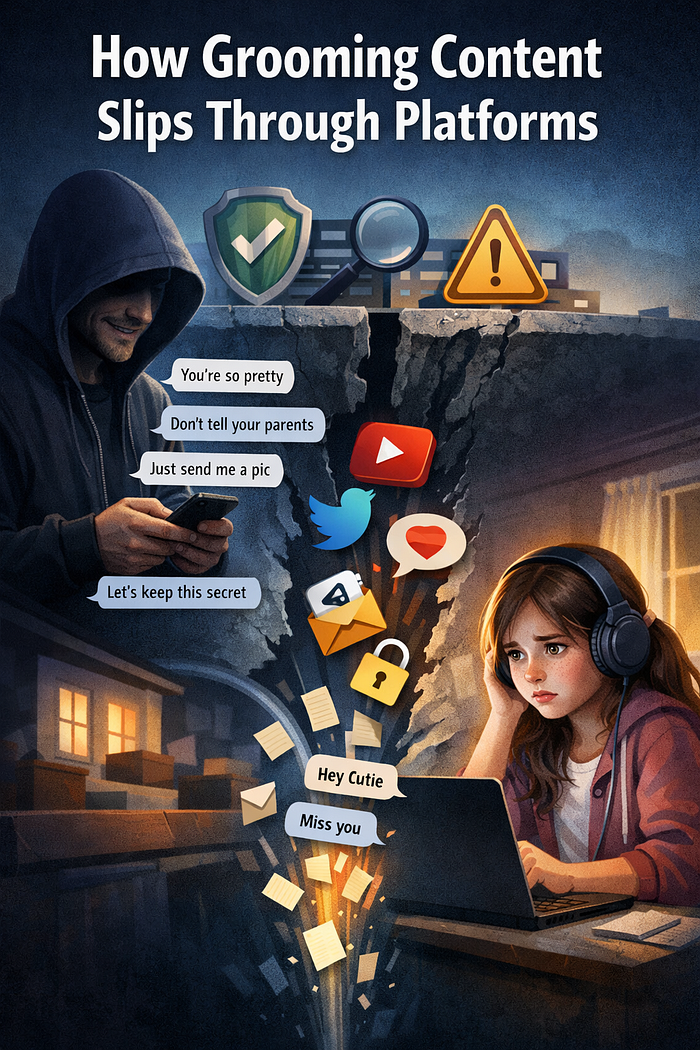
Phrases like “You’re so mature for your age” or “Don’t tell anyone, this is our secret” may not violate policy outright, depending on context.
Automated systems rely on clear signals. Grooming often uses coded, indirect communication.
Without strong behavioral analytics, these conversations may never trigger review.
3. Migration to Private Spaces
Public content is easier to monitor.
Grooming frequently begins in public comments or gaming chats, then shifts quickly to direct messages or external platforms.
Once conversations move to encrypted or private channels, detection becomes more limited.
Platforms can enforce policies within their own systems, but cross-platform behavior creates blind spots.
Bad actors understand this.
They test boundaries publicly, then migrate once trust is built.
4. Report Hesitation
Minors often don’t recognize grooming immediately.
It can feel flattering. Supportive. Secretive in a way that feels special rather than dangerous.
By the time discomfort appears, emotional manipulation may already be established.
And many young users hesitate to report.
They fear getting in trouble.
They fear losing online privileges.
They fear not being believed.
Underreporting allows grooming patterns to persist longer than they should.
5. Scale vs Context
Platforms operate at massive scale.
Billions of interactions happen daily.
Even with advanced detection models, it’s unrealistic to expect every risky conversation to be flagged instantly.
Human reviewers cannot monitor private conversations proactively at scale. Privacy protections also limit surveillance.
This creates a tension between safety and user privacy.
And grooming exploits that tension.
The Hard Reality
Grooming slips through not because companies don’t care.
It slips through because it’s subtle, gradual, and behavior-driven rather than content-driven.
Detection systems are improving. Behavioral analytics are evolving. Safety education for young users is expanding.
But the most powerful defense remains awareness.
When users understand that grooming starts with small boundary shifts, they’re more likely to recognize it early.
From inside Trust & Safety, one thing is clear:
The fight against grooming isn’t just about removing explicit content.
It’s about identifying patterns before they escalate.
And that requires constant adaptation, smarter systems, and ongoing education.
Because the earliest stages rarely look dangerous.
Until they are.