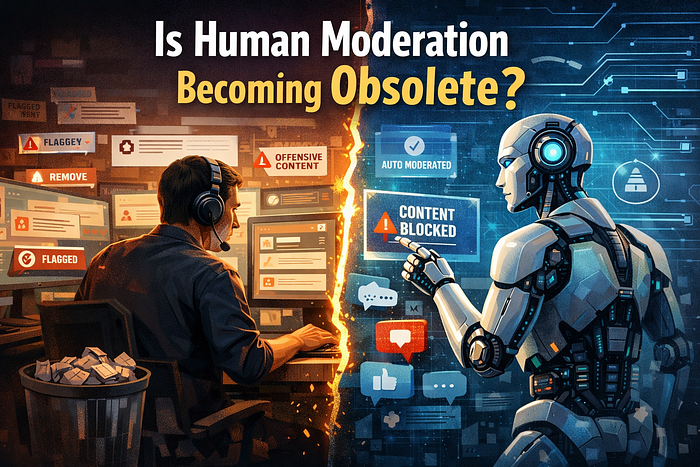
Every few months, a new headline appears claiming that artificial intelligence will soon replace human moderators completely.
The argument usually sounds convincing.
AI is faster.
AI scales better.
AI works 24/7.
AI can scan millions of posts within seconds.
From the outside, it feels logical to assume the future of content moderation will eventually become fully automated.
And honestly, before working in Trust and Safety, I thought something similar myself.
Then I saw how moderation actually works behind the scenes.
And I realized something important:
Human moderation is not disappearing.
In many ways, it’s becoming even more important than before.
Because moderation is not simply about detecting harmful content.
It’s about interpreting human behavior.
And human behavior is messy.
Automation Solves The Easy Problems First
Artificial intelligence is extremely effective at identifying clear, repetitive violations.
Things like:
- Spam campaigns
- Duplicate scam messages
- Explicit nudity
- Known terrorist imagery
- Repeated hate phrases
- Malware links
- Bot behavior
- Fake engagement networks
Machines excel when harmful patterns are obvious and repeat consistently.
I’ve seen automation systems detect thousands of coordinated spam accounts in minutes, something impossible for human reviewers alone.
Without AI assistance, modern platforms simply could not function operationally.
The volume is too massive.
Every minute online platforms receive:
- Videos
- Livestreams
- Images
- Comments
- Audio uploads
- Stories
- Advertisements
- Messages
No human workforce could manually review all of that content fast enough.
Automation is not optional anymore.
It’s infrastructure.
But here’s the important part:
The easiest moderation problems are the ones machines handle best.
The hardest problems still end up reaching humans.
The Hard Cases Are Never Simple
The content human moderators review is rarely obvious.
Most of the time, it exists inside policy gray areas.
I’ve reviewed cases where the challenge wasn’t identifying harmful words.
The challenge was understanding intent.
For example:
- Is this satire or harassment?
- Is this criticism or hate speech?
- Is this documentary footage or glorified violence?
- Is this misinformation or misunderstanding?
- Is this activism or coordinated manipulation?
- Is this humor or targeted abuse?
AI struggles heavily with ambiguity because ambiguity requires interpretation.
And interpretation depends on:
- Cultural understanding
- Social context
- Tone
- Timing
- Behavioral history
- Regional sensitivity
- Human nuance
Machines detect patterns.
Humans understand meaning.
That difference matters far more than most people realize.
Moderation Is Not Just Enforcement. It’s Judgment.
One misconception about moderation is the idea that platforms simply compare content against fixed rules.
In reality, moderation often involves judgment calls under uncertainty.
I remember reviewing a video discussing extremist ideology for educational purposes. The content contained dangerous symbols and disturbing language that automation flagged immediately.
But context changed everything.
The video itself was condemning extremism, not promoting it.
A machine detected keywords and imagery.
A human reviewer understood intent.
That distinction prevented incorrect enforcement.
And situations like that happen constantly inside Trust and Safety operations.
Because the internet is full of context machines still struggle to interpret reliably.
Policies Themselves Need Human Interpretation
Another thing people often overlook is that moderation is not only about enforcing rules.
Someone also has to define those rules.
And online behavior evolves constantly.
Every year brings:
- New manipulation tactics
- New slang
- New misinformation trends
- New forms of harassment
- New platform abuse methods
- New cultural conflicts
- New AI-generated risks
Human Trust and Safety teams constantly analyze emerging threats and ask:
- Does existing policy cover this?
- Is enforcement consistent?
- Are there unintended consequences?
- Do thresholds need updating?
- Are users exploiting loopholes?
I’ve seen moderation queues expose entirely new abuse behaviors that existing policies simply weren’t designed to handle yet.
Machines can enforce written standards.
But humans still define, revise, and interpret those standards continuously.
And that work is becoming more important as internet behavior grows more complex.
AI Is Changing Moderator Roles, Not Eliminating Them
What automation is actually doing is changing the type of moderation work humans perform.
Earlier moderation operations often involved reviewing massive amounts of repetitive violations manually:
- Spam
- Duplicate scams
- Explicit imagery
- Repeated abuse
Now AI filters much of that automatically.
So what remains for humans are:
- Edge cases
- Escalations
- Investigations
- Appeals
- High-risk enforcement decisions
- Policy interpretation
- Behavioral analysis
In other words:
Moderation work is becoming more analytical.
I’ve personally noticed this shift over time. Reviewers increasingly spend less time identifying obvious violations and more time evaluating complex behavioral context.
That evolution matters because complex moderation decisions require deeper reasoning.
Cultural Context Still Breaks Automation
One of the biggest limitations of AI moderation systems is cultural nuance.
A phrase considered harmless humor in one country may represent targeted hate speech in another.
Political satire may look abusive without local context.
Regional slang evolves faster than training datasets.
I once worked on escalations involving coded harassment phrases used inside niche online communities. To outsiders, the language appeared harmless.
Locally, it carried very specific harmful meaning.
Humans recognized the context quickly.
Automation missed it completely.
This is why human reviewers remain essential globally.
Because moderation is not happening in one culture.
It’s happening across thousands of overlapping digital cultures simultaneously.
The Psychological Layer Still Exists
There’s another reality people rarely discuss openly.
Even with strong automation, disturbing content still reaches human reviewers.
Someone still needs to:
- Confirm violations
- Review escalations
- Assess authenticity
- Analyze context
- Make final enforcement decisions
That human responsibility cannot disappear entirely without creating major risks around fairness and accuracy.
And honestly, moderation decisions carry ethical weight.
Removing content affects:
- Visibility
- Speech
- Reputation
- Communities
- Sometimes even livelihoods
That level of impact requires human accountability.
Automation can assist decisions.
But fully removing humans from high-impact enforcement creates its own dangers.
The Future Is Humans And Machines Together
From inside Trust and Safety, the future looks far less like:
“AI replaces moderators.”
And far more like:
“AI and human reviewers operate as layered systems.”
Most likely, future moderation pipelines will continue evolving into partnerships where:
- AI handles scale
- Humans handle ambiguity
- Automation detects patterns
- Humans evaluate intent
- Machines flag risk
- Humans assess consequences
That collaboration is becoming the foundation of modern moderation systems already.
And honestly, it’s probably the only realistic path forward.
Because internet behavior changes too quickly for purely static automation.
The Bigger Challenge Ahead
The real challenge for moderation is not replacing humans.
It’s helping humans work effectively alongside increasingly powerful AI systems.
That means:
- Better escalation systems
- Stronger policy clarity
- Improved reviewer support
- More transparent automation
- Healthier moderation workflows
- Better cultural expertise
- Smarter behavioral analysis
Technology alone cannot solve moderation.
Because moderation is fundamentally about people.
And people remain unpredictable.
Final Thoughts
Before working in Trust and Safety, I assumed automation would eventually dominate moderation completely.
Now I see moderation differently.
AI is incredibly powerful.
Necessary.
Efficient.
Scalable.
But moderation is not only a technical problem.
It’s a human judgment problem operating at global scale.
Behind every difficult enforcement decision, policy escalation, appeal review, or contextual interpretation, there is still a human layer making sense of what machines cannot fully understand.
And for the foreseeable future, that layer is not disappearing.
If anything, it’s becoming more valuable than ever.