Not long ago, most content moderators were reviewing things created by humans.
Photos.
Videos.
Posts.
Comments.
But the internet is changing quickly.
Today, a growing portion of online content is being created by artificial intelligence. Text generators, image models, voice cloning tools, and synthetic video are producing material at a scale we’ve never seen before.
And that raises a strange but important question:
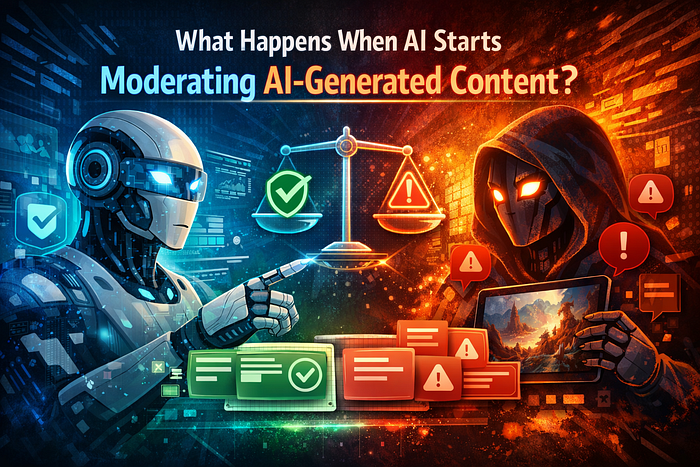
What happens when AI starts moderating content that was created by AI?
From a Trust & Safety perspective, this shift is already beginning.
The Volume Problem Gets Bigger
AI-generated content dramatically increases how much material platforms need to review.
One person using generative tools can produce hundreds of posts, images, or videos in minutes. Spam campaigns that once required teams of people can now be automated.
Moderation systems were already struggling with scale. AI generation multiplies the problem.
Platforms are now dealing with automation on both sides:
AI producing content and AI trying to control it.
Synthetic Content Is Harder to Classify
Moderation models are trained on patterns from real-world behavior. But generative AI can create new variations faster than moderation systems can adapt.
For example:
An AI can generate thousands of slightly different abusive messages.
It can rewrite harmful narratives in new wording.
It can create realistic-looking images that have never existed before.
From a moderation standpoint, this creates a moving target.
The model that detects violations today might struggle with a new format tomorrow.
The Rise of AI-Generated Manipulation
One of the biggest concerns in Trust & Safety is manipulation at scale.
AI-generated content can be used to create fake accounts, coordinated misinformation campaigns, or synthetic personas that interact with real users.
Imagine thousands of AI-generated profiles posting persuasive content around a political issue or social debate.
Even if each individual post looks harmless, the combined effect can influence public conversations.
Moderation systems are not just identifying harmful content anymore. They are trying to detect artificial behavior patterns.
Authenticity Becomes Harder to Verify
Another challenge is authenticity.
When users see a video or image online, they often assume it represents something real. But generative models can now create highly convincing visuals that never actually happened.
Moderators are increasingly asked to review content where the question isn’t just “Is this harmful?” but also “Is this real?”
That distinction is becoming harder to determine quickly, especially when content spreads rapidly.
AI Moderating AI Is Not as Strange as It Sounds
In many ways, this feedback loop is inevitable.
AI-generated content requires AI-level scale to monitor it. Human moderation alone cannot keep up with the speed and volume of synthetic media.
So platforms are developing detection systems specifically designed to identify AI-generated text, images, and videos.
But these systems face the same challenge as any security technology.
As detection improves, generation improves as well.
It becomes an ongoing cycle.
The Human Layer Still Matters
Despite all the automation, one thing remains clear from working in Trust & Safety.
Technology alone doesn’t solve moderation problems.
Human reviewers still interpret context, investigate coordinated behavior, and make judgment calls that algorithms struggle with.
When AI moderates AI-generated content, humans are still the ones designing the rules, reviewing edge cases, and deciding how enforcement should work.
The Internet Is Entering a New Phase
For years, the main challenge was moderating human behavior online.
Now the challenge is moderating artificial behavior as well.
The future of Trust & Safety will likely involve systems where AI generates content, AI filters it, and humans oversee the entire process.
It sounds complicated because it is.
But one thing is certain: as AI becomes a bigger part of the internet, the job of moderation becomes even more important.
Great article. Does anyone know of a tool that scans a computer for NSFW images? I have been trying to find something that doesn’t upload anything to the cloud for privacy reasons. Happy to hear any suggestions would be appreciated!
@Sau – there are a few options, but I’m not sure if they are any good. You could try Detectnix vision or punge nsfw media scanner.
HTH Markus