When people think about large technology companies, they often imagine massive engineering teams, billion-dollar research budgets, and cutting-edge artificial intelligence labs.
And those investments are real.
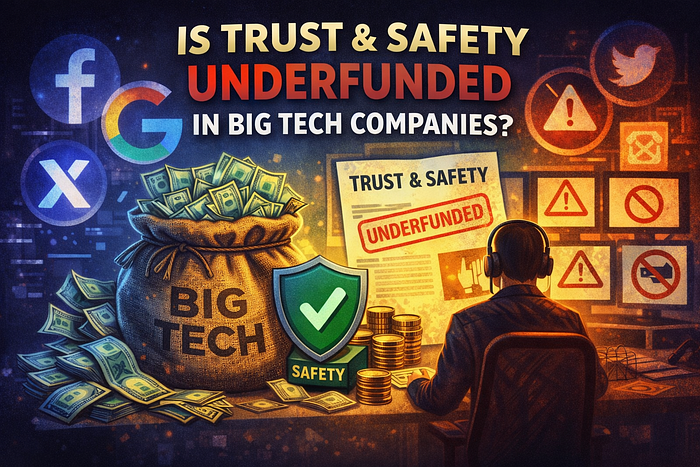
But there’s another part of the tech ecosystem that quietly carries enormous responsibility: Trust & Safety.
From my experience working in this field, one question comes up repeatedly among professionals in the industry:
Are Trust & Safety teams actually getting the resources they need?
The answer is more complicated than most people expect.
Safety Doesn’t Generate Revenue
One of the biggest challenges is structural.
Engineering teams build products that drive growth.
Sales teams generate revenue.
Marketing teams attract users.
Trust & Safety, on the other hand, exists to reduce harm and manage risk.
When a safety system works well, nothing dramatic happens. Harmful content gets removed. Spam accounts disappear. Dangerous behavior gets interrupted before it spreads.
But success in safety often looks like the absence of problems.
And in many organizations, it’s harder to justify large budgets for preventing problems than for building new features that visibly grow the platform.
The Scale Problem
Modern platforms operate at extraordinary scale.
Millions of posts are uploaded every hour.
Videos, images, comments, messages, livestreams — the volume is constant and growing.
To manage this scale, platforms rely heavily on automation. Artificial intelligence helps detect spam, nudity, violent imagery, and known abuse patterns.
But automation doesn’t solve everything.
Edge cases, complex context, political content, satire, harassment campaigns, and coordinated manipulation still require human judgment.
That means platforms need well-trained moderators, policy specialists, investigators, and escalation teams.
Yet in many cases, the resources dedicated to these teams struggle to keep up with the growth of the platforms themselves.
Another challenge is that safety investments often increase after a crisis.
A harmful trend goes viral.
A misinformation campaign spreads widely.
A serious safety incident reaches the news.
Suddenly, there are calls for stronger moderation, more oversight, and more staffing.
But ideally, Trust & Safety should be proactive, not reactive.
Investing in early detection systems, policy development, regional expertise, and mental health support for moderators can prevent many issues before they escalate.
Unfortunately, those investments don’t always happen until the risk becomes visible.
The Human Cost
Underinvestment in Trust & Safety doesn’t just affect platforms. It affects the people doing the work.
Moderators often operate under tight productivity targets, reviewing large volumes of complex or disturbing content. Without sufficient staffing, training, and wellness support, burnout becomes a real concern.
The people responsible for protecting online communities also need protection themselves.
Strong Trust & Safety programs require not just technology, but sustainable working environments for the humans behind the decisions.
Things Are Slowly Changing
To be fair, the industry is evolving.
Regulatory pressure is increasing in many regions. Governments are demanding stronger platform accountability. Public awareness of online harms is growing.
As a result, Trust & Safety is becoming more recognized as a critical function rather than a background operation.
Many companies are investing more in safety research, policy development, and responsible AI governance.
But the gap between platform scale and safety resources is still a conversation happening inside the industry.
Final Thoughts
Trust & Safety teams sit at the intersection of technology, policy, and human behavior.
They protect users, manage platform risk, and maintain the integrity of online spaces used by billions of people.
That responsibility is enormous.
If the internet is going to remain a place where people can safely connect, share ideas, and build communities, safety cannot remain an afterthought.
Because in the end, platforms don’t just need to grow.
They need to grow responsibly.