What You See vs. What We Handle
When people think about Trust & Safety during war, they often imagine content removal.
Take down harmful posts. Block accounts. Add warning labels.
But from my experience, that’s just the surface.
Behind the scenes, it’s not one problem. It’s layers of problems happening at the same time. Each layer behaves differently, spreads differently, and impacts people in different ways.
Over time, while handling multiple conflict-related spikes, I started seeing a pattern.
Not chaos. Structure.
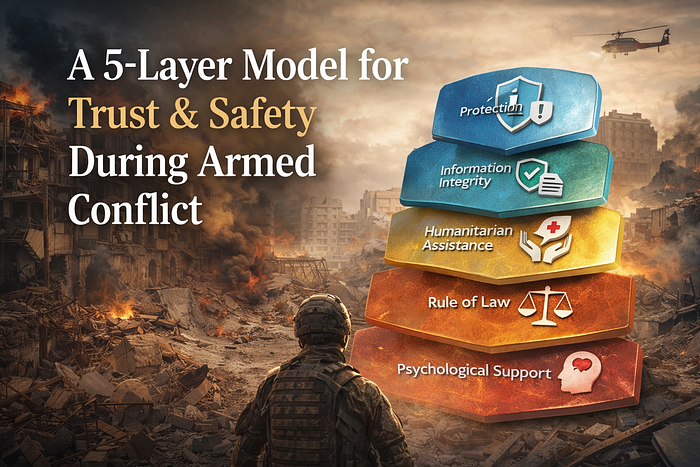
This is how I think about it now: a 5-layer model of how information behaves during armed conflict.
Layer 1: The Reality Layer (What Actually Happens)
Everything begins here.
Real-world events. Explosions, troop movement, supply disruptions, ceasefires. This layer is raw and unfiltered.
But even at this stage, there’s a gap.
During one incident, I reviewed multiple videos of what looked like fresh airstrikes. Same location, similar visuals, different captions. Some were real-time. Others were hours old.
From the outside, it all looked like one continuous event.
From the inside, it was fragmented reality.
Moderation at this layer isn’t about removal. It’s about identifying what’s actually happening.
And that’s not always immediately clear.
Layer 2: The Interpretation Layer (What People Think Is Happening)
The moment reality hits the internet, interpretation begins.
A video gets uploaded. Someone adds context. Someone else adds opinion.
I’ve seen a single clip turn into multiple narratives within minutes:
“Major escalation.”
“Retaliation attack.”
“Beginning of something bigger.”
None of these were verified. But they sounded confident.
This layer is where meaning gets assigned.
And once meaning is attached, it spreads faster than the original event.
From a moderation perspective, this is tricky. Because interpretation isn’t always wrong. But it’s often incomplete.
Layer 3: The Amplification Layer (How Platforms Spread It)
Now the system kicks in.
Posts that trigger emotion, especially fear or urgency, start gaining traction. More shares. More comments. More visibility.
I’ve tracked posts from small accounts reaching thousands within minutes simply because they created a sense of immediacy.
During one fuel-related scare linked to a conflict, a single post suggesting supply disruption gained massive engagement. Not because it was verified, but because it felt urgent.
This is where platforms unintentionally accelerate impact.
Moderation at this layer is about scale.
And scale is where things start slipping.
Layer 4: The Behavioral Layer (What People Do Because of It)
This is where things move offline.
People don’t just consume content. They act on it.
I’ve seen this happen repeatedly. Posts about potential shortages lead to long queues at petrol pumps. Messages about instability lead to people stocking essentials.
During one shift, I watched this unfold almost in sequence.
First, the posts.
Then, the reactions.
Then, the images of those reactions being posted again.
The behavior becomes new content.
And the cycle continues.
At this layer, moderation is no longer just about information. It’s about real-world impact.
Layer 5: The Residual Layer (What Stays After the Event)
This is the most overlooked layer.
Even after the conflict slows down or ends, the content doesn’t disappear.
Old videos resurface. Screenshots get reshared. Narratives evolve.
I remember reviewing posts days after a ceasefire that were still triggering panic. Not because they were new, but because they were being seen again.
This layer is about memory.
And memory, on the internet, doesn’t fade easily.
Moderation here becomes even more complex. The content may be accurate in origin, but misleading in timing.
How These Layers Interact
What makes this model important is not just the layers themselves, but how they interact.
A real event (Layer 1) gets interpreted (Layer 2), amplified (Layer 3), acted upon (Layer 4), and then remembered and reshared (Layer 5).
Each layer feeds into the next.
And by the time moderation catches one layer, the others are already in motion.
I’ve seen cases where even after removing high-risk content, the behavioral impact continued because the narrative had already settled.
The Moderation Gap: Where Systems Struggle
Most moderation systems are designed to act on individual pieces of content.
But this model shows that harm doesn’t come from one post.
It comes from the interaction of layers.
For example:
A single post about fuel shortage may not violate policy.
But combined with dozens of similar posts, rising engagement, and visible queues, it creates panic.
That’s the gap.
We’re moderating content.
But the impact is happening across layers.
What Needs to Change
From my experience, improving Trust & Safety during conflicts isn’t just about stricter policies.
It’s about better awareness of these layers.
Faster context detection.
Better handling of outdated content.
Understanding regional sensitivity.
Recognizing behavioral signals, not just content signals.
Because by the time harm is visible, it’s already moved beyond the platform.
Final Thought: It’s Not One Battle
Armed conflict doesn’t just happen on the ground.
It unfolds across information systems in real time.
And moderation isn’t fighting one problem. It’s managing multiple layers of the same problem, all moving at different speeds.
From the outside, it may look like content is the issue.
From the inside, it’s the system around it.
And unless we start thinking in layers, we’ll always be one step behind.