A few years ago, moderation pipelines were already busy.
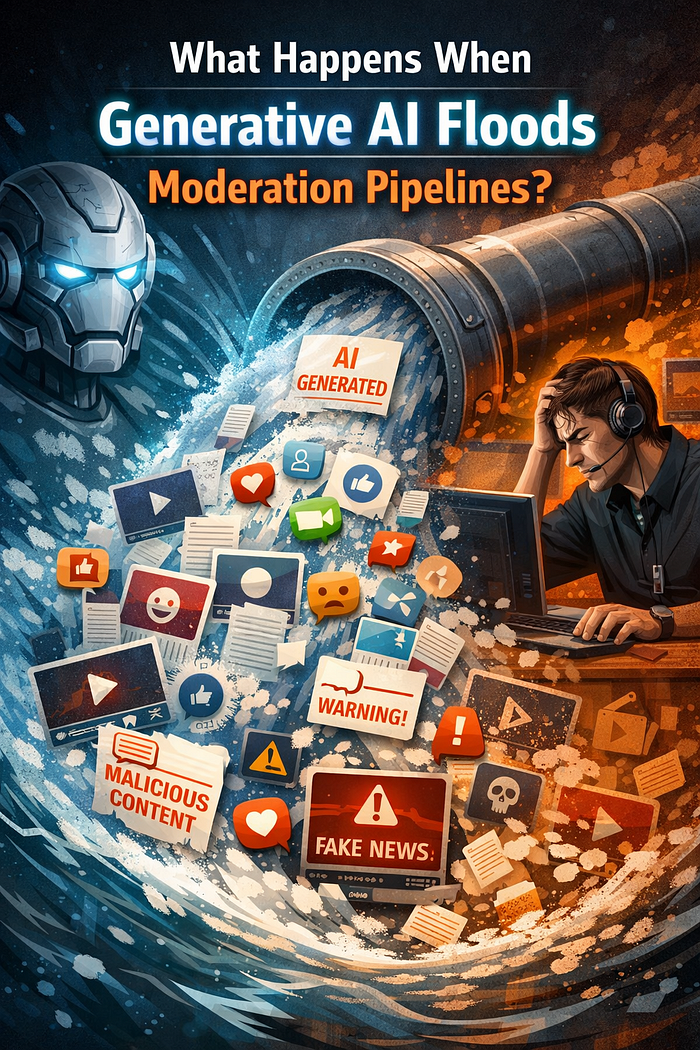
Millions of posts.
Videos uploaded every minute.
Comments appearing faster than any human team could ever review manually.
Then generative AI arrived.
And suddenly, the scale of online content didn’t just increase.
It exploded.
From my experience working in Trust and Safety, generative AI has not simply added “more content” to moderation systems. It has fundamentally changed what moderation pipelines look like.
The internet was already operating at impossible scale.
Now moderation systems are dealing with content generation happening almost instantly, endlessly, and globally.
And honestly, the industry is still trying to catch up.
The Scale Problem Has Changed Completely
Content moderation has always been a scale problem.
Platforms already processed:
- Billions of comments
- Millions of videos
- Massive livestream traffic
- Continuous image uploads
- Endless spam attempts
But generative AI changes the nature of scale itself.
Before AI tools became widely accessible, creating content required:
- Time
- Editing
- Design effort
- Writing ability
- Technical skill
Now one person can generate:
- Hundreds of images
- Dozens of videos
- Entire misinformation campaigns
- Thousands of comments
- Synthetic voices
- Fake screenshots
…within minutes.
I remember seeing spam investigations where previously coordinated abuse groups needed large teams to operate effectively.
Today, one motivated individual with generative tools can create massive amounts of content at speeds that would have been impossible a few years ago.
That changes moderation pipelines dramatically.
Because moderation capacity cannot increase at the same speed as generation capacity.
AI Content Is Constantly Changing Shape
Traditional moderation systems often rely on repetition.
Detection models work best when harmful patterns repeat consistently.
For example:
- Known extremist imagery
- Reused spam templates
- Duplicate misinformation narratives
- Repeated scams
- Previously identified abuse signals
But generative AI breaks repetition.
Now harmful content can be regenerated infinitely with slight variations.
A misinformation post can be rewritten hundreds of different ways.
An AI-generated image can change style instantly.
Synthetic voices can imitate real people dynamically.
Spam campaigns can continuously mutate wording.
From a moderation perspective, this creates a major challenge:
The harmful intent stays the same while the content appearance changes constantly.
I once reviewed coordinated AI-generated comment campaigns where every message looked unique individually, but the behavioral intent behind them was identical.
Traditional detection systems struggle heavily in these environments because they were originally built around recognizing recurring patterns.
Generative AI creates endless variation.
Moderation Is Becoming More About Authenticity
One of the biggest shifts generative AI introduced is that moderation is no longer only about policy violations.
It’s increasingly about authenticity.
Moderators now deal with questions like:
- Is this image real?
- Is this audio synthetic?
- Is this video manipulated?
- Is this person AI-generated?
- Is this screenshot fabricated?
- Was this statement actually made?
That changes the entire moderation workflow.
I remember earlier moderation pipelines where reviewers focused mostly on:
- Harm
- Harassment
- Violence
- Exploitation
- Spam
- Threats
Now reviewers may spend significant time simply verifying whether content itself is authentic before even evaluating policy impact.
And authenticity investigations are much slower than traditional moderation decisions.
Because determining whether something is fake often requires:
- Metadata review
- Behavioral analysis
- Cross-platform verification
- Escalation to specialized teams
- Advanced forensic tools
The complexity increases significantly.
Deepfakes Are Changing Risk Assessment
Deepfakes are one of the clearest examples of how generative AI is reshaping Trust and Safety operations.
A few years ago, fake media was usually easy to spot.
Today, synthetic media quality is improving rapidly.
I’ve seen cases where:
- AI-generated voices sounded nearly identical to real people
- Manipulated videos appeared convincing enough to spread widely before verification
- Fake public statements triggered confusion online
- Synthetic faces bypassed identity trust systems
The moderation problem here is not only removal.
It’s speed.
Because once manipulated content spreads widely, correction becomes much harder.
And that creates operational pressure for moderation teams:
Act too slowly, and misinformation spreads.
Act too quickly, and authentic content may be removed incorrectly.
That tension is becoming central to modern moderation pipelines.
Human Moderators Now Do More Cognitive Work
Generative AI also changes the role of human reviewers.
Earlier moderation work often involved identifying direct violations repeatedly:
- Explicit hate speech
- Graphic violence
- Spam
- Scams
- Harassment
Now moderation increasingly involves interpretation.
Reviewers ask:
- Is this satire or manipulation?
- Is this synthetic media harmful?
- Is this coordinated influence behavior?
- Is this AI-generated impersonation?
- Is this misinformation or fictional storytelling?
I’ve noticed moderation work becoming more analytical over time.
Instead of reviewing repeated duplicates, moderators increasingly review edge cases requiring:
- Context analysis
- Behavioral interpretation
- Technical understanding
- Authenticity evaluation
The work becomes mentally heavier because ambiguity increases.
And ambiguity is exhausting at scale.
False Positives and False Negatives Become More Common
One thing users often notice today is inconsistent enforcement around AI-generated content.
That inconsistency is not always due to poor moderation.
It’s often because platforms are balancing difficult trade-offs.
If moderation systems become too aggressive:
- Harmless AI-generated art gets removed
- Satirical content gets flagged
- Creative expression gets restricted
- Educational synthetic media gets penalized
But if systems become too lenient:
- Deepfake abuse spreads
- AI-generated scams increase
- Synthetic misinformation scales rapidly
- Impersonation becomes easier
This creates a difficult operational balance.
And honestly, there is no perfect threshold.
I’ve seen harmless AI-generated content mistakenly escalated simply because detection systems became more sensitive after major abuse incidents.
The moderation environment becomes reactive because threats evolve so quickly.
Moderation Pipelines Are Becoming Hybrid Systems
One thing seems increasingly clear:
The future of moderation will not be purely human or purely automated.
It will be hybrid.
Most likely, moderation pipelines will evolve into layered systems where:
- AI filters large-scale content volumes
- Specialized tools detect synthetic media
- Behavioral systems identify coordination patterns
- Human moderators review nuanced edge cases
- Escalation teams handle high-risk authenticity investigations
Automation handles scale.
Humans handle ambiguity.
That balance will become even more important as generative technology improves.
The Bigger Challenge Is Speed
One of the hardest realities for Trust and Safety teams today is this:
Generative AI evolves faster than moderation systems do.
New tools appear constantly.
New abuse methods emerge weekly.
Detection models quickly become outdated.
Moderation pipelines are no longer reacting to static internet behavior.
They are reacting to constantly evolving synthetic ecosystems.
And adaptation cycles are becoming shorter and shorter.
Final Thoughts
Before generative AI, content moderation was already one of the most difficult operational challenges on the internet.
Now the challenge has changed entirely.
Trust and Safety teams are no longer only moderating human-created content.
They are moderating synthetic scale.
And synthetic scale behaves differently:
- Faster creation
- Endless variation
- Blurred authenticity
- Coordinated automation
- Lower friction for abuse
From inside Trust and Safety, the biggest realization is this:
Generative AI did not just increase content volume.
It fundamentally changed the structure of moderation itself.
The future of moderation will depend on how effectively platforms combine:
- Automation
- Human judgment
- Authenticity verification
- Behavioral analysis
- Transparent policy systems
Because the internet is entering an era where seeing something online no longer guarantees it was ever real in the first place.
And moderation systems now have to operate inside that reality every single day.